
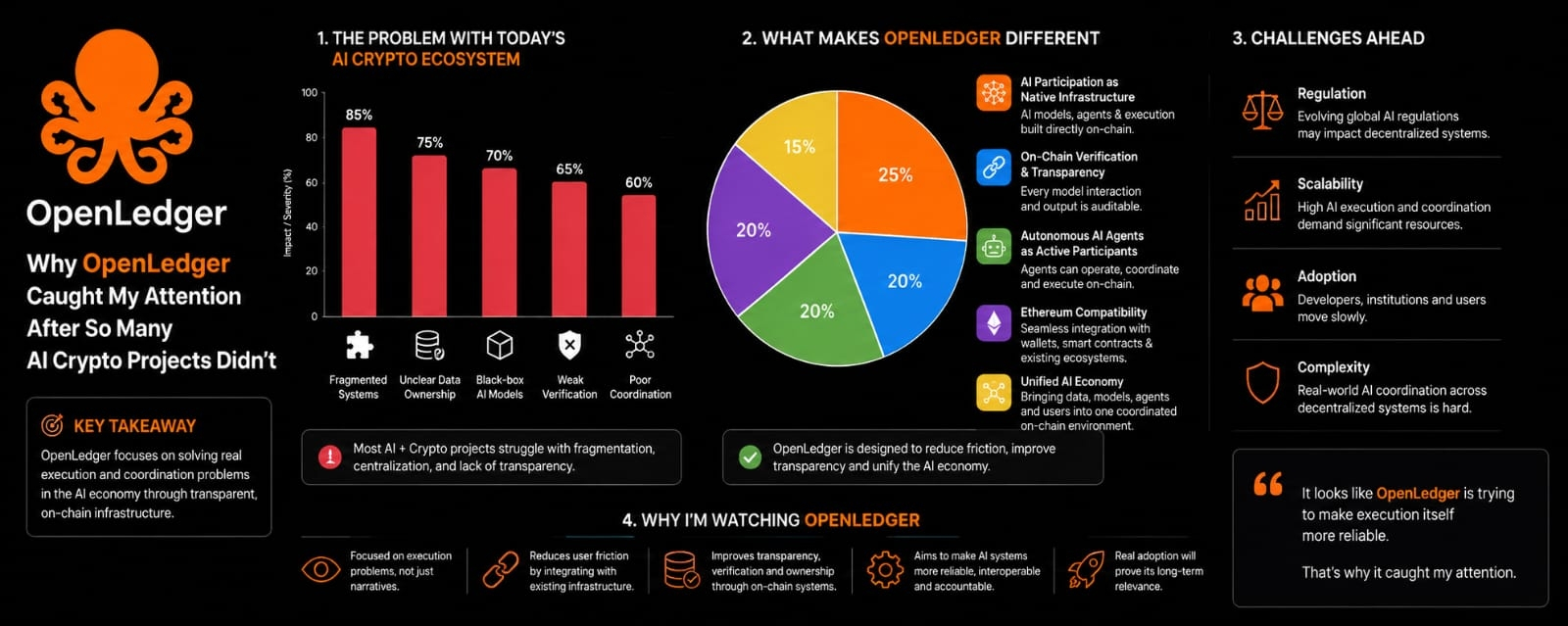
I’ll be honest, I almost ignored OpenLedger the first time I came across it. That reaction probably comes from seeing too many AI and crypto projects repeat the same pattern over the last couple of years. Everyone talks about infrastructure, decentralized intelligence, autonomous systems, and the future of AI coordination, but when you look closer, most of it still depends on fragmented tooling, centralized execution, or ecosystems that barely connect together in practice.That’s why I’ve become naturally skeptical whenever a project introduces itself as an “AI blockchain.” The phrase sounds ambitious, but it also sounds easy to misuse. Usually the blockchain part feels disconnected from the AI part, almost like two narratives pushed together because both are trending at the same time.What made me pause with OpenLedger wasn’t marketing. It was the way the system seemed designed around execution rather than presentation. The more I looked into it, the more it felt like the project was trying to solve operational friction that already exists inside the AI economy instead of simply attaching tokens to AI activity One thing that kept standing out to me was how OpenLedger treats AI participation as native infrastructure rather than an external service plugged into a blockchain afterward. That distinction matters more than people think. Right now, most AI systems still operate inside isolated environments. Models are trained somewhere else, data ownership stays unclear, execution happens off-chain, and users are expected to trust black-box systems while calling the whole process decentralized OpenLedger seems to approach that problem differently by building infrastructure specifically around AI coordination itself. The idea of connecting AI model training directly with blockchain infrastructure caught my attention because it addresses a very real issue: verification. In most AI systems today, users rarely know where models came from, how they evolved, or whether outputs can actually be audited properly. OpenLedger pushing model interaction and execution into an on-chain environment makes the process feel less abstract I also found the focus on autonomous AI agents more interesting than I expected. A lot of projects mention AI agents casually now, but OpenLedger appears to treat them like active participants within the network rather than simple automation scripts. That changes the conversation a bit. If agents can operate, coordinate, execute tasks, and interact with on-chain systems directly, then the infrastructure underneath them matters far more than branding What I appreciated was that OpenLedger didn’t seem obsessed with forcing users into an isolated ecosystem either. The Ethereum compatibility felt practical instead of performative. Most users already live inside Ethereum tooling whether they admit it or not. Wallet infrastructure, smart contracts, Layer 2 ecosystems, liquidity routing that environment already exists. Trying to rebuild all of that from scratch usually creates unnecessary friction.OpenLedger integrating directly with existing wallets and Ethereum standard systems makes adoption feel more realistic to me. Serious infrastructure projects usually reduce complexity quietly instead of asking users to completely relearn how they operate.Another thing I kept thinking about while reading through the ecosystem was how fragmented the current AI economy actually is. Data providers, model builders, inference systems, and AI applications often operate across disconnected platforms with unclear incentives and weak coordination. Ownership becomes messy very quickly. People contribute data without long-term value capture. Developers deploy models without transparent monetization. Users interact with systems they cannot properly verify.OpenLedger seems to be trying to pull those moving parts into a more unified environment where data, models, and AI agents can all interact directly on chain. Not perfectly, obviously, but the direction itself feels more grounded than many AI narratives I’ve seen recently.That matters to me personally because I’ve noticed how many blockchain projects still push responsibility back onto the user even while advertising decentralization. Verification becomes your problem. Coordination becomes your problem. Security becomes your problem. Integration becomes your problem With OpenLedger, I got the sense that the infrastructure is attempting to absorb some of that operational burden directly into the system architecture itself. That doesn’t guarantee success, but it does make the project more interesting from a practical standpoint.At the same time, I don’t think infrastructure alone solves everything. AI regulation is still evolving globally, and decentralized AI systems will eventually face pressure around compliance, accountability, and misuse. Scalability is another obvious concern. Systems designed for constant AI execution and coordination can become resource intensive very quickly.There’s also the reality that adoption is difficult even when technology works. Developers need incentives. Institutions move slowly. Real world AI coordination across decentralized systems introduces complexity that no whitepaper fully captures Still, I think this type of infrastructure makes the most sense in environments where transparency and interoperability actually matter. Automated systems interacting across decentralized economies need coordination layers that can handle verification, execution, and integration without depending entirely on centralized intermediaries.That’s where OpenLedger started feeling more credible to me. Not because it promises a futuristic AI narrative, but because it seems focused on reducing friction between systems that already struggle to work together.I’m still approaching it cautiously. I always do with infrastructure projects because execution matters more than ideas. What I care about now is observing how the ecosystem behaves in practice. I want to see whether integrations remain smooth as usage grows, whether AI workflows actually operate efficiently on-chain, and whether developers continue building around the infrastructure once early excitement fades.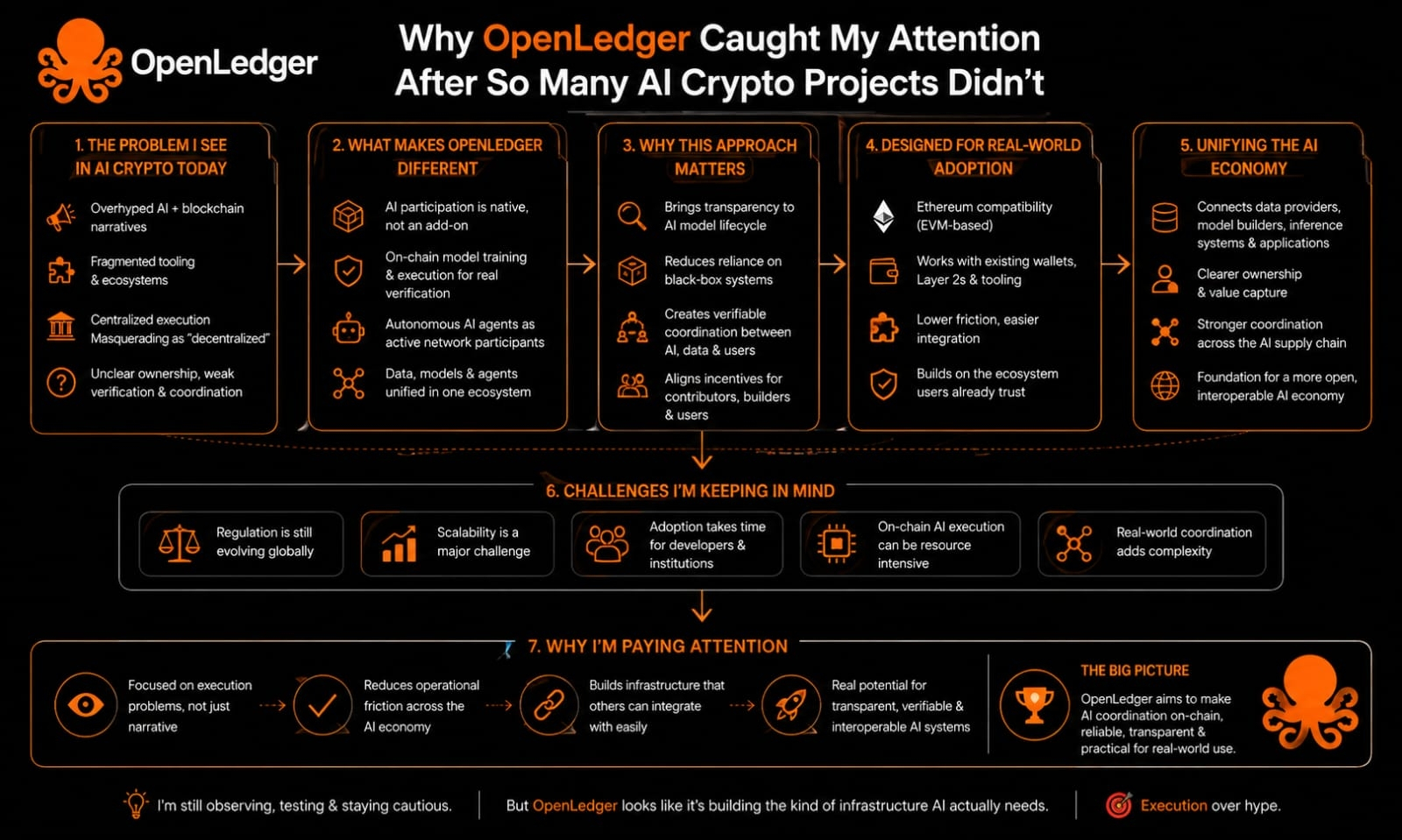
That testing mindset matters because branding alone means very little in this sector now. Plenty of projects sound intelligent before real usage begins.But I’ve learned that meaningful adoption usually arrives quietly. It comes through systems that reduce complexity enough for people to keep using them without constantly thinking about the infrastructure underneath. After spending time studying OpenLedger, that’s probably the main reason it held my attention longer than most AI crypto projects do.Not because it looked louder.Because it looked like it was trying to make execution itself more reliable.Looking Beyond the AI Hype: My Thoughts on OpenLedgerI’ve become pretty cautious around AI crypto projects because most of them sound bigger than the systems they actually build. After spending time looking into OpenLedger though, I found myself paying closer attention.What stood out wasn’t hype. It was the focus on infrastructure that treats AI participation as native to the blockchain itself model training, AI agents, execution, coordination, all operating directly on-chain instead of through fragmented external systems.The Ethereum compatibility also felt practical. Wallets, Layer-2 integration, and existing tooling already matter, so reducing friction there makes more sense than rebuilding isolated ecosystems.I still think adoption and scalability will be difficult. But OpenLedger feels more focused on execution problems than narrative alone, and that’s what made me keep watching it.