

A grounded, infrastructure-first look at how Haedal actually works and why it matters
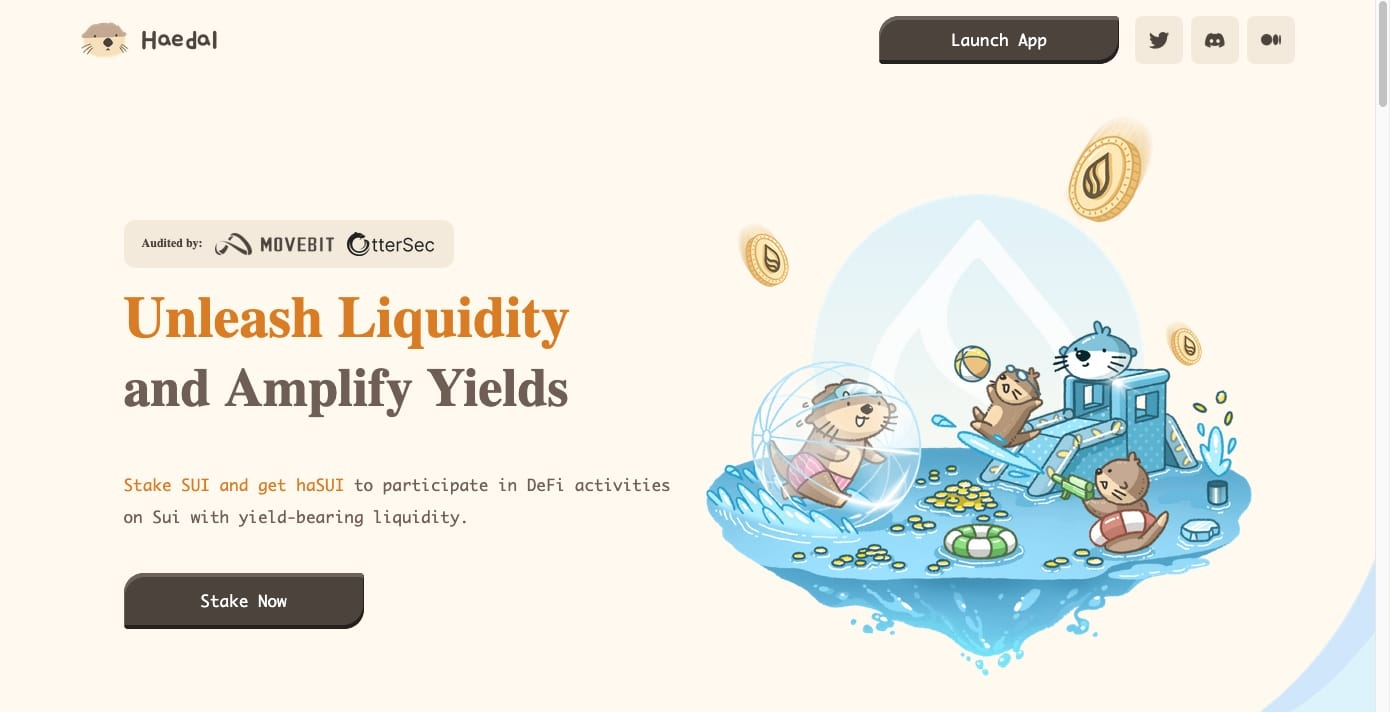
Most DeFi protocols tell you what they do. Few show you how the pieces actually connect. Haedal is one of the rare ones where the architecture is worth studying before the token.
If you have spent any time around the $SUI ecosystem in the past year, you have seen Haedal come up repeatedly. Not because of marketing pushes or airdrop farming, but because the protocol is quietly sitting at the center of how SUI liquidity moves. It is the first liquid staking protocol on SUI mainnet, and at this point, it has grown into something considerably larger than just a staking tool.
Let me break it down from first principles, because the surface level description does not do justice to what is actually being built here.
The Core Problem Haedal Solves
Let me Share most interesting thing with you Staking on a proof of stake chain is straightforward in concept. You lock up tokens, you help validate the network, you earn rewards. The problem is the word "lock." When your capital is frozen, it is not working anywhere else. You collect your staking APY but you opt out of everything else happening on chain. For most users, that is a real cost, not an abstract one.
Liquid staking flips this. Instead of locking your SUI and walking away, you stake through Haedal and receive haSUI in return. That token represents your staked position, accrues rewards over time, and can be deployed anywhere in the SUI DeFi ecosystem while your underlying stake continues earning. Your capital is no longer doing one job. It is doing two at the same time.
The elegance of liquid staking is not in the yield numbers. It is in the removal of a false choice: earn staking rewards OR participate in DeFi. Haedal removes the OR.
How It Actually Works

The flow is simpler than most people expect. You go to Haedal, deposit SUI, and receive haSUI. That is step one and step two done in a single transaction. The protocol handles validator selection automatically if you choose the default mode, or lets you pick specific validators manually if you want more control over where your stake is delegated. Both options exist because different users have different preferences, and forcing everyone into one path is a design failure Haedal deliberately avoids.
haSUI is a yield bearing token, which means its value relative to SUI increases over time as staking rewards accumulate at the protocol level. You do not receive daily reward deposits. Instead, the exchange rate between haSUI and SUI shifts upward. When you eventually redeem, you get back more SUI than you put in. This design is cleaner than reward dripping because it makes haSUI composable without complicating reward accounting for every protocol that integrates it.
The Live Numbers
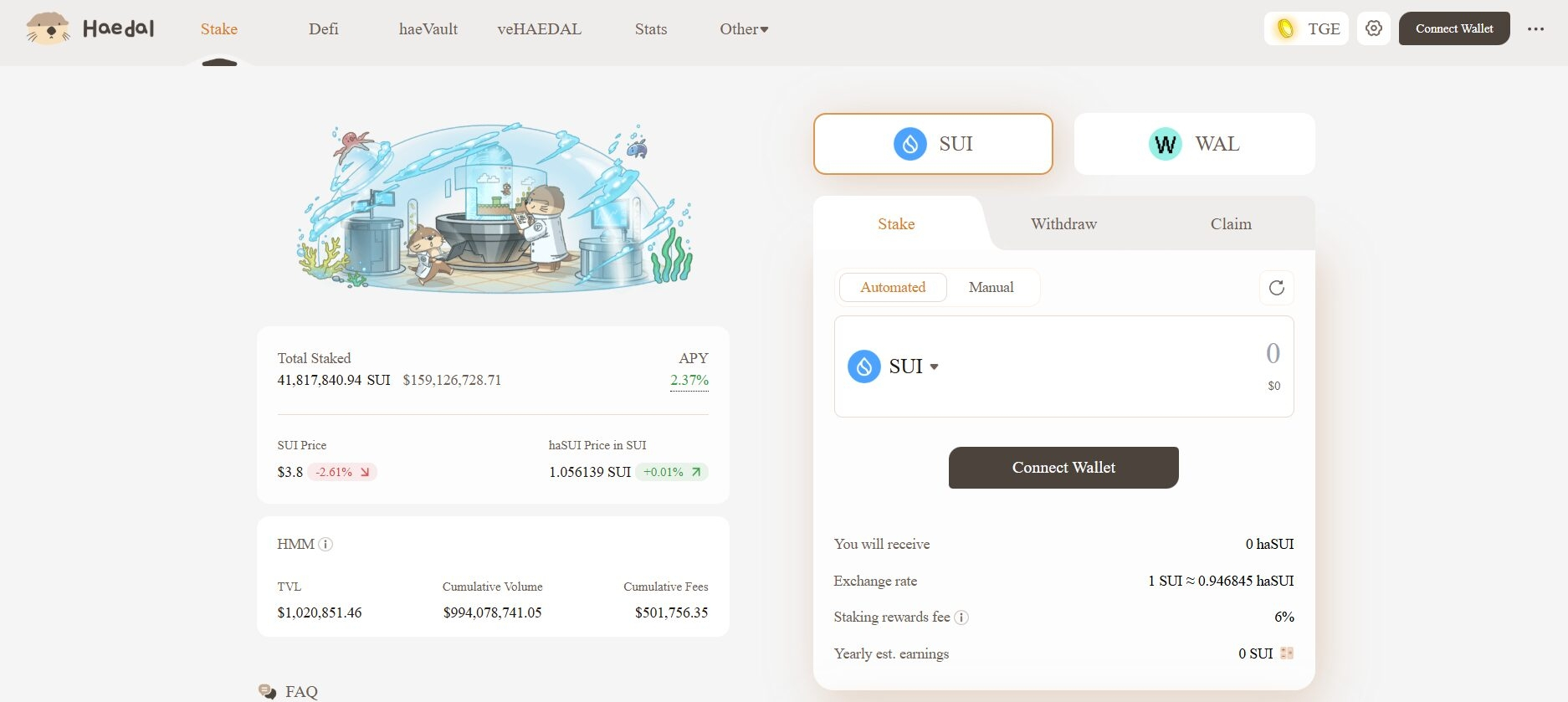
$159M+
Total Value Staked
$994M+
HMM Cumulative Volume
$501K+
Cumulative Fees Earned
These are not projected numbers. They are live protocol metrics visible on Haedal's own dashboard. Over 41 million SUI staked, roughly $159 million in value sitting inside the protocol, with the HMM component having processed nearly $1 billion in cumulative trading volume. For a protocol that launched its token in April 2025, those figures reflect genuine usage rather than speculative positioning.
The Haedal Market Maker: Where It Gets Interesting
Most liquid staking protocols stop at the LST. You stake, you get a token, you figure out what to do with it yourself. Haedal went further by building its own market making infrastructure directly into the protocol. This is the part most people overlook, and it is arguably the most important part of the long term design.
The Haedal Market Maker, or HMM, is an automated market maker built specifically to handle haSUI liquidity on SUI. What makes it different from a standard AMM is that it uses protocol owned liquidity as its foundation rather than depending entirely on external liquidity providers. Haedal seeds the liquidity itself, which means trading depth is more predictable and less vulnerable to the kind of sudden liquidity exits that hurt users on traditional DEXs.
HMM also concentrates liquidity within specific price ranges that are statistically likely to see activity, rather than spreading it thin across an infinite range. This is not a novel idea in isolation, but applying it specifically to a yield bearing LST, where the price relationship to the underlying asset follows a predictable trajectory, is a smart specialization. It makes every unit of liquidity more efficient.
The fee structure reinforces the flywheel. HMM charges 0.04% on trades. Half of that goes directly toward boosting haSUI yields. So the more trading activity the protocol attracts, the better the returns for haSUI holders. Trading volume becomes a yield enhancer rather than just a revenue line.
haeVault: Institutional Grade Strategies for Everyone
The third product in the Haedal suite is haeVault. If HMM is the market making layer, haeVault is the yield optimization layer sitting on top of it. It brings centralized exchange style market making strategies into a decentralized environment and makes them accessible to ordinary users.
The idea is simple even if the execution is not. Professional market makers on centralized exchanges use algorithms to continuously provide liquidity, capture spreads, and manage inventory across trading pairs. Retail users never had access to these strategies because they required significant capital, infrastructure, and expertise. haeVault packages that kind of strategy into a vault that anyone can deposit into, with over $7 million in TVL at the time of writing.
veHAEDAL: The Governance and Incentive Layer
The HAEDAL token sits at the center of the protocol's governance and incentive structure, but it is not straightforward token voting. Haedal uses a vote escrow model. You lock HAEDAL for a period of your choosing, between 1 and 52 weeks, and receive veHAEDAL in proportion to the duration and amount locked.
veHAEDAL is not transferable. It exists only within the protocol. It decays linearly over your lockup period, reaching zero at the end of your term. This design is intentional. It means governance weight belongs to people who are actually committed to the protocol's future rather than speculators who bought a governance token with no intention of staying.
Locking longer does not just give you more governance power. It gives you boosted farming rewards and access to protocol incentives that shorter term lockers do not receive. Conviction is directly rewarded. That alignment is rare and worth noting
On top of that Haedal runs a weekly buyback program using 50% of protocol revenue to purchase HAEDAL from the open market. Those tokens are redistributed to veHAEDAL holders. The protocol is essentially sharing its operating profits with the users who are most committed to its long term success.
Token Allocation and What It Signals
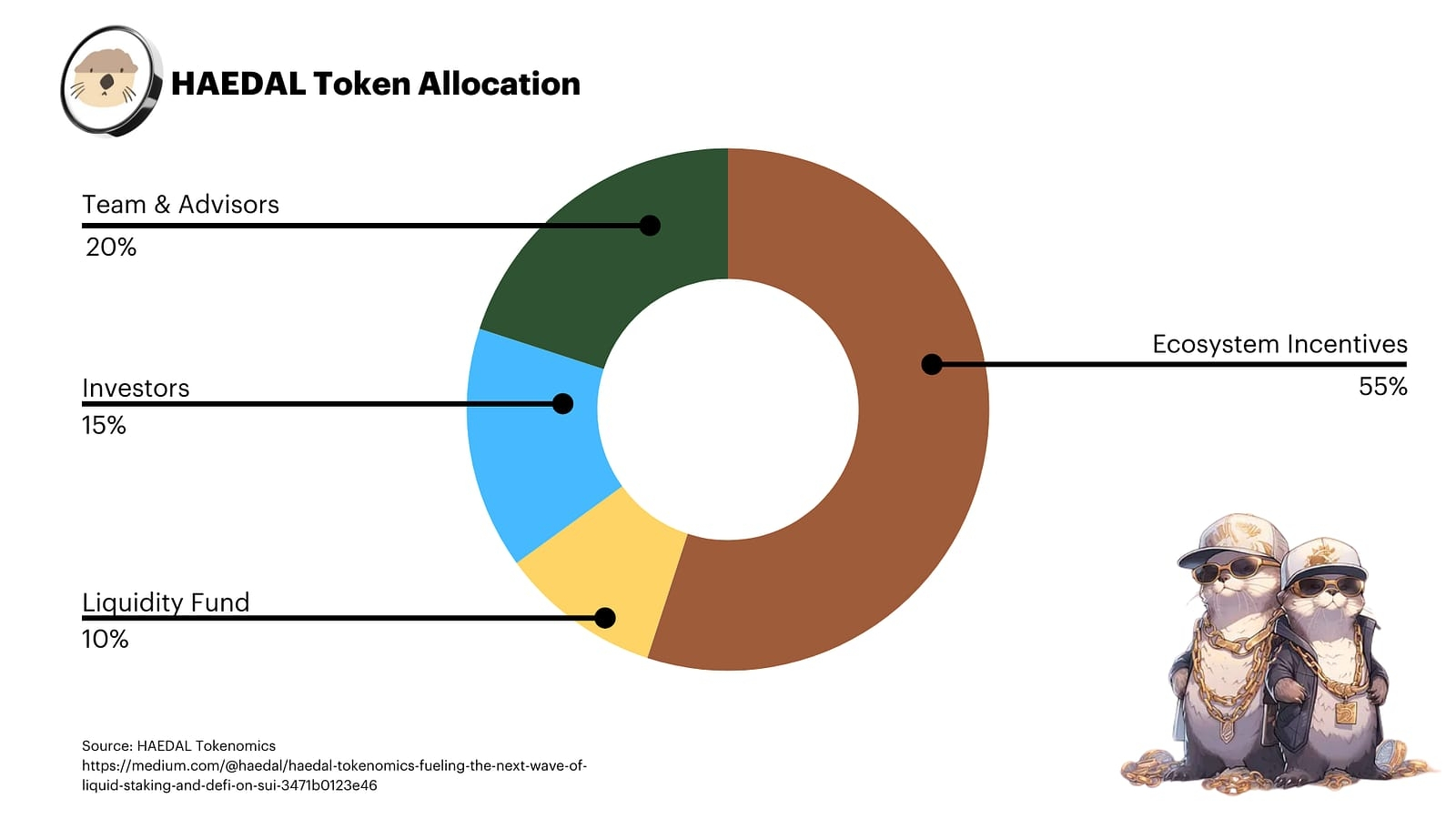
Ecosystem Incentives
55%
Team & Advisors
20%
Investors
15%
Liquidity Fund
10%
More than half of the total supply is directed toward ecosystem incentives. That is not a vanity number. When a protocol allocates the majority of its tokens to participants and builders rather than insiders, it is making a structural bet that the network grows through usage rather than through centralized control. The team and advisor allocation at 20% is significant but not unusual for a protocol of this ambition, and the investor allocation at 15% is lower than many comparable projects. The liquidity fund at 10% supports the market making infrastructure the protocol depends on.
Market Performance and Exchange Presence
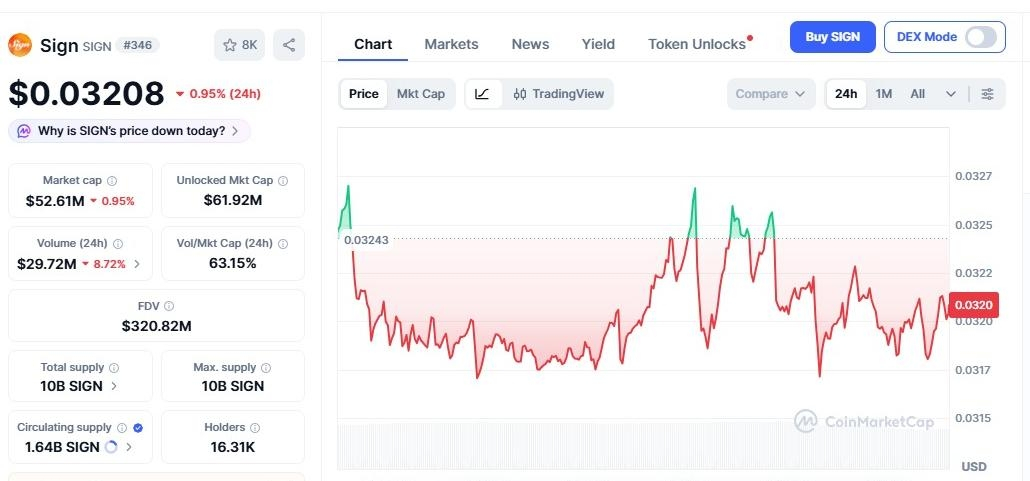
HAEDAL launched its TGE on April 29, 2025, and was listed on Binance on May 21, 2025, one of the fastest timelines from launch to top tier exchange listing seen in the SUI ecosystem. The market cap crossed $1.13 billion shortly after listing, with a 24 hour trading volume that briefly exceeded the market cap itself, reflecting high early market interest.
The price chart shows the typical post listing spike followed by consolidation. What matters more than the peak is the stabilization pattern afterward, which reflects organic holder behavior rather than a token that immediately collapsed after launch. With 230 million HAEDAL in circulating supply against a total of 1 billion, the unlock schedule will be worth watching as the protocol matures.
Why the Architecture Matters More Than the APY
It is tempting to evaluate a DeFi protocol purely by its current yield numbers. Haedal's staking APY sits around 2.37% on SUI at the time of writing, which is not the highest number you will find. But chasing the highest APY in DeFi is a reliable way to lose money, because those rates rarely persist and usually carry hidden risks.
What Haedal has built is a system with multiple interlocking revenue streams, a governance model that rewards long term commitment, protocol owned liquidity that does not depend on mercenary capital, and deep integration with the SUI DeFi ecosystem through partnerships with Cetus, Scallop, Turbos Finance, and others. That is a different kind of durability than a protocol sitting on temporarily inflated yields.
The audits by MoveBit and OtterSec, visible prominently on the Haedal website, are also worth noting. Security audits do not guarantee safety, but their presence and the choice of auditors signals that the team understands the stakes of handling user capital at scale.
The Honest Assessment
Haedal is not the only liquid staking protocol that will exist on SUI. Competition will come, and some of it will offer higher short term yields. The question is whether Haedal's infrastructure advantages, its protocol owned liquidity through HMM, its vault products, its governance flywheel, and its early network effects are durable enough to maintain its position.
Based on the architecture alone, the answer leans yes. But the real test is whether the team continues to execute on the product roadmap and whether the SUI ecosystem itself grows in a way that makes liquid staking infrastructure more valuable over time. Both of those are reasonable bets given where SUI is heading, but they are still bets.
What is not a bet is that Haedal has built something technically coherent, structurally thoughtful, and genuinely useful for the ecosystem it sits inside. That is a harder thing to find than it sounds.