

Artificial intelligence is advancing faster than almost any technology we have seen before.
Every month, new AI products enter the market.
Companies are investing billions into model development.
Governments are discussing AI regulation.
Entire industries are beginning to restructure around automation and machine intelligence.
But beneath all the excitement surrounding AI, there is one critical reality many people still overlook:
AI does not become intelligent on its own.
Behind every powerful model exists something incredibly valuable:
human-generated data.
Every interaction, preference, conversation, correction, behavior pattern and digital activity contributes to training the systems shaping the future AI economy.
In many ways data has become the true fuel of artificial intelligence.
Yet despite its importance, the structure surrounding data ownership and value distribution remains surprisingly centralized.
This creates an important contradiction inside today’s AI industry.
The technology becomes more powerful because millions of people continuously contribute information to digital ecosystems…but the economic value generated from that process rarely flows back toward the contributors themselves.
That imbalance is becoming harder to ignore.
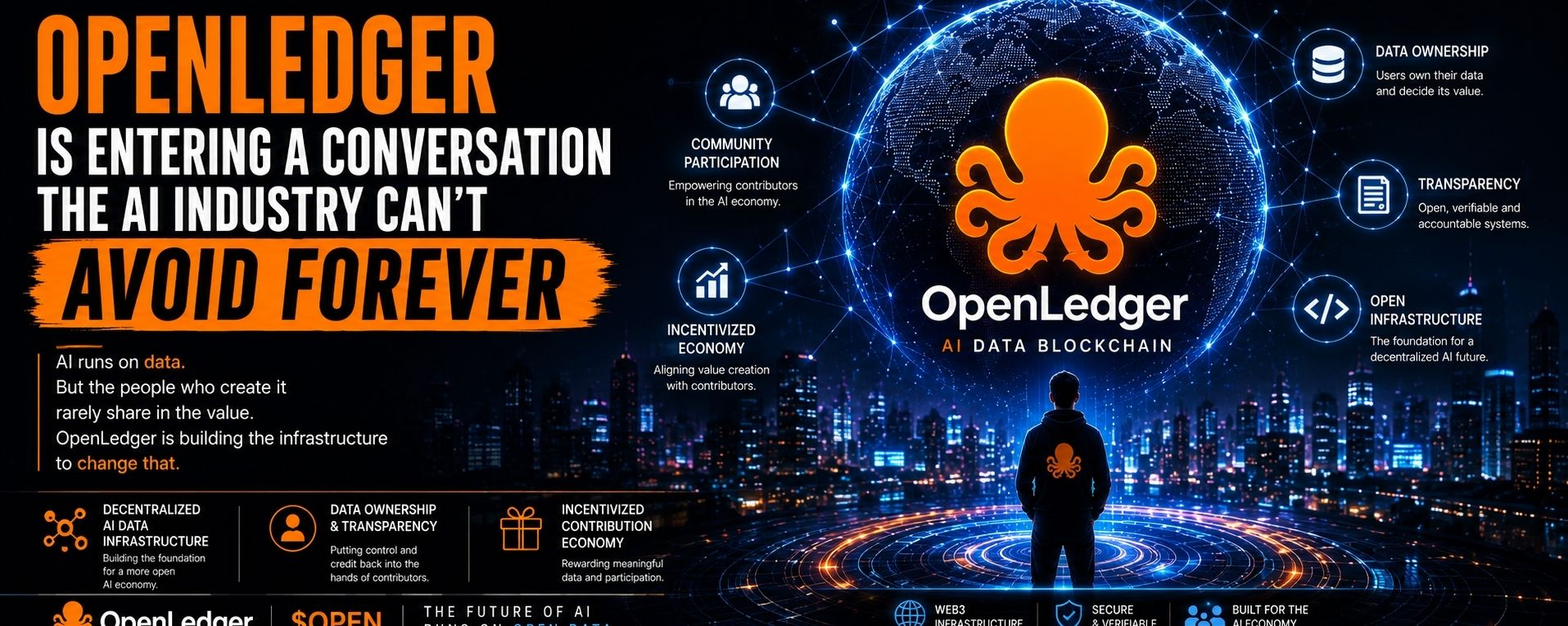
And this is exactly why projects like @OpenLedger are starting to gain attention across both AI and blockchain communities.
Rather than simply building another AI application, #OpenLedger is exploring a broader infrastructure narrative:
how decentralized coordination and data participation could eventually become part of the AI economy itself.
This positioning matters more than many investors currently realize.
Historically, major technological revolutions tend to create enormous value at the infrastructure layer.
The internet rewarded infrastructure. Cloud computing rewarded infrastructure. Blockchain rewarded infrastructure.
And now AI is beginning to follow the same pattern.
Most people today focus only on the visible side of AI:
chatbots, content generators, assistants, automation tools.
But underneath those applications exists an entire ecosystem built around data, computation attribution and coordination.
That foundational layer may eventually become one of the most important sectors in the entire AI market.
This is where OpenLedger enters a conversation the industry cannot avoid forever.
Questions around AI are evolving rapidly:
• Who owns the data powering intelligent systems?
• Should contributors participate in the value created from AI?
• Can AI infrastructure become more transparent?
• Will decentralized participation eventually become necessary?
• What happens when data itself becomes a globally valuable digital asset?
These are no longer small theoretical discussions.
They are structural questions connected directly to the future economics of artificial intelligence.
And markets tend to pay attention when infrastructure narratives begin intersecting with trillion-dollar industries.
What makes OpenLedger particularly interesting is that it operates at the intersection of several powerful narratives simultaneously:
• Artificial Intelligence
• Blockchain Infrastructure
• Decentralized Coordination
• Data Participation Economies
That combination alone positions the project inside one of the fastest-growing discussions in technology today.
Especially as investors increasingly search for long-term AI infrastructure opportunities rather than short-term speculative hype.
The reality is simple:
AI models may continue becoming smarter.
But eventually, the conversation will move beyond intelligence alone.
The future discussion may revolve around ownership, contribution, transparency and how value is distributed across the AI economy itself.
And when that shift accelerates, projects already exploring decentralized AI infrastructure could become significantly more relevant than they appear today.
$OPEN is positioning itself inside that future conversation early.
Whether the broader market fully understands the significance of that yet remains uncertain.
But the direction of the narrative is becoming harder to ignore.