
What stayed with me most wasn’t the technology itself. It was a small grocery store near my apartment.
Not because it was old-fashioned, but because it quietly revealed how trust actually works when systems become imperfect.
The owner still writes certain things down by hand. Not everything. Only the things memory eventually fails to carry on its own — who still owes money from last week, which supplier showed up late again, which customer always pays after payday but never disappears entirely. None of it looks sophisticated. There’s no dashboard, no algorithmic scoring system, no sleek interface pretending to optimize human behavior. Just a notebook sitting near the counter like a second memory the business built for itself over time.
And every time I’m there, I notice the same thing:
The most important systems are often the invisible ones people maintain quietly in the background.
I’ve been thinking about that while watching OpenLedger over the past year.
A lot of crypto projects talk about ownership, transparency, coordination, incentives. AI companies talk about scale, automation, intelligence. OpenLedger sits somewhere between those worlds, trying to build infrastructure where data, models, and even AI agents become economically traceable instead of disappearing into black boxes.
At the center of the project is this idea they call “Proof of Attribution” — the belief that if someone’s data, behavior, or contribution meaningfully shapes an AI system, there should be a way to measure that influence and compensate it automatically. Since the network’s mainnet launch in late 2025, the team has leaned further into what they describe as “Payable AI”: turning AI interactions into something economically auditable instead of opaque.
At least conceptually, it makes sense.
But crypto has a habit of reinventing the same ambitions every few years using different language.
A few cycles ago it was decentralized cloud computing. Then creator economies. Then data marketplaces. Now it’s AI agents, attribution layers, and autonomous economies. The surface narrative changes, but the emotional core usually stays the same: people wanting a fairer relationship with the systems extracting value from them.
Most projects fail for familiar reasons.
The incentives become too financial too early. Users optimize for rewards instead of usefulness. Token emissions start replacing actual product demand. Networks confuse activity with utility. Eventually the charts matter more than the service itself.
That’s partly why OpenLedger caught my attention in the first place.
Not because it solved those problems, but because it seems unusually aware of them.
Over the last year, the project’s language has slowly shifted away from speculative hype and toward accountability infrastructure. More focus on provenance, verifiable execution, licensing standards, auditability. Partnerships with projects like Story Protocol and Theoriq make it feel less like another short-lived “AI coin” and more like an attempt to build plumbing for a future where autonomous systems eventually need economic traceability.
That sounds responsible.
Crypto is very good at sounding responsible.
The harder question is whether people actually want this level of attribution once convenience enters the equation.
Most users say they care about fairness until fairness introduces friction. Most developers support openness until openness slows deployment. Most markets still reward speed and convenience faster than ethics or accountability.
And OpenLedger’s entire model depends on the assumption that provenance itself becomes valuable.
That regulators care. That enterprises care. That creators care. That eventually ordinary users care where AI outputs came from and who shaped them.
Maybe they will.
The broader AI conversation has already become more uncomfortable around copyright, training data, synthetic media, and black-box behavior. OpenLedger’s roadmap increasingly positions the chain as an accountability layer for machine economies rather than just another speculative token ecosystem.
But markets don’t always reward the most responsible infrastructure.
Sometimes they reward whatever feels fastest. Cheapest. Most entertaining.
That’s where I keep hesitating.
Because underneath all the elegant language about attribution and programmable fairness, OpenLedger still exists inside the same speculative environment as every other crypto network. OPEN went through the familiar lifecycle: exchange listings, explosive attention, community campaigns, retail enthusiasm, then the cooling-off period afterward.
That post-hype phase is usually where projects become more honest.
Anyone can attract attention during an AI narrative cycle. The harder thing is surviving after excitement normalizes and people stop confusing future potential with present adoption.
Right now, OpenLedger feels like it’s trying to mature into infrastructure instead of remaining pure narrative theater. The mainnet mattered. The attribution framework matters. The compliance-oriented direction probably matters even more long term.
Still, the tension between the product and the token is impossible to ignore.
The infrastructure story moves slowly. Carefully. Institutionally.
The token market moves emotionally. Impatiently. Cyclically.
Those two clocks rarely stay synchronized for long.
You can already see traces of that imbalance in some of the trading behavior around OPEN itself. Certain bursts of exchange-driven momentum — especially around Korean market speculation — feel less connected to AI accountability infrastructure and more connected to the familiar velocity-chasing behavior crypto repeatedly produces whenever a new narrative appears.
That doesn’t invalidate the project.
But it complicates the story people tell about it.
What interests me more is the psychological layer underneath all of this.
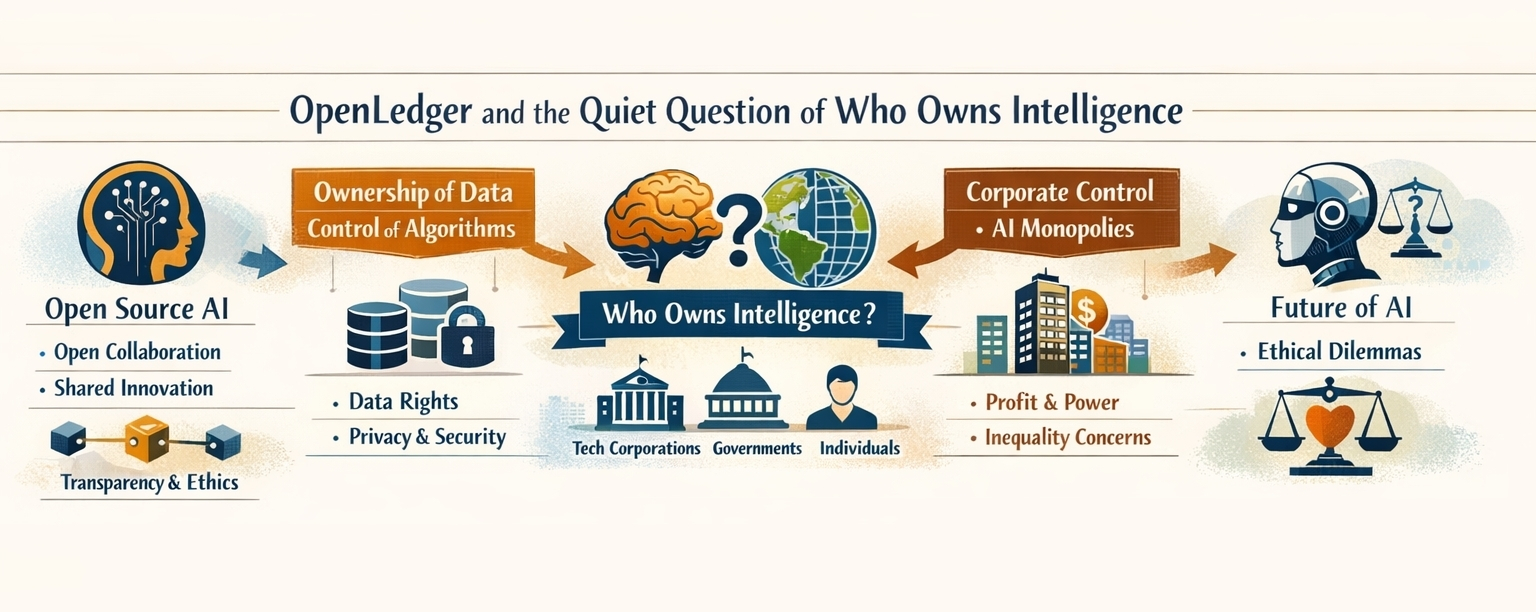
Projects like OpenLedger are ultimately trying to answer a much larger question:
Who benefits from intelligence systems once human contribution becomes too invisible to measure?
Most people already live inside extraction economies they barely notice. We train recommendation systems through behavior. Feed algorithms through attention. Generate metadata continuously without thinking about it because the interfaces feel frictionless.
AI intensifies that dynamic.
Suddenly labor isn’t only physical or creative anymore. It becomes behavioral, informational, ambient.
Crypto keeps trying to transform those invisible contributions into explicit markets.
Sometimes that feels empowering.
Sometimes it feels exhausting.
I’m not convinced every human interaction needs a compensatory layer attached to it. There’s a point where monetization starts flattening experience itself. Not every idea needs attribution accounting. Not every conversation should become a financial primitive. Not every contribution can be meaningfully measured by machines.
And yet I also understand why people keep trying to build these systems anyway.
Because the current alternative is usually centralized extraction hidden behind polished interfaces nobody questions anymore.
That’s the contradiction sitting underneath OpenLedger for me.
It’s trying to humanize machine economies through transparency and programmable fairness while simultaneously accelerating a world where more human behavior becomes machine-readable in the first place.
Maybe that tension is unavoidable now.
At the very least, the project seems more aware of that contradiction than most.
I don’t get the sense the team believes they’re building a utopian replacement for the internet. The tone surrounding the ecosystem lately feels more pragmatic than revolutionary — less “changing the world” and more “making the next version slightly less opaque.”
Honestly, that may be the more realistic ambition.
Still, I can’t fully tell whether systems like this create healthier digital economies or simply more efficient forms of financialization wrapped in ethical language. Crypto has always blurred that line. AI probably will too.
So I keep watching OpenLedger from a slight distance.
Not with conviction exactly. Not with dismissal either.
Mostly with the kind of curiosity that comes from seeing enough cycles to know that the loudest projects are rarely the ones that matter most — and the quieter infrastructure layers sometimes end up shaping everything underneath, though usually for reasons nobody fully understands at the beginning.
I still can’t tell whether OpenLedger becomes another passing AI-era narrative or something more durable beneath the noise.
That uncertainty feels like the most honest part of the story.
And maybe that’s exactly what makes it worth watching.
