
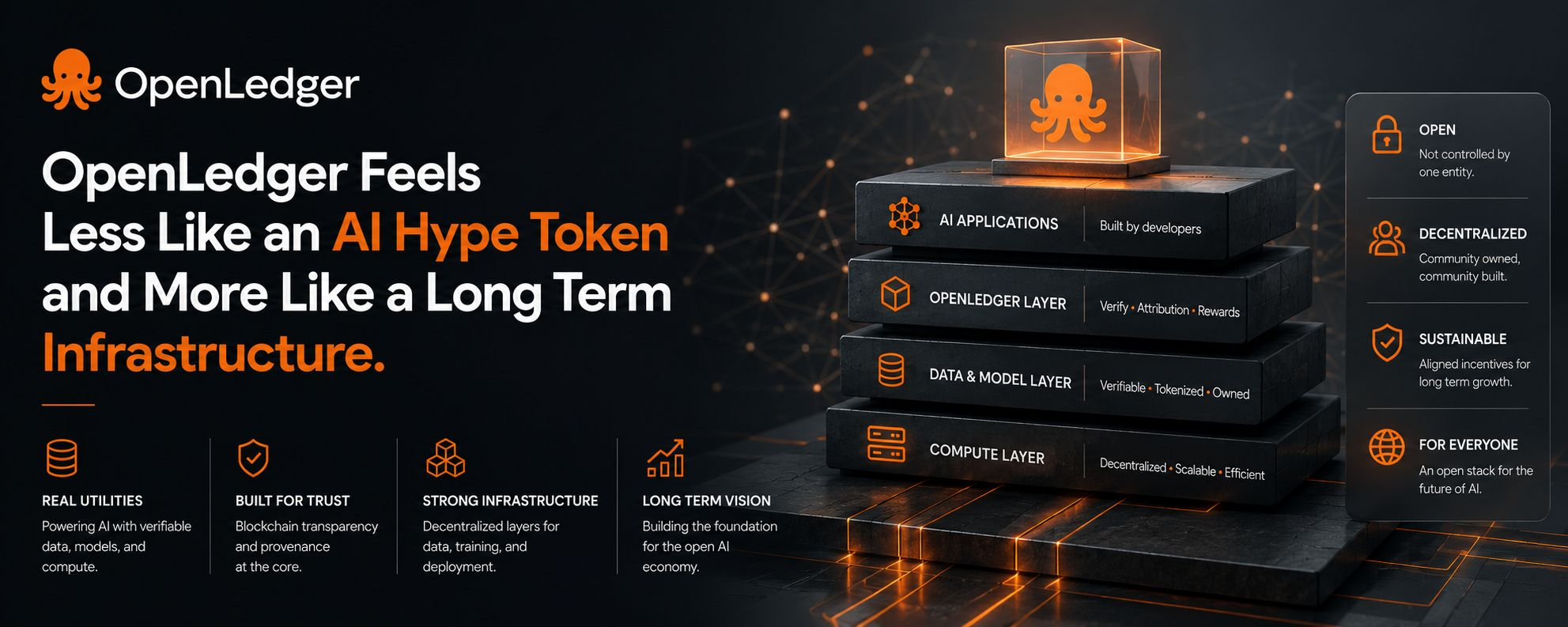
Most artificial intelligence projects in the crypto space currently feel assembled in a quick Discord call. Developers often type a few buzzwords into a chatbot, launch a speculative asset, and hope for a market pump. This cycle of recycled pitches has left many investors searching for actual substance beneath the surface.

However, #openledger is changing the narrative by prioritizing foundational utility over fleeting trends. Instead of chasing short-term gains, this project focuses on building the necessary plumbing for decentralized intelligence. It represents a significant shift in how the United States market views the intersection of blockchain and machine learning.
Smart capital is moving away from noise and toward projects with proven viability. By focusing on structural integrity, these platforms aim to survive market volatility while providing real value to users. Understanding this transition is essential for anyone looking to navigate the future of digital assets.
Key Takeaways
The crypto market is moving away from speculative AI projects toward functional infrastructure.
Many current AI tokens lack a clear roadmap or genuine product utility.
#openledger distinguishes itself by focusing on long-term technical foundations.
Investors are increasingly prioritizing project viability over rapid, hype-driven growth.
Understanding structural differences helps distinguish between market noise and real innovation.
The Current State of AI and Crypto Convergence
The rapid convergence of artificial intelligence and blockchain technology has created a landscape where genuine innovation is often buried under layers of speculative hype. While the potential for decentralized intelligence is immense, the market is currently flooded with projects that prioritize buzzwords over functional utility.
The Discord-Assembled Roadmap Problem
Many new ventures in this space feel like they were assembled in a frantic Discord call after someone typed “decentralized AI” into a chatbot. These teams often treat a generic AI roadmap as a substitute for actual engineering milestones.
This superficial approach to development leaves little room for long-term growth. When a project relies on automated prompts to define its future, it inevitably fails to address the complex technical hurdles required for real-world AI integration.
Why Retail Investors Are Skeptical of AI Narratives
Retail investors are becoming increasingly wary of narratives that lack clear, verifiable progress. They have learned that a flashy website and a catchy ticker symbol are not enough to sustain a project in a volatile market.
This skepticism is driving a shift in focus toward platforms like $open, which emphasize technical execution over empty promises. By providing transparent milestones, $open helps bridge the growing divide between aggressive marketing and the reality of decentralized infrastructure.
Ultimately, the market is beginning to reward projects that demonstrate tangible value. Investors are no longer satisfied with vague visions; they demand proof that the technology can actually function at scale. As the industry matures, the reliance on $open as a benchmark for quality will likely continue to grow.
Why Most AI Crypto Projects Are Just Vaporware
Beneath the polished websites and buzzwords, a troubling trend of vaporware has taken hold in the crypto market. Investors often encounter projects that promise to revolutionize artificial intelligence, yet they fail to provide any meaningful technology. This disconnect between marketing and reality creates a dangerous environment for those seeking long-term value.
The Pattern of Recycled Pitches
The industry has fallen into a predictable cycle of recycled pitches. A team launches a token, slaps the label of "AI infrastructure" on their homepage, and adds a redundant GPU marketplace. They hope retail investors will rotate into the narrative before anyone notices the lack of a functional product.
"In a gold rush, the people selling the shovels often make more money than the miners, but in the crypto AI space, many are selling shovels that don't even exist."
This strategy relies heavily on hype rather than substance. By focusing on branding over building, these projects capture short-term attention while leaving long-term holders with nothing but empty promises.
Identifying the Lack of Real Product Utility
Discerning the difference between a legitimate project and a hollow shell is essential for any serious investor. Many teams claim to offer decentralized AI solutions, yet they lack the underlying architecture to support such complex operations. True innovation requires tangible product utility that solves actual problems in the data pipeline.
When we look at projects like @openledger, we see a stark contrast to the typical vaporware model. Instead of relying on buzzwords, @openledger prioritizes functional development and transparent infrastructure. By focusing on the mechanics of data attribution and sustainable growth, they demonstrate that real utility is the only way to survive the inevitable market corrections.
OpenLedger Feels Less Like an AI Hype Token and More Like a Long Term Infrastruc.
My initial skepticism toward #openledger was rooted in the exhaustion of seeing endless AI-themed tokens. I expected another project attempting to force itself into the current cycle simply because that is where the liquidity flows. However, my deep dive into the architecture of #openledger revealed a refreshing departure from standard industry trends.
https://www.youtube.com/watch?v=gag3493lzeM
Shifting the Focus from Hype to Utility
The project distinguishes itself by addressing genuine industry pain points rather than relying on buzzwords. Instead of chasing short-term market sentiment, the team focuses on building durable infrastructure. This approach suggests that #openledger is designed to solve specific technical bottlenecks in the AI ecosystem.
By prioritizing functional utility, the platform moves away from the speculative nature of typical crypto assets. It creates a foundation where developers can actually build and scale applications. This shift is essential for any project aiming to survive beyond the current hype cycle.
Why OpenLedger Stands Out in a Crowded Market
In a market saturated with clones, #openledger provides a unique value proposition that is hard to ignore. The following table highlights the key differences between standard speculative tokens and this infrastructure-focused approach.
FeatureSpeculative AI Tokens#openledger ApproachPrimary GoalLiquidity ExtractionLong-term UtilityDevelopmentRecycled CodeCustom InfrastructureMarket FocusShort-term HypeSustainable GrowthProblem SolvingVague PromisesSpecific Pain Points
Ultimately, the project stands out because it treats blockchain as a tool for real-world integration. While others focus on price action, this platform focuses on the underlying mechanics of data and compute. This commitment to substance over style is exactly what the industry needs to mature.
The Invisible Labor Crisis in Modern AI Development
We must confront the uncomfortable reality that the AI revolution is fueled by the unpaid efforts of everyday people. While the industry celebrates breakthroughs in machine learning, the backbone of this progress relies on a massive, largely ignored workforce.
This system functions by harvesting oceans of public data without providing any form of compensation or recognition to the original creators. It is a cycle that prioritizes rapid development over ethical transparency.
Defining the Unseen Workforce
The unseen workforce consists of millions of individuals who contribute to AI development through their daily digital interactions. Every time a user posts on a forum, labels an image, or provides feedback on a platform, they are effectively training the next generation of models.
These contributions are rarely voluntary in a meaningful sense. Most users are unaware that their forum posts, social media comments, and behavioral patterns are being scraped to build proprietary systems. This creates a massive imbalance where the value generated by the public is captured entirely by private corporations.
The Hidden Costs of Model Training
The economic and ethical costs of this model are becoming impossible to ignore. When companies train models on uncompensated human value, they bypass the need for fair labor practices, which artificially lowers their operational expenses.
"The most profound technologies are those that disappear. They weave themselves into the fabric of everyday life until they are indistinguishable from it."
— Mark Weiser
This lack of attribution creates a critical issue for the future of the industry. Without a mechanism to track and reward these contributions, the current AI pipeline remains fundamentally extractive. True innovation should not depend on the exploitation of public data, but rather on a sustainable model that respects the rights of every contributor.
How Big Tech Labs Absorb Uncompensated Human Value
Behind every sophisticated AI model lies a vast, often invisible, workforce that remains largely uncompensated. Large technology labs have built their empires by harvesting the collective output of the internet. This process creates a systemic imbalance between massive corporate profits and the individuals who make the technology possible.
The Exploitation of Public Data
Most proprietary AI models are trained on massive datasets scraped directly from the public web. This data includes everything from personal blog posts to creative works and social media interactions. Crucially, the original creators of this content rarely receive any form of compensation or even acknowledgment for their contributions.
Companies treat this information as a free resource to fuel their commercial products. By ignoring the rights of the original authors, these labs effectively privatize public knowledge for private gain. This practice raises significant ethical questions about the ownership of human creativity in the digital age.
Feedback Loops and Annotation Without Attribution
Beyond raw data, AI development depends on constant human feedback loops. Millions of users unknowingly provide this labor by interacting with chatbots, correcting errors, or labeling images. These inputs are essential for refining model accuracy and safety protocols.
Despite the high value of this work, the contributors remain anonymous and unrewarded. The current centralized model relies on this hidden labor to function, yet it offers no mechanism for attribution. This structure is fundamentally unsustainable for the average contributor who provides the very intelligence that powers these systems.
The Mechanics of Decentralized Data Attribution
Imagine a world where every piece of data you contribute to an AI model is verified and rewarded on a public ledger. Currently, the AI industry suffers from a lack of transparency, where the origins of training data remain hidden behind corporate firewalls. By utilizing $open, we can finally shift toward a model that prioritizes verifiable, decentralized attribution for every participant.
Tracking Contributions on the Blockchain
The core of this transformation lies in the ability to record data provenance directly on the blockchain. When a contributor submits information, the protocol creates a permanent, immutable record of that input. This ensures that the contribution is not only recognized but also linked to the specific model training cycle.
Using $open, the system automates the verification process to ensure that only high-quality data enters the pipeline. This technical framework relies on several key pillars:
Immutable Logging: Every data point is timestamped and hashed on the ledger.
Automated Verification: Smart contracts validate the relevance and quality of incoming data.
Transparent Provenance: Users can trace the lineage of a model back to its original data sources.
Ensuring Fair Compensation for Data Providers
Moving away from opaque, centralized systems allows for a more equitable distribution of value. In traditional setups, the entities providing the raw material for AI models are often ignored or uncompensated. Decentralized attribution changes this dynamic by embedding payment logic directly into the data lifecycle.
"True innovation in artificial intelligence will be defined by how we value the human labor that powers our models."
By leveraging $open, the protocol ensures that contributors receive fair compensation for their work without the need for intermediaries. This creates a direct link between the value provided and the reward earned. As the ecosystem grows, $open continues to serve as the primary mechanism for maintaining trust and integrity in the data economy.
Moving Beyond the GPU Marketplace Narrative
Moving beyond the hype of GPU marketplaces requires a fundamental shift in how we view AI infrastructure. Many projects currently focus on the commoditization of hardware, assuming that decentralized compute is the primary bottleneck for innovation. However, this hardware-centric approach often ignores the deeper, more systemic issues regarding how AI models are actually built and trained.
Why GPU Marketplaces Are Often Redundant
The market is currently flooded with platforms offering decentralized GPU access. While these services provide utility, they are increasingly becoming redundant as cloud providers lower costs and hardware becomes more accessible. Simply renting out graphics cards does not solve the core problem of model performance or accuracy.
Investors often mistake the availability of hardware for the presence of a competitive advantage. In reality, hardware is a commodity that offers little long-term defensibility for a project. Without a unique value proposition, these marketplaces struggle to maintain relevance in a rapidly evolving landscape.
Focusing on Data Integrity Over Hardware Rental
True innovation lies in the quality of the data used to train models. This is where @openledger distinguishes itself by prioritizing data provenance and integrity. By ensuring that data is verified and traceable, the platform creates a more sustainable foundation for artificial intelligence.
Focusing on the data layer allows for better value distribution among contributors. Instead of just paying for compute, the ecosystem rewards those who provide high-quality, actionable information. This shift ensures that the resulting AI models are more reliable and less prone to the biases found in unverified datasets.
FeatureHardware-Centric ModelData-Centric (@openledger)Primary FocusCompute RentalData IntegrityValue DriverHardware AvailabilityData ProvenanceSustainabilityLow (Commoditized)High (Foundational)OutcomeShort-term UtilityLong-term AI Quality
Building Sustainable Infrastructure for AI Training
True progress in artificial intelligence requires a shift from temporary hype to the creation of lasting, sustainable infrastructure. Developers must move beyond experimental models to focus on the structural integrity of the systems that power modern machine learning. Without a solid base, even the most advanced algorithms will struggle to maintain performance over time.
Creating a Decentralized Foundation
A truly resilient foundation relies on decentralization to ensure that data remains both accessible and verifiable. By distributing the burden of storage and processing, we eliminate single points of failure that often plague centralized labs. This approach fosters a more transparent environment where data quality is prioritized over sheer volume.
When the foundation is decentralized, it becomes easier to maintain high standards for information integrity. Contributors can verify their inputs, ensuring that the models are trained on clean, reliable datasets. This shift is essential for building trust within the broader AI ecosystem.
Scalability Challenges in AI Data Pipelines
Managing massive, decentralized data pipelines across global networks presents significant technical hurdles. As the demand for training data grows, the infrastructure must be able to scale without sacrificing speed or security. Engineers are currently working to solve the latency issues that often arise when moving large files across distributed nodes.
Ensuring that AI development remains open and equitable requires overcoming these complex bottlenecks. If the pipeline cannot handle the load, the benefits of decentralized AI will remain out of reach for many participants. Robust architecture is the only way to guarantee that the next generation of models is built on a foundation that is both scalable and inclusive.
The Role of OpenLedger in Empowering Data Contributors
The traditional AI landscape often leaves the individual contributor behind, but #openledger is changing that dynamic. Instead of keeping the benefits of machine learning within closed corporate walls, this platform invites users to become active participants. By shifting from passive consumption to rewarded participation, the ecosystem ensures that the people who provide the raw material for AI are finally recognized.

Democratizing Access to AI Value
Access to the wealth generated by artificial intelligence has historically been restricted to large tech conglomerates. #openledger breaks this cycle by creating a transparent framework where value flows back to the source. Individual contributors can now claim their stake in the models they help build, effectively democratizing the digital economy.
This approach ensures that the benefits of innovation are distributed more fairly across the community. When users contribute data, they are not just performing a task; they are investing in a decentralized foundation that prioritizes collective growth over private hoarding.
Incentivizing Quality Data Inputs
High-quality models require high-quality data, which is why the platform implements robust incentive structures. By rewarding accuracy and reliability, #openledger encourages contributors to provide their best work. This mechanism creates a self-sustaining loop where better data leads to better AI, which in turn increases the value of the entire network.
The following table highlights the key differences between traditional data collection and the decentralized model offered by the project:
FeatureTraditional AI Labs#openledger ModelData OwnershipCentralized/CorporateUser-Owned/TransparentContributor RewardNone/MinimalDirect Economic IncentiveModel QualityVariable/Black BoxVerified/High-IntegrityValue DistributionShareholders OnlyCommunity-Wide
By fostering a collaborative and fair ecosystem, the project ensures that every participant has a clear path to success. This shift is essential for building long-term trust in AI systems that are truly representative of human knowledge.
Addressing the Liquidity Trap in AI Narratives
Navigating the landscape of AI tokens requires a keen eye for projects that prioritize substance over speculation. Many investors fall into a liquidity trap, where high-volume trading masks a lack of underlying utility. This environment often leaves participants holding assets that lose value as soon as the initial market excitement fades.
By focusing on structural integrity, $open distinguishes itself from projects that rely solely on market sentiment. Instead of chasing fleeting trends, the platform builds a foundation rooted in verifiable data contributions. This approach ensures that the ecosystem remains resilient even when broader market conditions become unstable.
Avoiding the Pump and Dump Cycle
The crypto market is notorious for cycles that benefit early insiders at the expense of retail buyers. These pump and dump schemes thrive on artificial scarcity and aggressive marketing campaigns. True sustainability requires a shift away from these predatory tactics toward transparent development goals.
The $open protocol mitigates these risks by aligning incentives with long-term participation. By rewarding contributors for high-quality data rather than just speculative trading, the project creates a natural barrier against volatility. This mechanism discourages short-term manipulation and fosters a healthier, more predictable market environment.
Building Real Value for Long Term Holders
Investors who prioritize stability often look for projects that demonstrate consistent growth in their core infrastructure. A sustainable economic model must reward patience and commitment rather than rewarding those who seek quick profits. When a project provides tangible utility, it creates a floor for value that speculative hype cannot replicate.
Building $open as a long-term infrastructure play means prioritizing the needs of the community over the demands of day traders. By fostering a culture of contribution and ownership, the project ensures that its value is tied to real-world AI development. This strategy provides a clear roadmap for those seeking to avoid the pitfalls of the current AI narrative cycle.
Long Term Viability Versus Short Term Speculation
True market longevity is rarely found in the noise of daily price action, but rather in the bedrock of solid architecture. While many participants chase the next viral trend, seasoned investors understand that sustainable growth depends entirely on the strength of the underlying technical foundation.
The Importance of Fundamental Technology
Projects that prioritize core technical advancements create a defensible moat against market volatility. By focusing on solving real-world problems through robust code and scalable systems, these ventures move beyond the reach of temporary sentiment shifts. Fundamental technology acts as a stabilizer, ensuring that the project remains relevant even when the broader market experiences a downturn.
"The most resilient systems are those built to solve structural inefficiencies rather than those designed to capture fleeting attention."
Why Infrastructure Projects Outlast Hype Cycles
Infrastructure-focused initiatives like @openledger are better positioned to survive because they provide essential utility to the ecosystem. Unlike speculative tokens that rely on marketing cycles, these projects build value through consistent development and adoption. The following table highlights the key differences between speculative ventures and infrastructure-focused projects.
FeatureSpeculative TokenInfrastructure ProjectPrimary DriverSocial Media HypeTechnical UtilityValue SourceMarket SentimentNetwork AdoptionRisk ProfileExtremely HighModerate/Calculated
By focusing on long-term goals, @openledger demonstrates how a commitment to decentralized infrastructure creates lasting value. Investors who look past the immediate noise often find that the most successful projects are those that quietly build the future of the industry while others chase the latest distraction.
Conclusion
The shift from speculative hype to durable infrastructure marks a turning point for the digital economy. Projects like OpenLedger prove that long-term value stems from solving real problems rather than chasing market trends. By prioritizing fundamental technology, the industry moves away from empty promises toward tangible utility.
Addressing the invisible labor crisis remains a vital step in this evolution. Fair attribution for data contributors ensures that the people powering modern models receive proper recognition. This approach creates a more equitable landscape where value flows back to those who provide the essential inputs for innovation.
Transparency serves as the bedrock for this new era of development. Investors and users should demand accountability to avoid the pitfalls of short-term cycles. Focusing on sustainable growth protects the ecosystem from volatility and builds trust among participants.
The path forward requires a commitment to decentralized principles and ethical data practices. By supporting projects that value integrity, the community shapes a future where technology serves everyone. Share your thoughts on how decentralized infrastructure will change the way we interact with data in the coming years.
FAQ
How does #openledger distinguish itself from the current wave of AI hype tokens?
Unlike many projects that are assembled quickly in Discord calls with roadmaps generated by ChatGPT, #openledger focuses on foundational utility and long-term infrastructure. While most speculative tokens chase short-term liquidity cycles, this project addresses the structural needs of the decentralized AI ecosystem, prioritizing the data layer and verifiable technical milestones over superficial marketing narratives.
What are the primary red flags that indicate an AI crypto project might be vaporware?
Common signs of vaporware include recycled pitches that promise "decentralized AI" without a tangible product, or projects that launch a token and immediately pivot to a GPU marketplace that lacks actual demand. Many of these projects are simply branding exercises designed to capture retail interest during narrative rotations. In contrast, @openledger provides a functional framework for solving real-world data attribution problems.
What is meant by the "invisible labor crisis" in modern artificial intelligence?
The AI industry currently relies on billions of data points—forum posts, annotations, and user feedback—contributed by millions of people who receive no compensation or attribution. Major labs like OpenAI and Google absorb this uncompensated human value to train proprietary models. This systemic imbalance creates an ethical and economic crisis that #openledger seeks to rectify through decentralized protocols.
How does the $open ecosystem facilitate fair compensation for data providers?
By utilizing blockchain technology for decentralized data attribution, $open tracks individual contributions within the AI training pipeline. This ensures that when a model is improved through high-quality data inputs, the original contributors are recognized and rewarded. This transparency moves the industry away from opaque, centralized systems and toward an equitable AI economy.
Why is @openledger shifting the focus away from redundant GPU marketplaces?
While hardware rental is a common narrative, many decentralized GPU marketplaces are redundant or solve the wrong problem. @openledger prioritizes data integrity and quality, recognizing that the true bottleneck in AI development isn't just raw compute power, but the availability of verified, high-quality data. By focusing on the infrastructure for data provenance, the project builds more resilient and sustainable value.
What technical challenges exist when building sustainable infrastructure for AI training?
The primary hurdles involve scalability within decentralized data pipelines. Managing massive datasets across global networks while maintaining data quality and accessibility requires a robust architectural foundation. Projects like #openledger are designed to overcome these hurdles by creating a decentralized foundation that can handle the rigorous demands of modern model training without sacrificing performance.
How can investors avoid the typical "pump and dump" cycles associated with AI crypto narratives?
Investors should look for projects that prioritize fundamental technology and long-term viability over fleeting market hype. By focusing on the creation of real value for long-term holders and avoiding speculative liquidity traps, $open aims to establish a stable economic model. Choosing projects with a defensible moat—such as unique infrastructure—is key to outlasting the volatility of the crypto market.
In what way does @openledger democratize access to AI value?
@openledger empowers individual contributors by transforming them from passive data sources into active, rewarded participants. By incentivizing quality data inputs, the platform ensures that the value generated by artificial intelligence is distributed more fairly among those who actually provide the training material, rather than being consolidated solely within a few large technology corporations. #open #openLadge $OPEN