
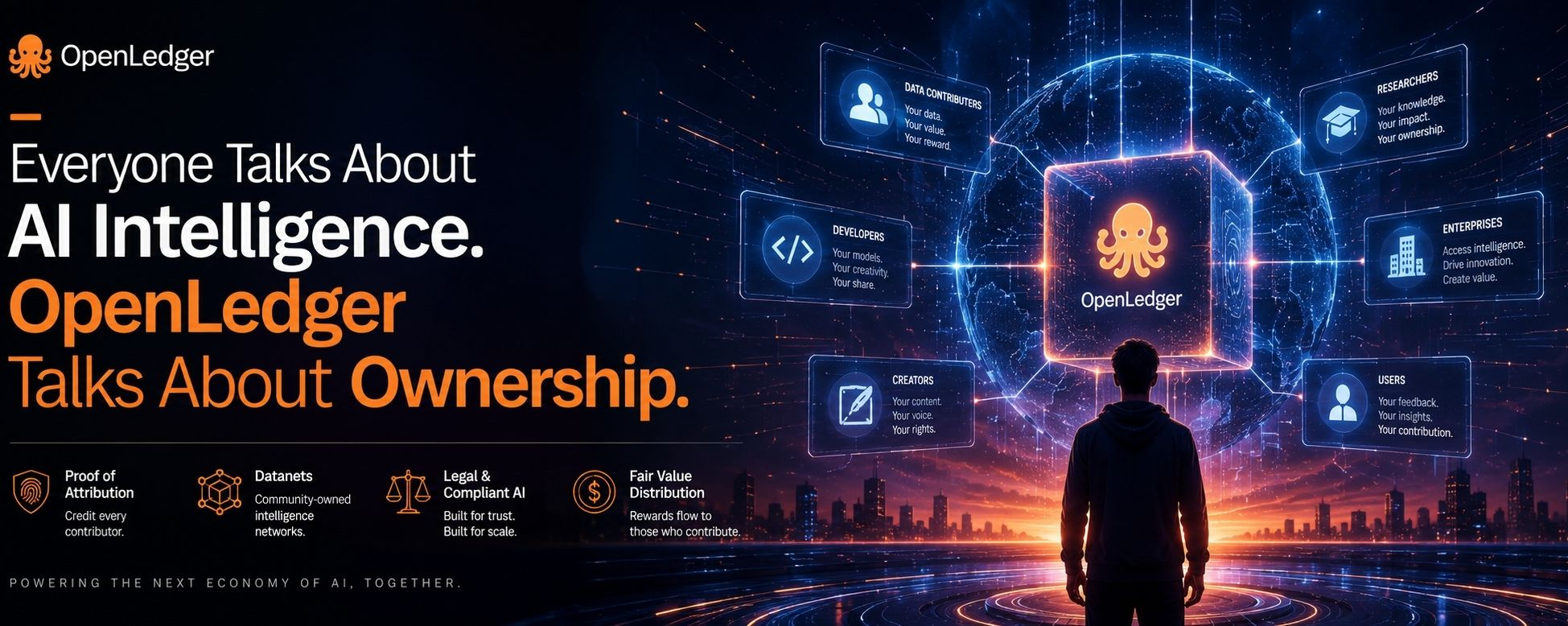

The AI industry is entering a strange phase. Everyone talks about intelligence, but very few talk about ownership.
Every single day, millions of people unknowingly contribute to the AI economy through their data, expertise, research, conversations, niche knowledge, creative work, and human feedback. Yet when the value is finally created, most of the rewards flow toward a small group of centralized companies controlling the infrastructure behind these models. That imbalance is becoming harder and harder to ignore.
And honestly, that’s why openledger.xyz started catching my attention.
At first, I dismissed it like most people probably would. Another AI + crypto project. Another futuristic narrative trying to capitalize on hype. The industry is already flooded with projects promising “AI agents,” “autonomous economies,” and “decentralized intelligence.” But after spending more time understanding OpenLedger’s direction, it became clear that they are trying to tackle something much deeper than market attention.
They are asking a far more important question:
Who actually owns the intelligence that AI creates?
That question alone may define the next era of the internet.
Modern AI does not emerge out of nowhere. Models are trained on human-generated information. Real people provide the raw material — whether through datasets, domain expertise, financial research, healthcare knowledge, legal frameworks, scientific insights, or creative content. Yet despite contributing the very foundation of these systems, most people never participate in the value generated afterward.
OpenLedger’s philosophy seems built around changing that dynamic.
Their thesis is simple: if AI is powered by human knowledge, then humans should also share in the economic upside created by AI. The idea sounds simple in theory, but implementing it is extraordinarily difficult.
Because decentralization alone solves nothing.
The real challenge is attribution.
How do you prove which data contributed to a model? How do you identify which knowledge influenced a specific output? How do you automate revenue sharing fairly across thousands of contributors without relying on blind trust?
That is where OpenLedger’s Proof of Attribution framework becomes genuinely interesting.
The vision is ambitious: build infrastructure capable of tracing contribution flows behind AI systems themselves. Imagine a future where specialized financial AI models are trained using verified market intelligence from contributors around the world. Later, institutions access those systems through APIs. OpenLedger wants the backend infrastructure to identify contribution paths automatically and distribute rewards accordingly.
Not through promises.
Through infrastructure.
And honestly, this feels much bigger than simple crypto speculation.
The AI industry is rapidly moving toward a future where ownership, transparency, and compliance may matter just as much as model performance itself. Regulators are already moving aggressively in that direction. Europe’s AI Act is only the beginning. Questions around licensing, training rights, commercial usage, accountability, and transparency are becoming unavoidable across the entire industry.
What data trained the model?
Who approved its usage?
Who owns the outputs?
Can the intelligence be monetized legally?
These are no longer theoretical debates. They are becoming infrastructure requirements.
That’s why OpenLedger’s partnership with story.foundation feels more strategic than promotional. Because OpenLedger seems to understand something many projects still underestimate:
Enterprise AI adoption will depend heavily on trust and legal clarity.
Not hype.
Not narratives.
Not token speculation.
Trust.
Another concept that makes OpenLedger interesting is their idea of “Datanets.” This goes far beyond storing datasets on-chain. The broader vision appears to revolve around community-owned intelligence networks — ecosystems where specialized expertise becomes programmable, traceable, and economically valuable.
And honestly, that direction makes a lot of sense.
The future AI economy probably will not be dominated entirely by giant general-purpose models. Instead, highly specialized AI systems may become increasingly important across industries like healthcare, biotech, finance, law, and scientific research. These systems require precision, domain-specific intelligence, and highly refined niche datasets.
That is exactly where OpenLedger appears to be positioning itself.
What makes this timing even more interesting is how rapidly AI infrastructure has evolved in recent years. A few years ago, building specialized AI systems required enormous GPU resources and massive capital. Today, lightweight fine-tuning architectures like LoRA have changed the economics dramatically.
Smaller, more efficient, highly specialized models are becoming increasingly viable. And if that trend continues, the infrastructure layer supporting niche intelligence economies could become extremely valuable.
Of course, there is still a brutal reality here.
AI infrastructure is expensive. Very expensive.
Building sustainable systems requires far more than narratives and token momentum. The hardest challenge for decentralized AI is still enterprise adoption. Because enterprises do not care about futuristic slogans. They care about uptime, latency, compliance, scalability, and reliability.
And they will not move critical workloads onto experimental infrastructure unless those systems can truly operate at scale.
That is ultimately the real test for OpenLedger.
Can they build enterprise-grade infrastructure?
Can attribution systems function efficiently across global inference economies?
Can the economics remain sustainable long term?
Those questions matter far more than short-term market excitement.
Still, one thing deserves real credit: at least they are trying to solve an infrastructure-level problem. And in a market crowded with shallow AI narratives, that alone makes them stand out.
Maybe OpenLedger succeeds.
Maybe it pivots.
Maybe it fails completely.
But the underlying idea feels important.
Because if AI truly becomes the foundation of the future digital economy, then ownership, attribution, and revenue sharing may eventually become unavoidable layers of the system itself.
And OpenLedger is betting on that future earlier than most.
