

I’ve been around crypto long enough to recognize the rhythm of recycled narratives. Every cycle introduces a new phrase that suddenly becomes unavoidable. A few years ago it was interoperability. Then it became modularity. Then real-world assets. Now the industry has shifted toward AI with almost mechanical predictability. Every other project suddenly claims to be building “AI infrastructure,” and most of the time it feels like branding pasted onto systems that would have existed exactly the same without artificial intelligence attached to the pitch.
That’s probably why I didn’t pay much attention to OpenLedger at first.
An “AI blockchain” sounds dangerously close to the kind of vague terminology this industry produces when it wants attention faster than understanding. I’ve learned to distrust projects that introduce themselves with broad futuristic language because crypto has a habit of talking about revolutions long before it solves ordinary coordination problems. And honestly, AI itself is already surrounded by enough noise. Combine that with crypto, and the result is usually either speculation disguised as infrastructure or infrastructure searching desperately for a reason to exist.
But the more I looked into OpenLedger, the more I felt it was at least asking a more interesting question than most projects in this space.
Not necessarily answering it yet. But asking it properly matters.
The thing that kept staying in my mind was this idea of liquidity around data, models, and agents. Most people hear those words and immediately think about monetization in the simplest sense — people selling datasets or AI services on-chain. But I think the deeper issue underneath all this is ownership. Crypto, at its core, has always been obsessed with ownership structures. Ownership of money. Ownership of networks. Ownership of governance. Ownership of identity. AI introduces a strange contradiction because the systems becoming most valuable are trained on enormous amounts of public human behavior, while the actual economic upside tends to concentrate around a handful of centralized companies.
That imbalance is becoming impossible to ignore.
People generate the data. Communities refine models indirectly through usage. Developers build tools and agents on top of existing ecosystems. Yet value capture collapses upward into centralized infrastructure providers almost every single time. Crypto has spent years talking about decentralization, but when AI entered the conversation, most of the ecosystem quietly accepted centralized dependence again because training models and managing inference at scale is expensive, technically difficult, and operationally brutal.
That’s the tension OpenLedger seems to be positioning itself around.
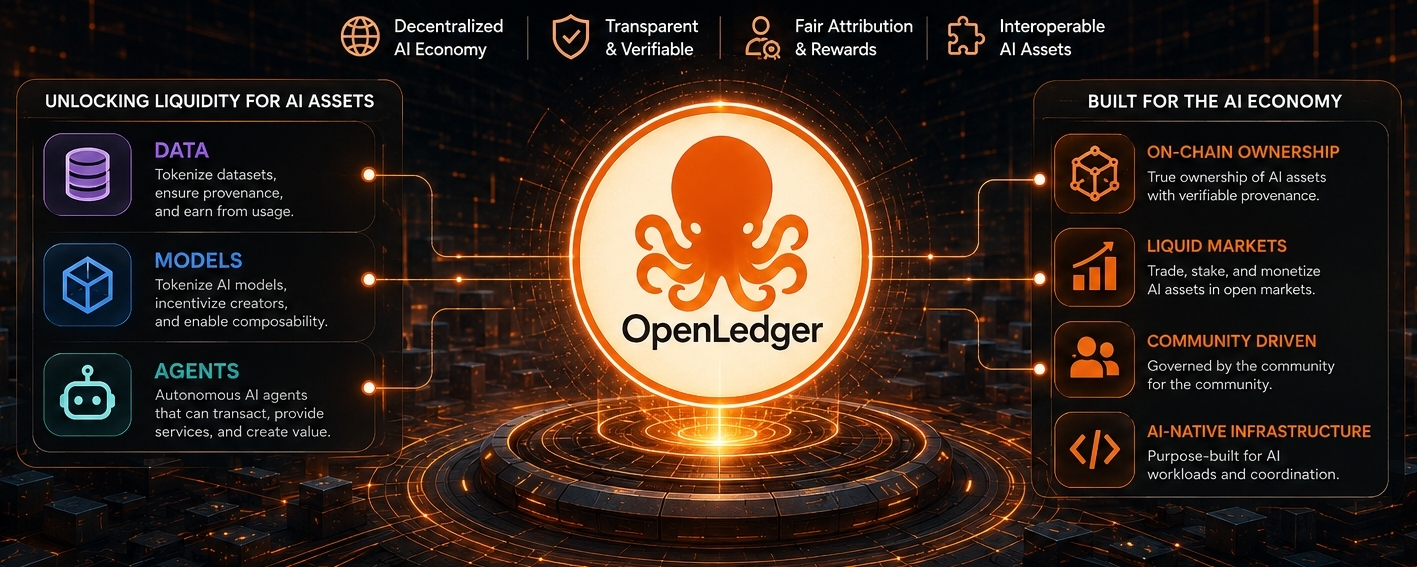
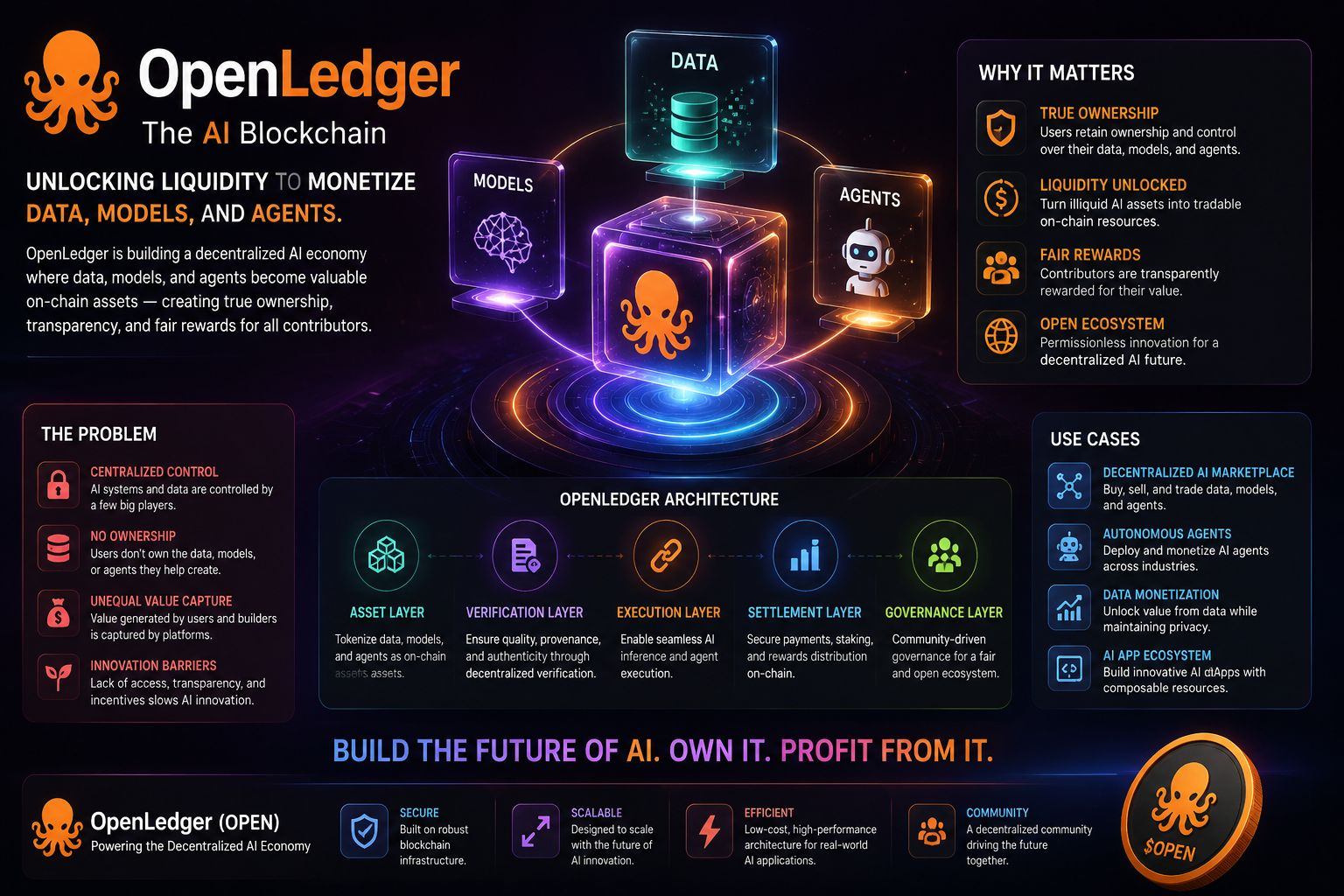
Not just “AI on blockchain,” which honestly means very little most of the time, but an attempt to create a market structure around AI resources themselves. Data becomes an asset. Models become composable economic primitives. Agents become participants in an ecosystem instead of isolated applications.
At least conceptually, that’s more meaningful than launching another token attached to a chatbot.
What interested me wasn’t the surface narrative. It was the architecture implied underneath it. OpenLedger appears to treat AI coordination almost like decentralized finance treated capital coordination years ago. DeFi unlocked dormant liquidity by making assets programmable. OpenLedger seems to believe AI components can become programmable economic units too.
And I think that’s where the idea becomes more serious.

Because right now the AI economy is incredibly fragmented. Data exists in silos. Models operate behind APIs. Independent developers rely on centralized gateways they don’t control. Even open-source AI often depends on centralized hosting layers somewhere in the stack. The ecosystem talks about openness while structurally reinforcing dependence. That contradiction keeps growing.
The crypto industry usually responds to these situations with ideology first and engineering second. That’s one of the reasons so many projects collapse under their own narratives. They assume decentralization itself automatically creates value. But decentralization without efficiency, incentives, or usability simply becomes friction disguised as philosophy.
OpenLedger seems aware of that problem, at least partially.
What caught my attention was the emphasis on liquidity rather than pure decentralization rhetoric. Liquidity changes behavior because liquidity creates participation. Markets emerge when assets can move efficiently between actors. If AI models, datasets, or autonomous agents become economically interoperable, then entirely new behaviors become possible. Smaller builders might finally access systems that currently belong only to heavily funded companies. Contributors might receive direct economic alignment instead of indirect platform dependency.
Still, this is where my skepticism returns.
Crypto projects are very good at imagining ideal incentive structures. Reality tends to be harsher. Creating markets around AI resources sounds elegant theoretically, but markets only work when quality, trust, and pricing mechanisms function reliably. Data quality is notoriously difficult to verify. Model outputs are inconsistent. Agents behave unpredictably. Even defining value becomes complicated.
One dataset may appear useful until biases emerge later. One model may perform well under benchmarks but fail under real-world conditions. Agents can generate activity without generating meaningful utility. Crypto itself already struggles with incentive misalignment, and AI adds another layer of uncertainty on top of it.
So when I think about OpenLedger, I don’t really think about whether the idea sounds ambitious. Crypto has no shortage of ambition. I think about whether the coordination layer they’re imagining can actually survive contact with human behavior.
Because human behavior breaks elegant systems constantly.
I’ve seen countless protocols designed around perfect participation assumptions. Then greed, apathy, speculation, or manipulation enters the equation and suddenly the entire model looks fragile. The same risk exists here. If monetization becomes the dominant incentive, ecosystems often optimize for quantity instead of quality. We already watched social media platforms decay under engagement incentives. AI marketplaces could easily drift toward spam, synthetic noise, or low-quality automation if the economics aren’t extremely carefully designed.
That risk feels very real to me.
At the same time, ignoring the problem entirely doesn’t feel realistic anymore either. AI is moving toward becoming foundational infrastructure for digital systems, and the ownership structure of that infrastructure matters more than people realize. If a tiny number of corporations end up controlling the majority of models, data pipelines, inference systems, and intelligent agents, then the internet itself starts changing shape. Open systems become dependent systems.
Crypto originally emerged partly as a reaction against concentrated control. Somewhere along the way, parts of the industry lost that philosophical grounding and became obsessed with short-term speculation cycles instead. What makes OpenLedger somewhat refreshing is that it feels connected to a larger structural issue rather than just another trading narrative.
Even then, I keep reminding myself that identifying a real problem does not guarantee a successful solution.
That distinction matters.
The graveyard of crypto is filled with projects that diagnosed genuine issues correctly but failed because execution, timing, adoption, or economics never aligned. Infrastructure projects especially face brutal adoption curves because users rarely migrate simply because architecture improves. Convenience almost always wins first. Centralization wins because it reduces friction. People say they care about decentralization until decentralization becomes slower, harder, or more expensive.
AI compounds this challenge because the computational demands are enormous. Training advanced models requires resources that naturally centralize. Even if OpenLedger creates better economic coordination around AI assets, there’s still the question of whether decentralized systems can compete operationally against massive centralized infrastructure providers with billions in funding.
I don’t think the answer is obvious yet.
But maybe the more interesting possibility isn’t replacing centralized AI entirely. Maybe it’s creating parallel ecosystems where ownership becomes more distributed at the edges. Smaller specialized models. Community-owned datasets. Autonomous agents operating economically without platform dependency. Interoperable systems that reduce lock-in over time instead of eliminating centralization overnight.
That feels more realistic to me.
Crypto sometimes fails because it frames every challenge as absolute revolution rather than gradual structural pressure. Most industries don’t transform instantly. They fragment first. Alternative coordination systems emerge quietly before they become unavoidable. OpenLedger might fit more naturally into that kind of trajectory instead of the dramatic narratives crypto usually prefers.
I also think timing matters here in a strange way.
The market is exhausted by superficial AI tokens already. People are becoming more capable of distinguishing between infrastructure and branding theater. That skepticism is healthy. It forces projects to justify themselves beyond aesthetics and partnerships. OpenLedger entering during this phase may actually help it because expectations are no longer blindly optimistic.
And honestly, skepticism itself is valuable in crypto. I trust projects more when they survive doubt instead of feeding exclusively on excitement.
The older I get in this industry, the less interested I become in certainty. Early in crypto, everyone wanted definitive answers about which protocol would dominate, which chain would win, which narrative would reshape everything. Over time I realized technology ecosystems rarely evolve cleanly. They emerge through contradictions, partial successes, failures, and unexpected recombinations.
OpenLedger feels like one of those experiments sitting at the intersection of several unresolved tensions at once: AI ownership, decentralized coordination, economic interoperability, and programmable incentives. Maybe it succeeds. Maybe it becomes another technically interesting system that never escapes niche relevance. Both outcomes are possible.
But I do think it touches something real.
The internet is entering a phase where intelligence itself is becoming infrastructure. Once that happens, the question stops being whether AI matters and becomes who owns the mechanisms behind it. That’s ultimately the deeper conversation hiding underneath projects like OpenLedger.
Not whether AI and blockchain can be combined for marketing purposes.
But whether decentralized systems can meaningfully participate in the next layer of digital coordination before everything consolidates again.
And honestly, I still don’t know the answer to that. But at least OpenLedger made me spend time thinking about the question seriously, which is already more than I can say for most projects entering the AI narrative right now.
