
I keep looking at crypto these days with a different kind of mindset than I had a few years ago. Maybe that just happens after watching enough market cycles come and go. At some point, the excitement settles down and you stop reacting to every shiny new thing that promises to change everything overnight. Crypto moves in waves—one month everyone is convinced a certain trend will redefine the future, and a few months later people barely mention it. I’ve watched narratives appear, explode, and quietly disappear often enough to know that big promises are easy here. Real execution is usually the hard part.
That’s partly why I didn’t think much at first when OpenLedger (OPEN) started showing up on my radar. Crypto and AI together almost feels inevitable now, maybe even a little overused. Every other project seems to be connecting itself to artificial intelligence in some way, often with language that sounds impressive but becomes difficult to explain in plain English. My first thought was honestly simple: this might just be another protocol trying to ride the latest attention cycle.
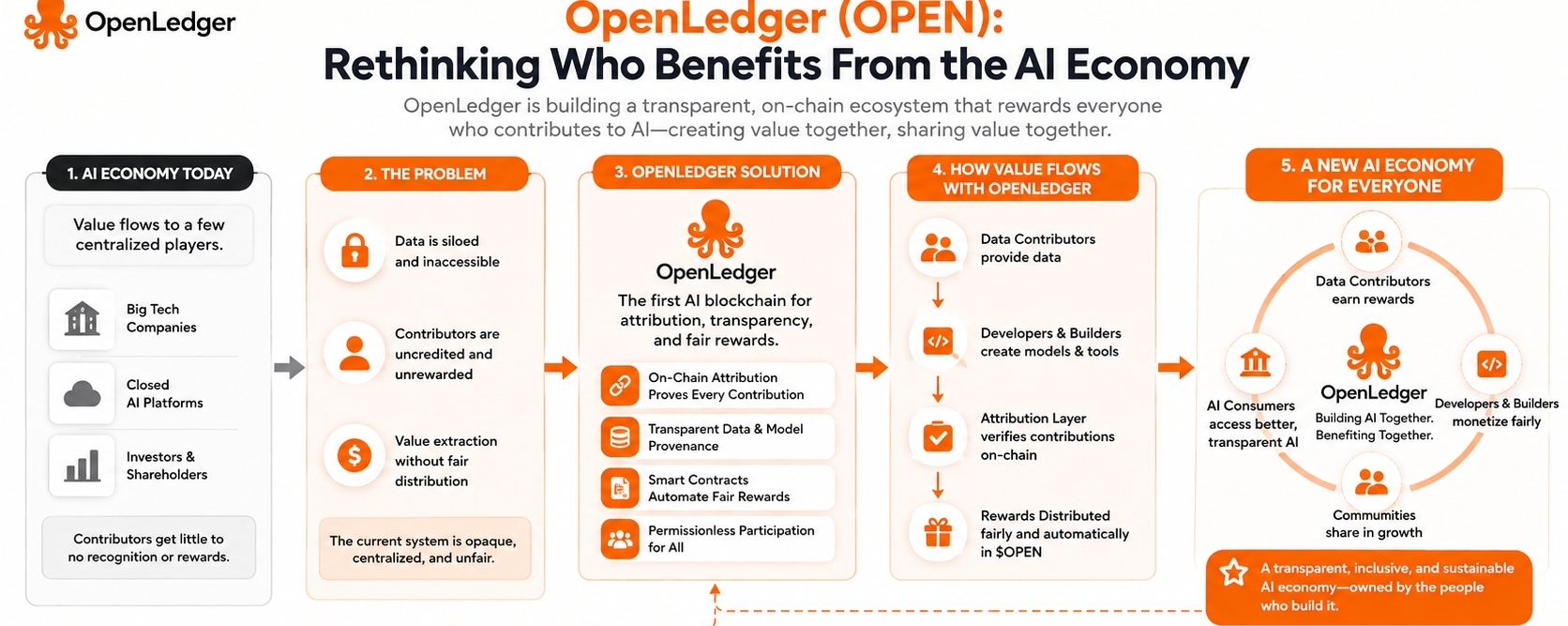
But the more I sat with the idea, the more I found myself thinking about the problem it seems to be trying to solve. OpenLedger talks about unlocking liquidity around data, AI models, and agents, which sounds complicated until you slow it down a bit. In reality, it seems to revolve around a pretty reasonable question: if data and human input are helping build valuable AI systems, shouldn’t there be some fairer way for people to benefit from that value?
That thought feels more relevant than people sometimes realize. Most of us are constantly creating data without thinking much about it. We interact with platforms, train recommendation systems without noticing, contribute information through habits, searches, conversations, and digital behavior. Meanwhile, enormous businesses are built on top of that value. OpenLedger appears to be asking whether there’s a better structure for how that value moves, especially as AI becomes more important in everyday life.
Of course, this is usually where experience makes me slow down a little. Crypto has a habit of making difficult problems sound simple. A strong idea on paper doesn’t automatically become something people actually use. There’s a long road between an interesting concept and meaningful adoption, especially when traditional industries are involved. Companies don’t suddenly rebuild systems because crypto thinks something should happen quickly. Real-world integration tends to move at its own frustrating pace.
I also think there’s a deeper challenge here that doesn’t get discussed enough. People in crypto sometimes assume decentralization alone makes an idea stronger, but that’s not always true. Sometimes it genuinely solves problems around ownership, access, or fairness. Other times it just adds complexity that ordinary users never asked for. Projects like OpenLedger eventually have to answer a difficult question: does this structure genuinely make things better, or does it simply sound better inside crypto conversations?
Still, I can understand why some people are paying attention to it. At the very least, it seems focused on something tangible instead of abstract promises about “changing the world.” The relationship between AI, ownership, and value distribution is probably going to matter more over time, not less. Whether OpenLedger becomes part of that story is impossible to know right now.
For me, it feels like one of those projects worth watching quietly rather than celebrating loudly. Maybe it manages to bridge something real between AI and ownership. Maybe execution turns out to be harder than the idea itself. But in a market full of narratives that often feel temporary, there’s something refreshing about a project at least trying to wrestle with a problem that actually exists.