
been thinking a lot about why some AI chains get attention fast… but developers still don’t actually build on them.
that gap matters more than people think.
A lot of projects talk about AI agents, decentralized models, data ownership, Proof of Attribution, or autonomous economies. cool ideas. seriously. But developers are usually more practical than narratives. The first thing most builders ask is way simpler:
“Can I deploy without relearning everything?”
That’s why OpenLedger’s EVM-friendly approach stands out to me.
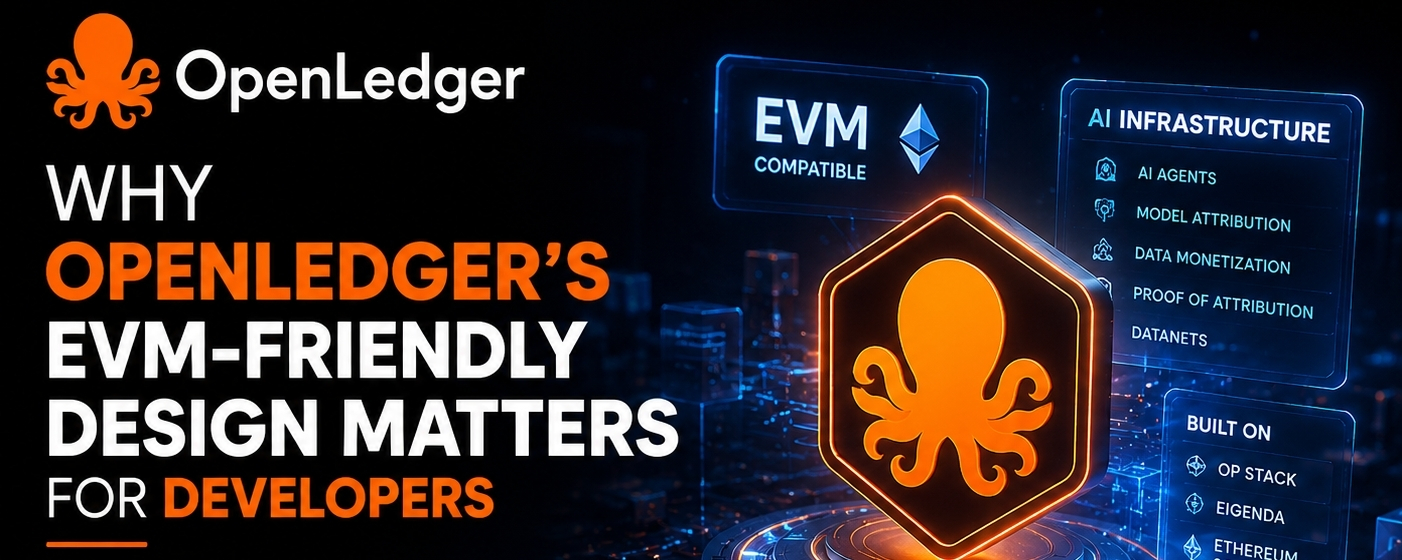
@Not every blockchain problem needs a brand new programming model. Sometimes the smarter move is reducing friction instead of reinventing every layer. And honestly… that seems to be what @OpenLedger is trying to do with its architecture around Ethereum compatibility, OP Stack, EigenDA, and Ethereum settlement.
The AI narrative in crypto has become crowded very quickly. Every week there’s another protocol promising decentralized intelligence, model ownership, data monetization, or AI-native infrastructure. But a surprising number of these projects accidentally create too much complexity for builders.
They introduce unfamiliar virtual machines.
New languages.
New wallet standards.
New tooling.
Different deployment logic.
Completely separate ecosystems.
And then everyone wonders why developer activity slows down after the initial hype cycle.
EVM compatibility might sound boring compared to “autonomous AI economies,” but boring infrastructure decisions are usually the ones that determine adoption curves.
Solidity still dominates smart contract development. Ethereum tooling still dominates workflows. MetaMask is still the default wallet for huge parts of crypto. Hardhat, Foundry, Remix, ERC standards, Layer 2 deployment habits… developers already built years of muscle memory around these systems.
that part matters more than people think.
If an AI-focused blockchain forces developers to abandon all of that just to experiment with AI-native applications, many simply won’t bother. Especially experienced builders. Most teams optimize for speed and familiarity first.
OpenLedger seems to understand this tradeoff.
By staying EVM-compatible while building AI-focused infrastructure like Datanets, Proof of Attribution, model contribution tracking, and data monetization layers, the project lowers the mental overhead for Ethereum-native developers. A Solidity team can theoretically move faster because the environment already feels familiar.
That’s strategically important.
There’s also a deeper point here people sometimes miss: AI infrastructure itself needs composability. AI agents won’t operate in isolation forever. They’ll probably need access to liquidity, DeFi rails, identity systems, stablecoins, governance layers, and cross-chain settlement.
Ethereum already has those ecosystems.
So when OpenLedger talks about Ethereum settlement and modular infrastructure using OP Stack and EigenDA, it feels less like marketing language and more like an attempt to anchor AI systems into existing crypto liquidity networks instead of building another isolated chain nobody uses.
Still, EVM compatibility alone is definitely not enough.
And this is probably where the real test begins.
Almost every new chain now claims to be EVM-compatible. At this point it’s basically expected infrastructure. Developers hear “EVM support” the same way users hear “fast transactions.” It’s useful, but not differentiating by itself anymore.
The harder question is whether OpenLedger can actually build tooling developers want to use repeatedly.
Because AI infrastructure gets complicated very fast.
Model attribution sounds good conceptually, but attribution systems need to work cleanly under real network conditions. Data monetization sounds exciting too, but the incentive layers have to be practical, not theoretical. Developers need APIs, SDKs, indexing systems, debugging environments, reliable data availability, documentation that doesn’t feel half-finished, and onboarding that takes hours instead of weeks.
Otherwise even strong narratives fade.
I also think AI-native applications introduce a different type of pressure compared to traditional DeFi apps. AI workloads evolve rapidly. Models change constantly. Data pipelines shift. Throughput requirements become unpredictable. So scalability discussions around EigenDA and modular infrastructure probably matter more here than they do for simpler financial applications.
And honestly… crypto still hasn’t fully proven that decentralized AI infrastructure can outperform centralized alternatives in day-to-day usage.
That uncertainty is real.
OpenAI, Anthropic, and other centralized systems still dominate because they’re easy to use and deeply optimized. Decentralized AI projects need to compete on developer experience too, not just ideology. Builders won’t tolerate unnecessary friction simply because something is “more decentralized.”
That’s another reason why familiar Ethereum tooling helps.
Reducing friction is underrated strategy.
A developer who already understands Solidity, Ethereum wallets, ERC standards, L2 deployment flows, and existing EVM tooling can experiment with AI-focused products on OpenLedger without feeling like they entered a completely foreign environment. The barrier becomes lower psychologically and technically.
sometimes adoption is just momentum plus convenience.
I’m also curious how OpenLedger evolves its Datanets concept over time. If data contribution, attribution, and monetization actually become programmable primitives instead of abstract ideas, that could create interesting incentives for AI agents and autonomous applications. Especially if builders can compose those systems directly with existing Ethereum infrastructure.
That intersection feels more interesting to me than pure AI hype.
Not because it guarantees success. Nothing does in crypto. But because it aligns with how developers usually behave in practice.
They follow usable infrastructure.
They follow tooling.
They follow ecosystems that save time.
Narratives attract attention first. But workflows keep ecosystems alive.
And maybe that’s the bigger point here.
The future AI chains that survive probably won’t be the ones with the loudest branding. They’ll be the ones that quietly make developers feel productive from day one.
@OpenLedger seems aware of that reality. Whether it can fully execute on it is still an open question. But at least the direction makes sense.
In this market, practicality tends to outlast hype.
