
I have been sitting on this for a while because I wanted to make sure I actually understood what #OpenLedger is doing before writing about it. Too many people in this space write about projects after reading a one-pager. I did not want to do that here.
The thing that got my attention first
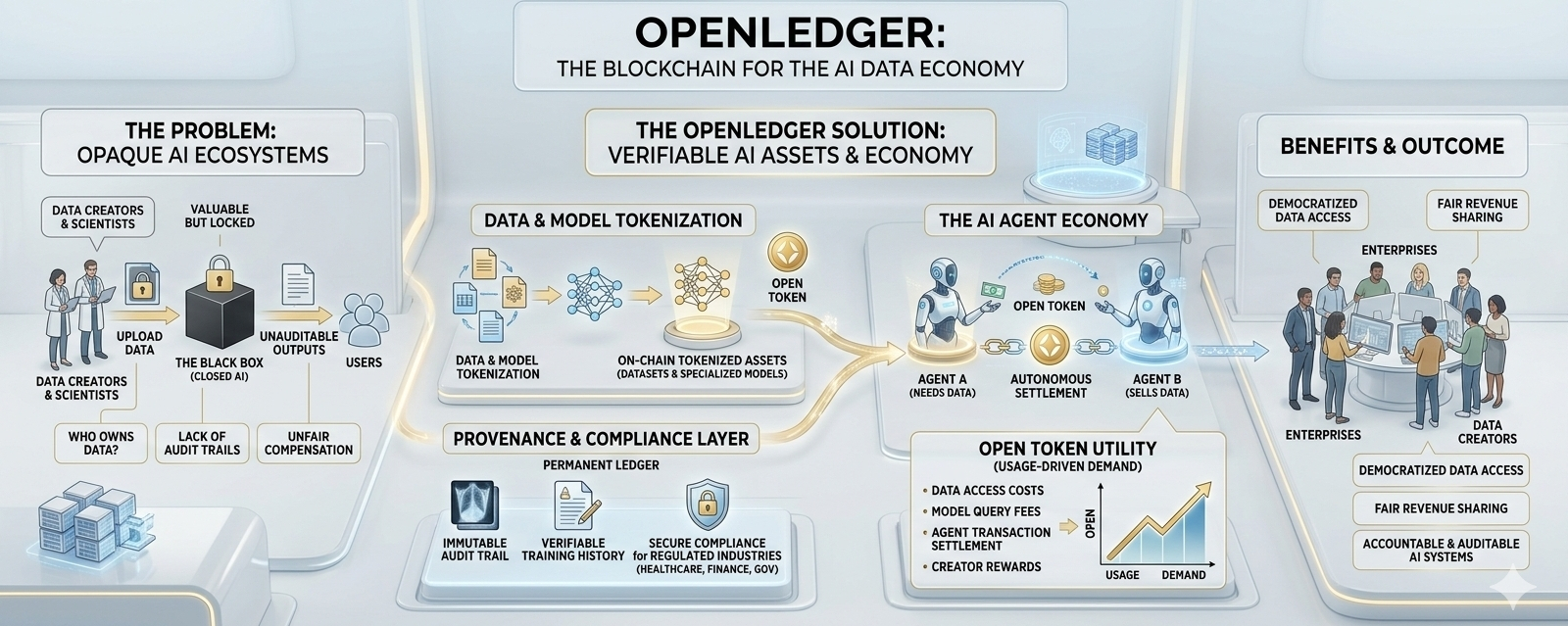
So the basic pitch is this. OpenLedger is a blockchain built specifically for AI. Not "AI-powered" in the way every project calls itself AI-powered. It is literally designed to be the financial layer for AI assets. Data, models, agents. All of it tokenized, traded, and settled on-chain using the OPEN token.
And when I first read that, I thought okay, another AI blockchain. There are dozens. But then I kept reading and something clicked for me.
The problem OpenLedger is solving is not a crypto problem. It is an AI problem that nobody has fixed yet. Who owns the data that trained the model you are using right now? Who gets paid when that model generates revenue? The answer today is almost always "not the person who created the data." That is a real problem. And OpenLedger is building the infrastructure to fix it.
What the project is actually doing on the ground
The way it works is pretty straightforward once you get past the technical language. Imagine you have a dataset. Rare medical imaging data, let us say, or a curated legal document library. Right now you have two options. You lock it up and nobody uses it, or you hand it to a big AI company and hope they treat you fairly. Neither option is good.
OpenLedger gives you a third option. You put your dataset on-chain as an asset. You set the terms. When someone uses it to train a model or query an agent, the OPEN token flows back to you automatically. No middleman. No hoping someone writes you a check. The protocol handles it.
Same thing for model developers. You build a specialized model, fine-tune it on proprietary data, and list it on OpenLedger. Every time someone licenses or queries it, you earn. The model becomes a revenue-generating asset instead of a project that just sits in a GitHub repo.
And then there are agents. This is the part I find most interesting personally. OpenLedger is building infrastructure for agents to transact with each other. Autonomously. Agent A needs data from Agent B. It pays in OPEN. The whole interaction gets recorded on-chain. That sounds futuristic but it is already becoming relevant in 2025 as enterprise AI deployments get more serious about accountability and audit trails.
Why I think the timing actually matters here
I have watched enough crypto cycles to know that timing in infrastructure is almost everything. The projects that define a category are rarely the smartest ones. They are the ones that showed up at the right moment with something good enough to become the default.
Right now the AI agent economy is moving from demo territory into real deployment conversations. Enterprises are asking hard questions about how to track what their agents are doing, who authorized transactions, and how to audit outputs. Those questions do not have clean answers today. OpenLedger is building toward those answers.
What I find genuinely interesting is that this is not a solution looking for a problem. The problem exists. It is just that most of the people experiencing the problem are not looking at blockchain infrastructure as the answer yet. When that perception shifts, the projects already building will have a real head start.
I want to be straight with you here because I think a lot of writing about tokens skips this part.
OPEN is not a governance token with some light utility sprinkled on top. The token has to move for the network to function. Data access costs OPEN. Model queries cost OPEN. Agent transactions settle in OPEN. That is a real demand driver if the network grows. But it also means the token's value is directly tied to whether people actually use the protocol, not just whether people are excited about it.
That is the honest version of the bull case. Usage drives demand. And right now the usage question is the one I keep my eye on most. Not the price. Not the announcements. Are real developers, enterprises, or independent AI builders actually running things through OpenLedger's infrastructure?
The incentives are designed well enough that I think adoption is possible. The data contributor rewards are generous in the early stages. The developer tooling is improving. And the agent transaction rails are addressing a need that is going to get louder every month as autonomous AI systems get deployed more widely.
One thing most people skip over
Here is something I have not seen written about much. OpenLedger is not just building a marketplace. It is building verifiability for AI assets.
This sounds boring until you realize how important it is. One of the biggest blockers for AI in regulated industries is the black box problem. You cannot prove where the training data came from. You cannot audit what the model was exposed to. You cannot verify the chain of custody for an AI output.
On-chain provenance fixes this. Every dataset has a verifiable origin. Every model has a recorded training history. Every agent transaction has an immutable log. That is not just a nice feature for crypto enthusiasts. That is a compliance answer for healthcare companies, financial institutions, and government agencies who want to use AI but cannot take the liability risk of opaque systems.
In my view, that is actually one of the more underappreciated parts of what OpenLedger is building. The crypto community focuses on the token. The enterprise world is eventually going to focus on the verifiability layer. Those two audiences meeting in the middle is where the real growth story lives.
I think OpenLedger is one of the more honest projects in this category. The problem is real. The token utility is real. The timing is not forced. And the team is building toward a future that is already arriving, not one they have to convince people is coming.
The question I sit with though is this. The data economy has been "about to change" for a decade now, with every new platform promising creators and contributors their fair share. What makes this time different? And is blockchain infrastructure finally the thing with enough teeth to actually redistribute value away from the platforms that have held it for so long?