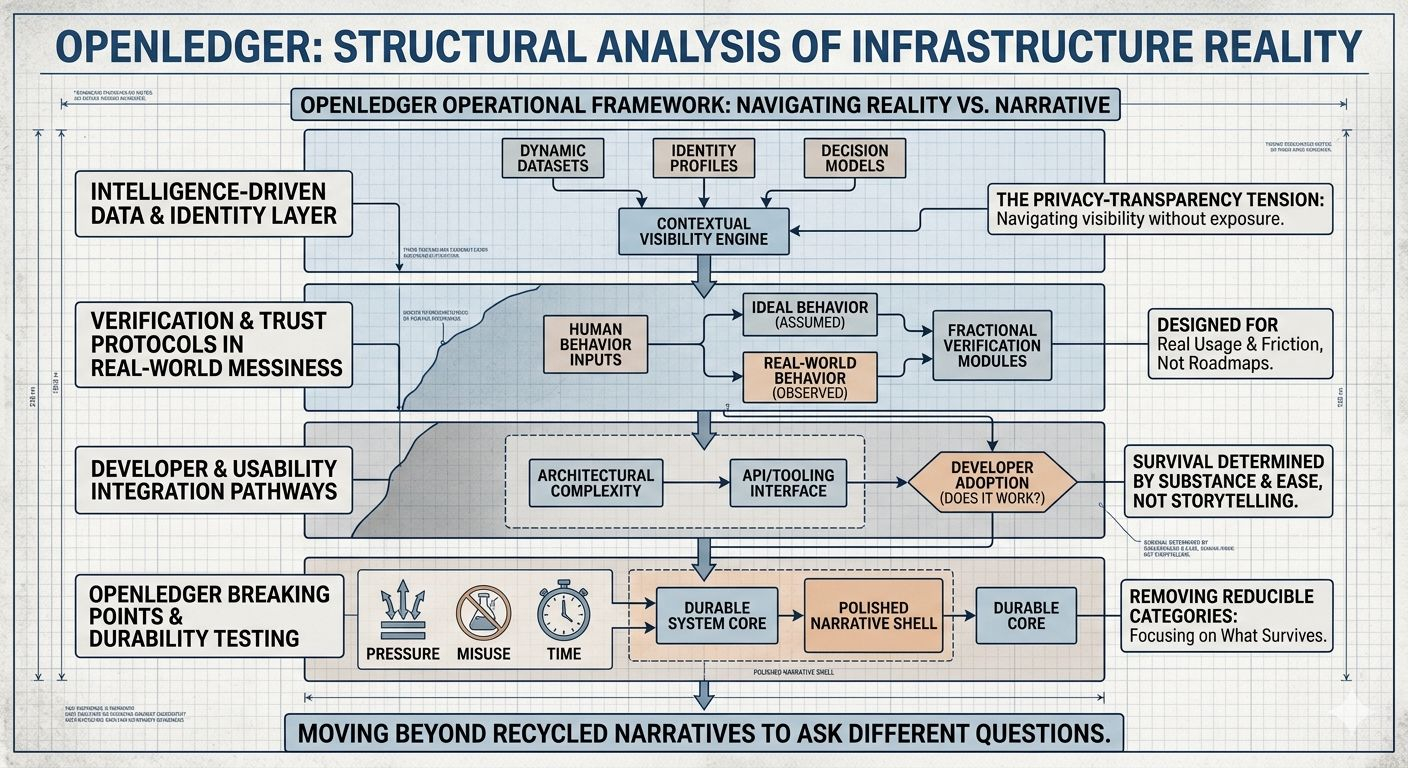
After spending years watching the same cycles repeat, I’ve started noticing how often entire industries end up speaking in slightly different versions of the same language. Every few months, a new narrative arrives wrapped in fresh branding, new terminology, and polished certainty, but underneath it all, the structure usually feels familiar. I keep seeing the same promises recycled until the words themselves almost stop meaning anything. OpenLedger is one of the few things that made me pause long enough to question whether I was looking at another recycled narrative or something trying to move in a different direction entirely.
What keeps pulling me back toward OpenLedger isn’t excitement. If anything, it’s hesitation. I’ve become skeptical of systems that sound too complete before they’ve faced real pressure. Most infrastructure stories sound convincing in theory because theory is easy to control. Reality isn’t. Real usage exposes weak assumptions faster than any roadmap ever will. That gap between ambition and actual adoption is something I’ve watched over and over again, and it rarely closes as neatly as people pretend it will. OpenLedger feels interesting to me mostly because I still can’t fully reduce it into a clean category, and that uncertainty feels more honest than polished certainty.
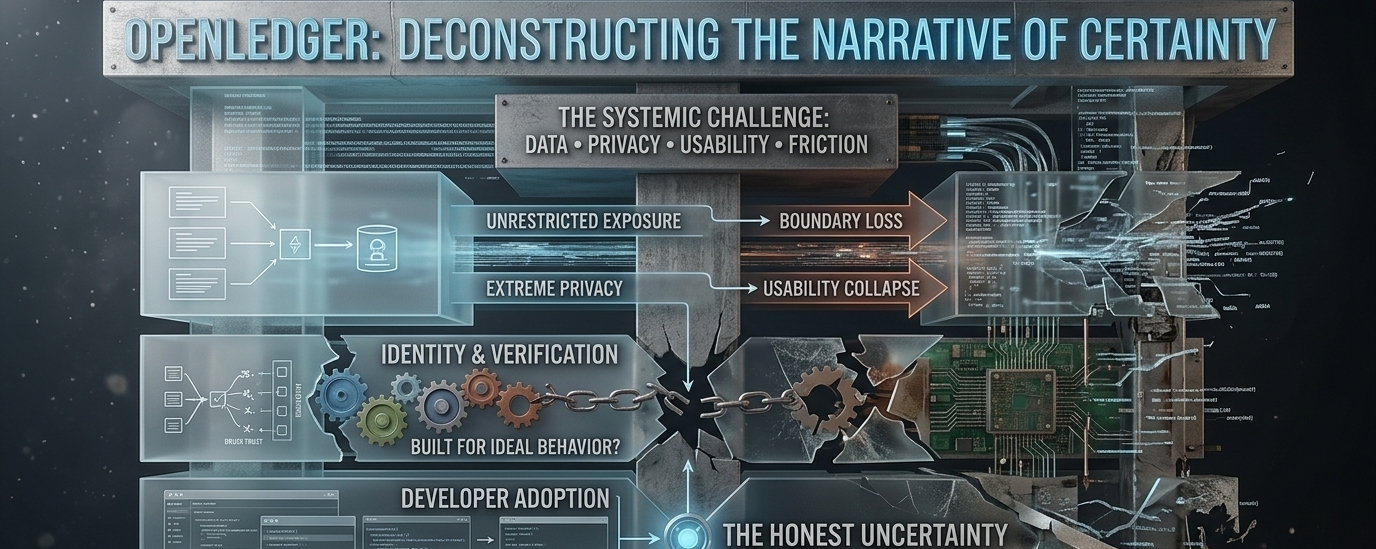
One thing I’ve grown tired of is how the industry keeps forcing this strange choice between transparency and privacy, as if those are the only two states systems can exist in. Either everything becomes visible and exposed to the point where basic boundaries disappear, or privacy solutions become so extreme that usability collapses and trust disappears alongside it. Somewhere along the way, too much exposure became normalized, even in places where it clearly shouldn’t have been. OpenLedger keeps making me think about that tension because intelligence-driven systems make those problems harder, not easier. Once data, identity, and decision-making start interacting dynamically, the old assumptions around visibility and trust begin breaking apart.
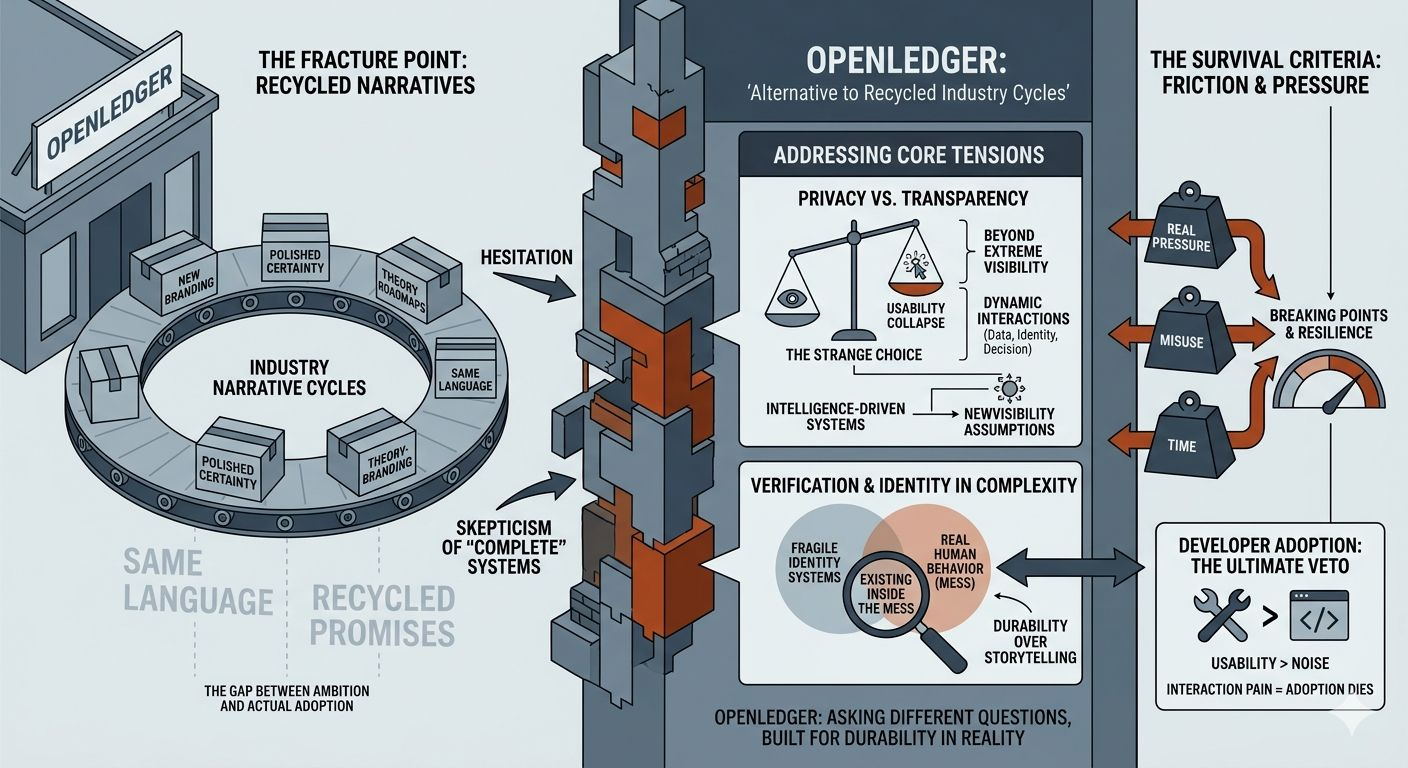
That’s also where I start noticing how fragile most verification and identity systems still are. People talk about trust as if it’s already solved infrastructure, but from where I’m standing, it still feels messy and unreliable. Most systems seem designed around ideal behavior rather than real human behavior. OpenLedger interests me because it feels like it’s trying to exist inside that mess instead of pretending the mess isn’t there. I don’t know if that works yet, but at least it acknowledges the complexity instead of hiding it behind marketing language.
A lot of projects also forget something surprisingly basic: developers usually determine whether systems survive. You can build the most ambitious architecture imaginable, but if interacting with it feels painful, adoption quietly dies long before the public notices. OpenLedger makes me think about that because so much infrastructure today feels built for storytelling first and usability second. The market keeps rewarding noise over substance, polished narratives over durable systems, and eventually I stopped trusting projects that sound too smooth too early.
That’s probably why I keep watching OpenLedger carefully without fully committing to a conclusion. I’m less interested in promises now and more interested in breaking points. I want to see what survives friction, pressure, misuse, and time. Maybe OpenLedger becomes meaningful. Maybe it doesn’t. But at least it feels like it’s asking different questions, and lately, that matters more to me than hearing the same answers repeated again.