
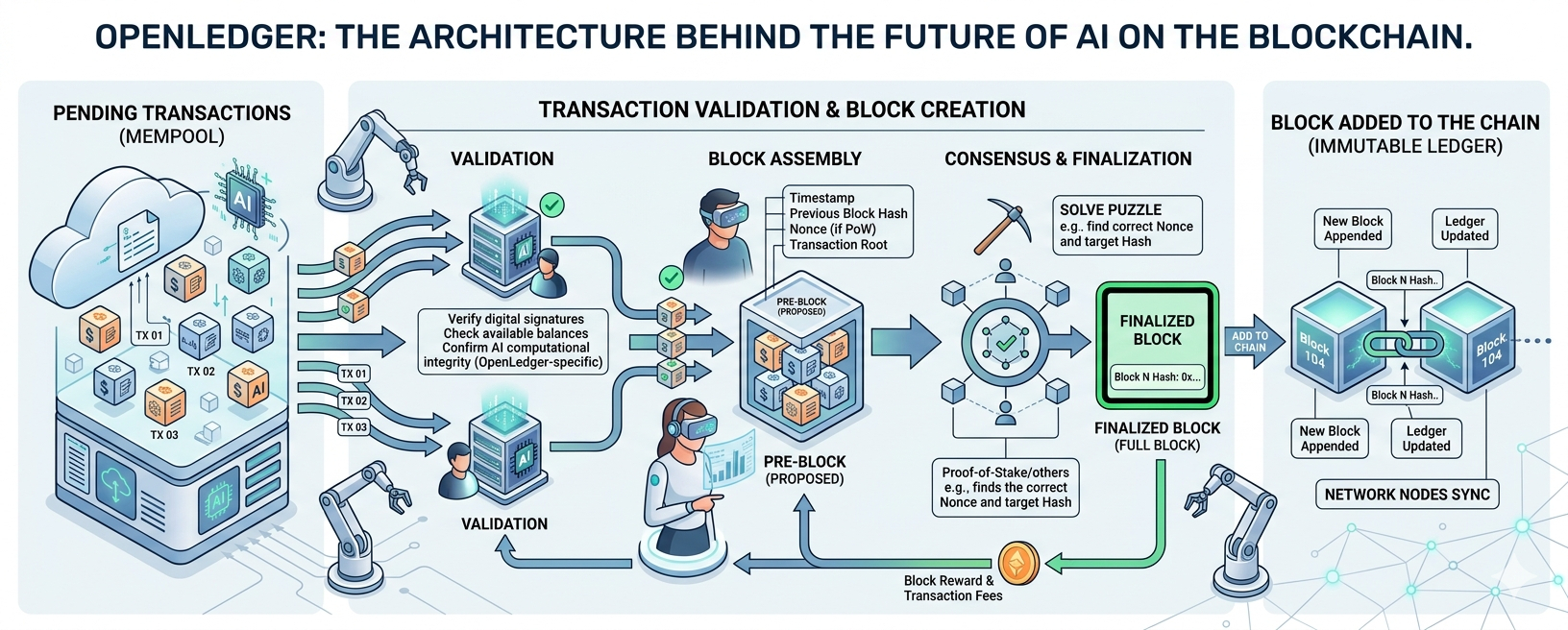
OpenLedger is the architecture behind the future of intelligence on the blockchain. When I first came across OpenLedger I did not just see another blockchain project trying to get attention in a market. I saw something that was different something that was made to serve a purpose. The more I learned about its foundation the more I understood why this matters so much to the future of artificial intelligence and decentralized infrastructure.
OpenLedger is a blockchain that is made for intelligence. It is built on Ethereum Layer-2 using the OP Stack and EigenDA technology. From the start I could see that this was not a general-purpose chain that added artificial intelligence capabilities later on. This was a platform that was made to support the artificial intelligence lifecycle from getting raw data to deploying models and verifying outputs. You can see this intention in every layer of its design.
The performance benchmarks of OpenLedger are really impressive. It can handle over 15,000 transactions per second thanks to sharding and off-chain computing. This is optimized for the demands of artificial intelligence workloads. Most blockchains struggle to reach these numbers under normal conditions.. Openledger achieves them easily because it knows that artificial intelligence needs high-bandwidth environments.
What really caught my attention was the Proof of Attribution system. This is a framework that records which datasets and models contributed to any given artificial intelligence output. This creates a chain of credit and accountability that makes it possible to distribute rewards transparently and verifiably on the blockchain. I have seen the artificial intelligence industry struggle with attributing value to contributors, such as data providers and researchers. OpenLedger has built a solution to this problem into its consensus architecture.
OpenLedger also has data provenance, which means it keeps track of all changes to datasets and models. This is like a version control system, where every iteration and update is traceable and timestamped. This level of transparency is much needed in the intelligence industry. What is more compelling is that OpenLedger does not compromise on security or developer familiarity to deliver these capabilities. It uses EVM- infrastructure, which means developers can build on a stack they already know without sacrificing performance or decentralization.
Every action on OpenLedger whether it is uploading data or recording an output is. Settled on the blockchain. As someone who believes in accountability I think this commitment to transparency is not just impressive, but necessary for the future of intelligence. OpenLedger is a blockchain that is made for the future of intelligence and it has the potential to make a real difference. OpenLedger is the key to unlocking the potential of artificial intelligence, on the blockchain.