OpenLedger: Must Know 👇
With AI increasingly concentrated among a few tech giants and built largely on uncredited public data, the need for a transparent, decentralized AI economy is critical. Enter OpenLedger, the world's first blockchain purpose-built for the AI economy.
Launched on Binance in September 2025, it is designed to rewire the entire infrastructure, promising a future where contributions are tracked, credited, and fairly rewarded.
⚙️ Purpose & Value: Enabling a "Payable AI" Economy
OpenLedger's core mission is to dismantle the "black box" of AI, making every step—from data contribution to model output—visible and monetizable. Its native OPEN token is the fuel for a new data economy, used for gas fees and governance, and as a reward mechanism that directly compensates contributors.
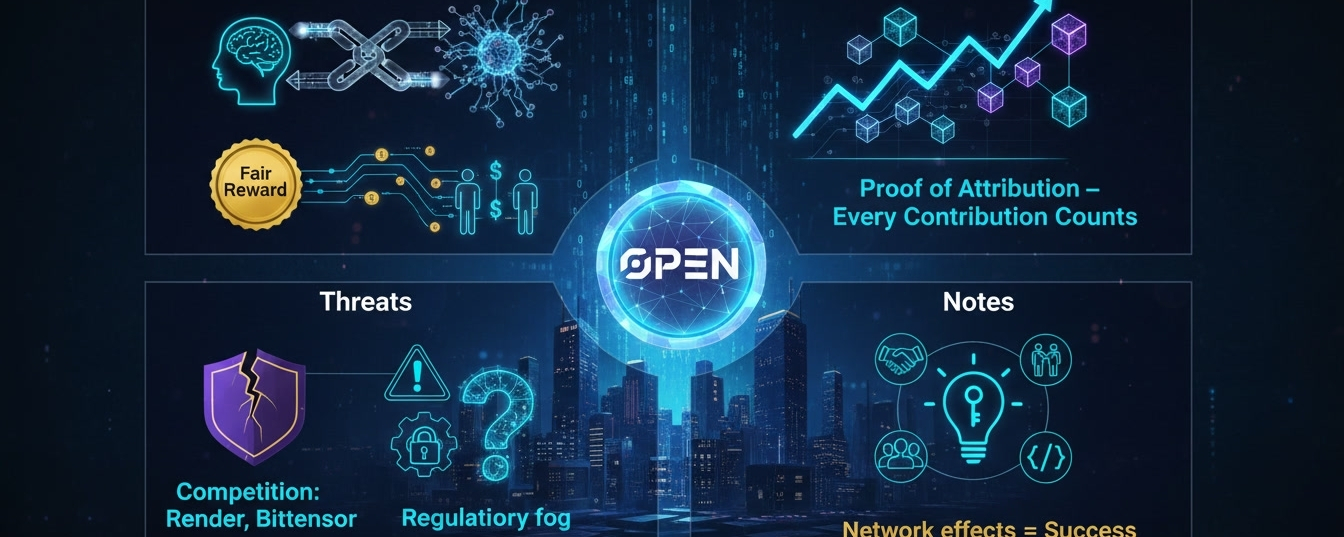
At its heart is the Proof of Attribution system, which tracks the lineage of each data point, model, and AI agent on-chain. This provides a transparent ledger that compensates creators with micro-payments whenever their data is used. The platform also includes OpenLoRA for cost-effective model deployment, democratizing AI for a much wider range of developers.
💻 Dual-Layer Infrastructure
To balance efficiency and security, OpenLedger uses a dual-layer architecture: an off-chain layer for high-performance AI inference and an on-chain layer for settling and verifying outputs. This secure, verifiable design ensures the complex process of tracking AI contributions doesn't slow the system down, making a large-scale "Payable AI" economically viable.
⚠️ Threats & Challenges
Despite its promise, OpenLedger faces a fiercely competitive landscape. It must carve out a distinct niche against established players like Render, Bittensor, and Fetch.ai. Major hurdles include ensuring strong quality control to prevent low-quality data from degrading AI models and overcoming scalability issues.
🔮 The Author's Outlook
In my analysis, OpenLedger tackles a fundamental, systemic injustice: the growing divide between AI's immense value creation and the lack of compensation for its human contributors. Its ambitious vision is a crucial step toward building a more equitable and transparent AI-driven future. However, success depends on more than just groundbreaking technology. The critical test will be its ability to attract a vibrant community of developers and users to create sustainable network effects. While the project has the potential to be a foundational layer for decentralized intelligence, navigating the financial and legal risks of a highly volatile asset class in a complex regulatory environment will be paramount.