
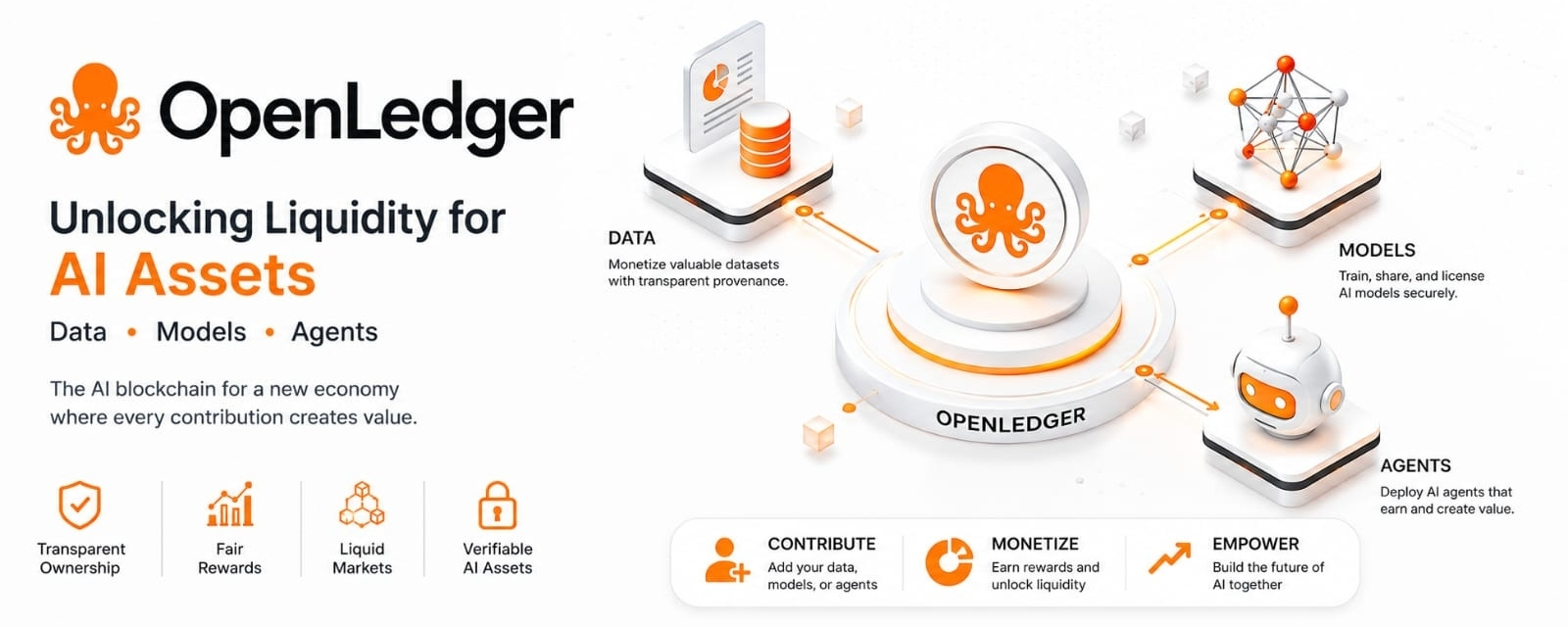
OpenLedger is one of those projects I don’t want to over-romanticize.
It’s about data, models, and AI agents.
That already sounds like the kind of sentence crypto people abuse until it means nothing.
But look, the problem underneath it is real.
AI is eating the internet, and nobody really knows how value should move through that mess. Data gets used. Models get trained. Agents get built. Someone creates value somewhere in the middle, and by the time money shows up, the original contributor is usually invisible.
That’s the ugly part.
Not exciting.
Just ugly.
OpenLedger is trying to build infrastructure around that. Not the shiny kind. More like plumbing. The boring layer under the hood that tries to track who contributed what, what gets used, and how value should move around data, models, and agents.
And honestly, that makes sense.
Because crypto has already taught us what happens when there is no proper tracking. Fake users. Fake volume. Fake activity. Airdrops farmed by bots. Protocols pretending they have demand when they mostly have wallets chasing rewards.
We’ve all seen it.
Some of us participated.
Some of us got dumped on.
Most of us learned the same lesson: incentives without proof turn into garbage.
That’s why OpenLedger is interesting to me. Not because it has “AI blockchain” attached to it. That phrase alone almost makes me want to close the tab. But because AI is heading into the same mess crypto already knows too well.
Who owns the data?
Who gets paid when a model improves?
Who benefits when an agent starts producing useful work?
Who verifies that anything useful even happened?
These are not cute questions. They matter.
The thing is, blockchain can help with records, ownership, access, payments, and coordination. It can create a system where AI assets are not just locked inside private platforms. That part is worth paying attention to.
But it won’t magically fix the hard stuff.
A ledger can show that something happened. It cannot automatically prove that a dataset is good. It cannot guarantee that a model is reliable. It cannot stop people from trying to farm the system. And if rewards are involved, people will absolutely try to farm the system.
That’s crypto nature.
Give people an incentive and someone will build a script before breakfast.
So OpenLedger has a hard job.
It has to build infrastructure that actually works, not just another place where low-quality data, weak models, and fake AI agents come to look valuable. If it gets that wrong, the whole thing becomes another marketplace full of noise.
And we already have enough noise.
The OPEN token also needs to earn its place.
I don’t care how nice the narrative sounds. The token has to do something real. It has to be tied to usage, coordination, access, security, or incentives in a way that actually matters. Otherwise, it’s just another ticker wearing an infrastructure costume.
Crypto has plenty of those.
Honestly, the most interesting part of OpenLedger is also the least glamorous part. It is trying to deal with the boring economic layer of AI. Who contributes. Who uses. Who pays. Who earns. Who verifies.
That is not flashy.
It’s just necessary.
And maybe that’s why it feels more serious than the usual AI hype. Real infrastructure usually doesn’t look exciting at first. It looks complicated. Slow. Annoying. Easy to ignore until something breaks.
Bridges were like that.
Gas was like that.
Airdrop systems were like that.
Everyone ignored the plumbing until the plumbing failed.
OpenLedger is pointing at a similar kind of problem inside AI. The value is growing, but the rails around it are still messy. If data, models, and agents really become economic assets, then someone has to build better rails for them.
Maybe OpenLedger can do that.
Maybe it can’t.
It will take time. It will be hard to build. Adoption will not come just because the idea sounds good. AI builders need a reason to use it. Data owners need a reason to trust it. Users need a reason to care. And the system needs to prove that it can handle real value without becoming another farm.
That is the real test.
Not the branding.
Not the AI label.
Not the token chart.
For now, I see OpenLedger as one of those projects sitting in the uncomfortable middle. The problem is real. The solution is ambitious. The risk is obvious.
And that’s probably the honest take.
It might become useful infrastructure.
It might become another crypto experiment that sounded better in theory.
I don’t know yet.
But I do know this: if AI keeps growing, the mess around data, models, and agents will only get worse. And if OpenLedger can bring some order to that mess without drowning in its own incentives, then it might actually matter.
Not in a loud way.
In a plumbing way.
Which, in crypto, is sometimes the only thing that survives.