
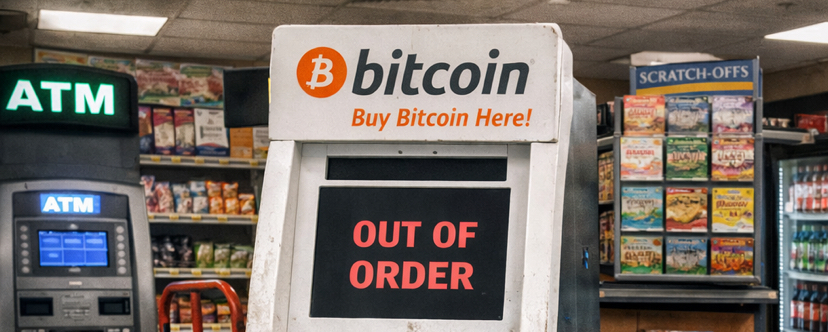
A guy walks into a gas station with cash, pays a disgusting spread, scans a wallet, gets $BTC , walks out.
That was the product.
Not elegance. Not low fees. Not institutional custody. Just frictionless access:
cash in, coin out.
No Coinbase onboarding.
No bank asking questions.
No compliance queue deciding whether your account “looks normal.”
The entire Bitcoin ATM model depended on impulse transactions surviving long enough to justify the ugly economics.
Then the friction arrived.
Lower transaction limits.
More KYC.
Fraud screens.
AML reviews.
Lawsuits.
Local bans.
Operators treated less like kiosk vendors and more like money transmitters sitting under a spotlight.
The machine still sits in the corner of the store, but the flow is dead.
The customer now has to stop, scan ID, read warnings, verify information, hit smaller limits, and wonder whether the operator is about to get shut down anyway.
That kills the original use case.
Now there are 9,000+ machines offline.
And this is where the story becomes physical.
A dead Bitcoin ATM is not an app feature you sunset.
It is a bolted steel box sitting next to scratch-off tickets and soda coolers.
Somebody still has to:
— unbolt it
— move it
— ship it
— store it
— scrap it
— terminate contracts
— settle merchant disputes
— handle support calls nobody wants anymore
That overhead does not disappear just because transaction volume collapses.
Meanwhile the numbers got ugly fast.
$BTM dropped more than 20% overnight after already losing roughly 42% the week before.
Revenue fell 49.2% year-over-year.
The company swung to a $9.5M net loss.
And when a physical network loses half its revenue, the fixed costs become lethal.
Rent share still exists.
Technicians still cost money.
Cash logistics are still painful.
Fraud review does not get cheaper because fewer customers show up.
The Chapter 11 filing in the Southern District of Texas simply formalized what the machines were already saying.
The real problem is simpler:
Bitcoin Depot built a business that required transaction volume to survive…
then entered a regulatory environment where transaction volume itself became the liability.
The old bull case was scale.
More locations → more access.
More access → more transactions.
More transactions → spreads cover overhead.
But compliance inverted the model.
Now more locations mean:
— more machines to maintain
— more jurisdictions to monitor
— more merchant relationships
— more regulatory exposure
— more places where a lawyer or regulator can create a problem
That is how a moat turns into dead weight in real time.
The machine did not stop working because Bitcoin failed.
It stopped working because the cash-to-crypto gray zone that made the economics viable started getting regulated like finance infrastructure.
And finance infrastructure is expensive.
Someone still has to get a wrench under those bolts.

