

Artificial intelligence is moving faster than almost anyone expected. New models appear every few months, companies race to build smarter systems, and investors continue pouring billions into the sector. But behind all the excitement sits a quieter issue that rarely gets enough attention: AI depends heavily on human-created data, yet the people behind that data are usually disconnected from the value it produces later.
That gap is exactly where OpenLedger is trying to position itself.
OpenLedger, powered by the OPEN token, is an AI-focused blockchain project built around the idea that data should not simply disappear into centralized systems without transparency, attribution, or compensation. Instead, the network aims to create an environment where datasets, AI models, and autonomous agents can be tracked, verified, and monetized in a more open way.
It is an ambitious concept, but also a timely one.
The conversation around artificial intelligence is slowly changing. A year ago, most discussions focused purely on capability — which model was faster, smarter, or more powerful. Now the focus is becoming broader. Questions about ownership, data rights, transparency, and accountability are beginning to matter just as much as raw performance.
OpenLedger seems designed around that shift.
The AI Industry Has a Data Problem
Most people interact with AI every day without thinking much about what powers it underneath. A chatbot answers a question, an image generator creates artwork, or an AI assistant automates a task in seconds. The process feels seamless from the outside.
What users rarely see is the enormous amount of information required to make those systems work.
Modern AI models are trained on vast collections of text, images, conversations, code, research material, and public content gathered from countless sources across the internet. In many cases, that information comes from ordinary people creating posts, articles, tutorials, discussions, or creative work online over many years.
The issue is not just that this data gets collected. The issue is that the flow of value is almost entirely one-directional.
Large companies build products using these massive datasets, generate revenue from AI services, and continue improving their systems through user interaction. Meanwhile, the original contributors behind the information rarely receive recognition, ownership, or ongoing participation in the economic value being created.
That imbalance has become one of the most uncomfortable realities inside the AI economy.
OpenLedger is attempting to build infrastructure around the idea that contribution should be measurable and rewardable rather than invisible.
Why OpenLedger Feels Different From Typical AI Crypto Projects
The crypto industry has seen an endless wave of AI-related tokens recently. Many projects use artificial intelligence as branding without offering much depth underneath. In some cases, blockchain and AI feel awkwardly connected, almost as if the technologies were combined mainly because both are trending.
OpenLedger approaches things differently.
Instead of focusing only on trading narratives or speculative hype, the project is centered on a specific problem: how to create transparent economic systems around AI development.
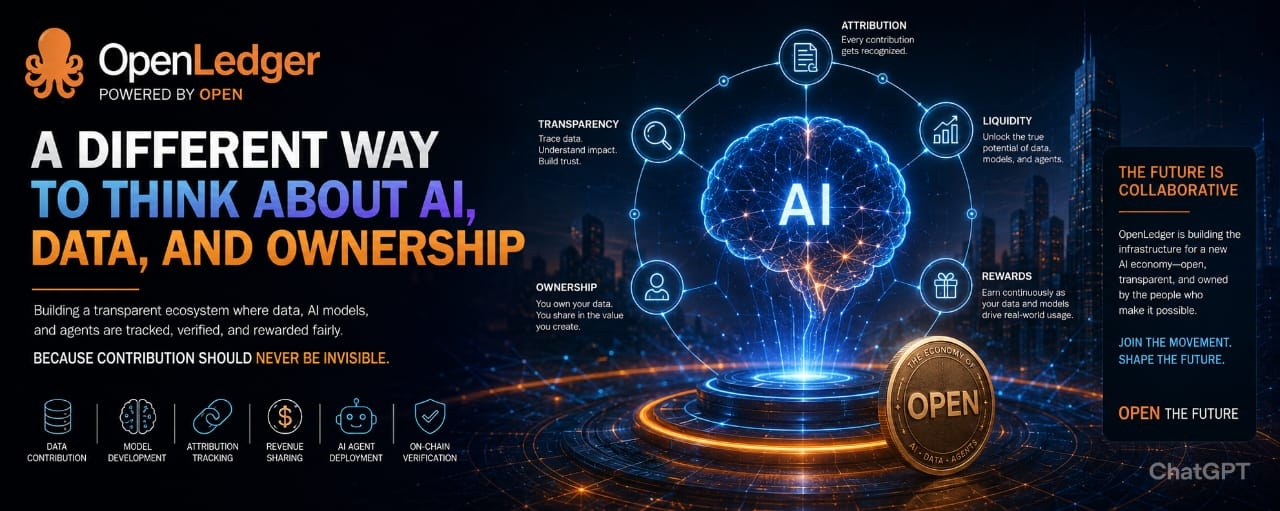
The network is designed to support several layers of the AI process, including:
Data contribution
Model development
Attribution tracking
Revenue sharing
AI agent deployment
On-chain verification
The important part is not simply that blockchain is involved. The important part is how blockchain is being used.
OpenLedger treats blockchain less like a payment system and more like a public record system. The goal is to make the relationships between data, models, and outputs visible instead of hidden behind centralized infrastructure.
That changes the conversation entirely.
The Core Idea Behind OpenLedger
At the heart of OpenLedger is the belief that data has long-term value.
Today, most platforms treat user data as something to collect once and monetize forever. Once information enters a centralized system, contributors lose visibility into how it is used later.
OpenLedger wants to create a different model where data contributors remain connected to the ecosystems they help build.
The project introduces attribution mechanisms designed to track how datasets influence AI models over time. In theory, if a particular dataset contributes meaningfully to a model’s capabilities, the people behind that dataset could continue receiving rewards as the model generates activity.
That concept may sound technical at first, but the underlying idea is actually simple.
If your contribution helps create something valuable, you should not disappear from the equation afterward.
This becomes especially important as AI moves toward specialization.
The next generation of AI systems will likely depend less on generic internet-scale information and more on carefully curated, domain-specific data. Medical AI needs reliable healthcare information. Legal AI needs accurate legal data. Financial AI depends on specialized market knowledge.
Those datasets are difficult to build and extremely valuable.
OpenLedger appears to recognize that the future AI economy may revolve around trusted information ecosystems rather than raw data volume alone.
The Meaning of “Data Liquidity”
One phrase frequently associated with OpenLedger is “unlocking liquidity” for data, models, and AI agents.
It sounds complicated, but the idea behind it is fairly practical.
In traditional systems, datasets often sit inside private silos controlled by large organizations. They are difficult to access, difficult to monetize independently, and usually disconnected from the people who contributed to them.
OpenLedger wants to make those resources more active and interconnected.
Instead of static datasets sitting unused after collection, the project imagines a network where data continuously participates in AI economies. Developers can build models on top of community-owned information. Users interact with those models. Contributors potentially receive ongoing rewards tied to usage and influence.
The entire system is designed to create movement around AI resources rather than concentrating control in a few centralized platforms.
Whether the model scales successfully remains uncertain, but the direction reflects a larger trend happening across technology right now: people increasingly want visibility into how digital value is created and distributed.
Transparency May Become More Important Than Speed
For years, the AI industry focused almost entirely on capability. The fastest and most powerful models attracted the most attention. But as AI systems become more deeply integrated into business, finance, education, healthcare, and public infrastructure, another issue is becoming impossible to ignore — trust.
People want to know where information comes from.
Governments want accountability around training data and model behavior.
Creators want clarity around ownership.
Businesses want systems they can audit and understand.
OpenLedger positions transparency as part of the infrastructure itself rather than an optional feature added later.
That approach could become increasingly important over time.
Many existing AI systems operate like black boxes. Users interact with outputs but cannot easily trace the origins behind them. OpenLedger’s blockchain-based structure attempts to make those relationships more visible and verifiable.
That does not automatically solve every problem, but it does represent a different philosophy from the dominant centralized AI model most people are used to today.
The Role of OPEN
The OPEN token functions as the economic layer of the ecosystem.
It is intended to support transactions, model interactions, contributor rewards, validator incentives, and various activities across the network. Rather than existing purely as a speculative asset, the token is tied to usage inside the broader OpenLedger infrastructure.
That distinction matters.
Many crypto projects struggle because their tokens have weak utility beyond trading activity. OpenLedger is clearly attempting to connect OPEN to actual participation inside AI systems and data economies.
Of course, building sustainable token ecosystems is difficult. Long-term success depends less on whitepapers and more on whether developers, contributors, and businesses genuinely adopt the platform over time.
Real utility is always harder than marketing.
The Bigger Conversation Around AI Ownership
What makes OpenLedger interesting is not only the technology itself but also the larger conversation surrounding it.
Artificial intelligence is creating enormous economic value, yet the structure of that economy remains highly centralized. A small number of companies currently control most of the infrastructure, computing power, and commercial AI systems shaping the industry.
Projects like OpenLedger represent an attempt to imagine a more distributed alternative.
The idea is not necessarily to replace major AI companies overnight. Instead, it is about building systems where participation, contribution, and ownership can become more transparent and more accessible.
Whether that vision succeeds is still unknown.
The project faces serious challenges, including adoption, scalability, competition, and the complexity of coordinating decentralized AI ecosystems. But the questions OpenLedger raises are becoming increasingly relevant across the entire technology industry.
Who owns AI-generated value?
Should contributors benefit when their data helps build successful systems?
Can AI become more transparent without sacrificing innovation?
And as artificial intelligence grows more powerful, who should control the infrastructure behind it?
These are no longer niche crypto discussions. They are becoming central questions about the future of digital economies.
Final Thoughts
OpenLedger arrives at a moment when both AI and blockchain are searching for deeper purpose.
Artificial intelligence is expanding rapidly but facing growing criticism around ownership, transparency, and data usage. Blockchain technology continues looking for applications that extend beyond speculation and financial trading.
OpenLedger attempts to connect those two worlds through a system focused on attribution, accountability, and shared participation.
Its vision is ambitious and far from guaranteed. Building decentralized AI infrastructure is technically difficult, commercially competitive, and still largely experimental. But unlike many short-lived AI token narratives, OpenLedger is at least addressing a real structural issue inside the modern AI landscape.
The project is built around a simple but important idea: the people and communities contributing to intelligence should not remain invisible once that intelligence becomes profitable.
As AI continues reshaping industries and digital life, that idea may become more important than many people currently realize.