
The Hidden Cost Behind a Simple Transfer
A user once moved assets from Ethereum to another chain expecting a cheap transfer because the bridge quote looked small. Minutes later, the final balance was lower than expected. The reason was simple: the visible bridge fee was only one part of the total cost.
Cross chain transactions rarely involve one payment. Most routes combine multiple actions across different networks and protocols. Each step adds its own cost, and many users only notice the first number shown on screen.
Why Cross Chain Costs Feel Confusing
Most cross chain workflows split fees into separate layers. One charge appears when the transaction begins, another is built into the bridge route, and another can appear after funds arrive on the destination chain.
The total cost usually comes from origin chain gas, provider fees, destination chain gas, DEX conversion fees, and slippage. Individually these costs may look small, but together they define the real price of moving capital across chains.
Understanding Chain Gas Costs
Gas is the most visible part of the process, but each blockchain handles it differently.
Ethereum remains one of the more expensive environments for swaps and bridge related activity. Base combines Layer 2 execution fees with Layer 1 security costs. BNB Chain and Polygon are generally cheaper, though transactions are never completely free.
Public trackers already show how different the cost structure can be between chains. Ethereum swap activity is noticeably more expensive than similar actions on Base or Polygon. That difference alone can influence the efficiency of a route.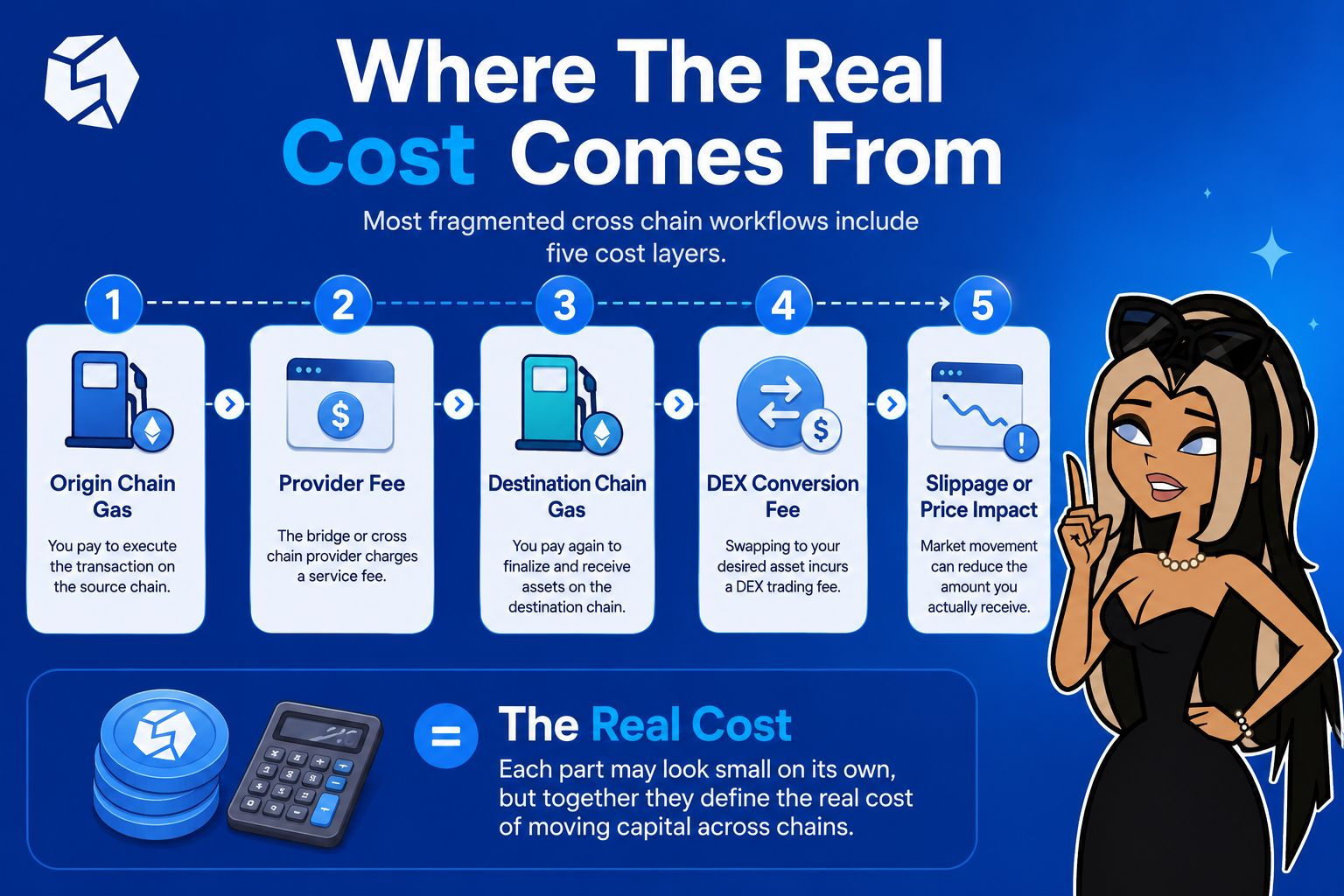
Provider Fees Are Often Hidden Inside the Quote
Bridge providers and cross chain protocols usually include service costs directly inside route estimates.
Some protocols explain these fees more transparently than others. Meson publicly describes a 0.05% protocol fee while also noting temporary waivers under certain limits. Symbiosis explains that gas costs are withheld during swaps and that pricing changes depending on route structure and chain combinations.
This is often where users lose visibility. The route can appear inexpensive because the provider fee is blended into the quote while additional costs remain outside the estimate.
The Destination Swap Still Matters
Many users think the process ends when assets arrive on the destination chain. In reality, the route often continues with another swap into the final asset they actually wanted.
That destination side conversion introduces another fee layer.
STON.fi documents explain that pool trading fees are configurable, with a default 0.3% structure split between liquidity providers and the protocol. Even outside the TON ecosystem, the broader lesson remains important: completing the bridge does not remove the cost of final execution.
Slippage Is the Most Overlooked Cost
Slippage rarely appears as a direct charge, but it still affects the final outcome.
Execution quality matters because users can receive less value than expected even when the transaction succeeds. STON.fi’s transaction parameter guide warns that swaps with price impact above 5% are usually disadvantageous.
That principle applies across decentralized trading. A successful transaction is not automatically an efficient one.
Looking at the Full Cost Stack
Before confirming a cross chain route, users should check current gas conditions on the source chain, understand provider fees, verify whether destination side actions are required, review DEX conversion costs, and monitor price impact.
The total of all these layers represents the actual swap cost, not the single number displayed during confirmation.
Final Thoughts
Cross chain transfers are becoming easier to use, but fee visibility still matters. Public gas trackers and protocol documentation help users understand where costs come from, yet the responsibility of calculating the full route often remains with the user.
As interoperability improves, products that combine fragmented actions into one transparent price may become easier for users to trust and compare.
Read more about cross chain infrastructure and trading tools at �https://blog.ston.fi/
𝐎𝐟𝐟𝐢𝐜𝐢𝐚𝐥 𝐑𝐞𝐬𝐨𝐮𝐫𝐜𝐞𝐬:
Official Site: ston.fi
Technical Documentation: docs.ston.fi
Analytics Dashboard: dune.com/stonfi
Follow for News: x.com/ston_fi
Community Chat: t.me/ston_fi