
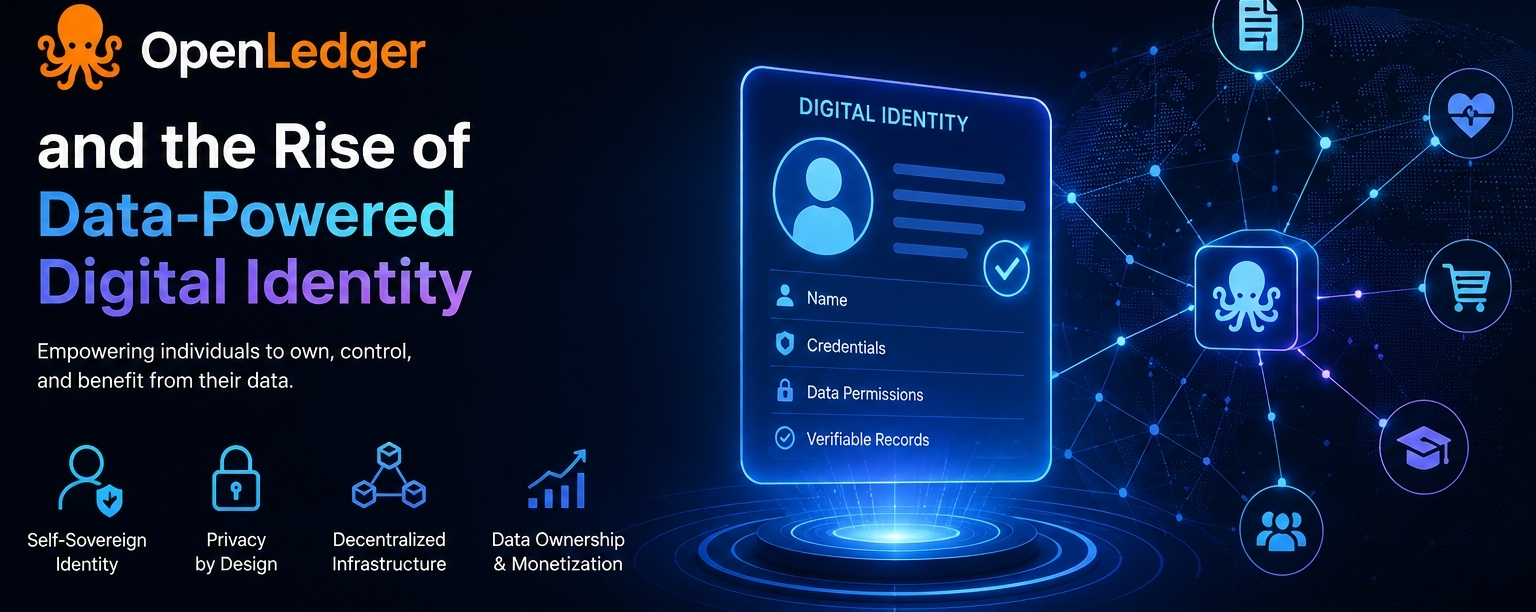
Identity has always played a central role in human society. Whether through passports, financial records, or online accounts, identity shapes access to services, opportunities, and trust. In today’s digital landscape, however, identity systems remain fragmented and heavily dependent on centralized authorities. Most importantly, they fail to recognize the true value behind identity: personal data.
@OpenLedger introduces a transformative vision where identities are strengthened, verified, and enriched through the data individuals create themselves—forming a decentralized and user-owned model of data-powered identity.
Traditional identity systems depend on intermediaries such as governments, banks, or digital platforms to issue credentials. These credentials are static in nature, representing only limited snapshots like ID cards, certificates, or social media profiles. They rarely evolve with a person’s experiences or contributions, and users often have minimal control over how their information is stored, shared, or monetized. OpenLedger aims to change this dynamic by enabling individuals to tokenize their datasets and connect them directly to self-sovereign identities.
A data-powered identity goes beyond basic verification. It becomes a dynamic and continuously evolving profile supported by authenticated data streams. For instance, a professional identity could include verified work records, certifications, or published achievements. Financial identities may integrate transaction activity and risk metrics secured on-chain. Health-related identities could draw from wearable devices, allowing users to selectively share biometric insights with healthcare providers or insurers. In every case, contributors maintain ownership of their data while benefiting transparently from its value.
Provenance and zero-knowledge proofs (ZKPs) are essential to this framework. Provenance ensures the authenticity and traceability of identity-related data, reducing the risk of fraud or manipulation. ZKPs add a privacy layer, enabling individuals to verify specific attributes—such as age eligibility, financial reliability, or wellness standards—without exposing sensitive underlying information. This balance between trust and privacy creates safer and more efficient digital interactions.
Data-backed identities also carry significant potential for global inclusion. Millions of people remain excluded from traditional systems because they lack formal documentation. However, many still generate valuable digital footprints through mobile activity, online participation, or financial transactions. OpenLedger’s infrastructure allows these data streams to become verifiable identity components, opening pathways to banking, services, and economic participation for underserved communities worldwide.
The economic possibilities are equally powerful. Data-backed identities could reshape industries such as lending, insurance, and personalized services by enabling fairer and more transparent assessment models. At the same time, individuals regain ownership over their digital presence instead of allowing platforms to profit from their data without consent.
In the end, OpenLedger’s vision of data-powered identity represents a shift in how recognition works in the digital age. Identity becomes dynamic rather than static, verifiable instead of fragmented, and empowering rather than exploitative. By combining tokenization, provenance, and privacy-preserving technologies, OpenLedger is building a future where digital identity is not only secure and decentralized, but also truly owned by the individual.