
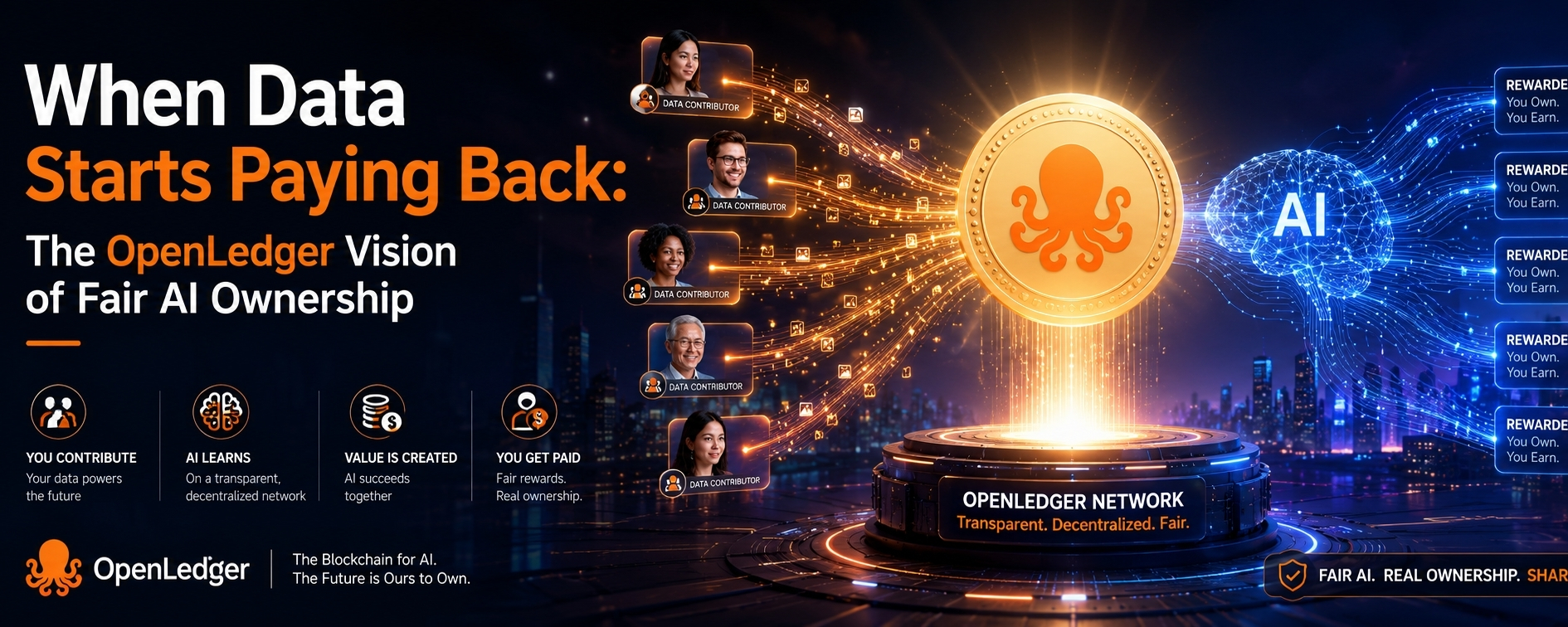
I find myself returning again and again to a strange imbalance in the AI world. I use these systems every day, I watch them generate language, code, ideas, even images that feel coherent and sometimes genuinely insightful, and yet I know something fundamental is being left unaccounted for underneath all of it. The intelligence feels immediate, almost weightless on the surface, but I also know it is built on years of human writing, labeling, behavior, and interaction that rarely gets acknowledged in any meaningful economic way.
That is where OpenLedger (OPEN) enters my thinking not as a polished solution, but as a question that refuses to disappear. It tries to imagine a world where data, models, and even AI agents are not just used and forgotten, but continuously traced and rewarded through blockchain-based attribution systems. I do not see it as a finished answer. I see it more like an attempt to redraw the invisible boundary between contribution and consumption in AI.
The idea sounds almost fair at first glance. If data helps train a model, why shouldn’t that contribution be recorded and compensated? If a model’s output is influenced by certain datasets or interactions, why shouldn’t that influence be measurable? OpenLedger’s approach to “Proof of Attribution” tries to answer exactly that by tracking how data influences outputs and distributing rewards back to contributors.
But the more I sit with that idea, the more complicated it becomes in my mind.
Because influence inside a neural network is not like a clean supply chain where I can point to a single part and say, “this is responsible for that output.” It is more like a diffusion of patterns across millions or billions of parameters. Even when attribution systems try to map contributions, what they produce is closer to a probabilistic story than a precise accounting of truth. And I have to ask myself whether I am comfortable building an economy on top of something that is fundamentally interpretive rather than exact.
Still, I cannot dismiss the appeal of what OpenLedger is trying to do. The current AI economy already feels uneven, just in a less visible way. Massive datasets scraped from the internet fuel billion-dollar models, while the original creators of that content rarely see any return. In that sense, the system is already extractive it just hides the extraction behind abstraction.
So I find myself stuck between two uncomfortable positions. On one side, I worry that monetizing every trace of data could turn intelligence into a constant financial transaction, where every interaction becomes something that needs to be priced and settled. On the other side, I also recognize that pretending data has no value is equally false. The value is already being captured it is just being concentrated.
OpenLedger’s attempt to introduce tokenized attribution through its OPEN token feels like an effort to formalize that hidden flow. In its design, tokens are not just speculative assets; they are supposed to function as the medium through which inference, data usage, and model contribution are all compensated. In theory, this turns AI into something closer to a circular economy, where value flows back to the people and systems that helped create it.
But I keep coming back to a deeper concern: fairness in systems like this is not just a technical problem, it is a philosophical one. I cannot fully agree on what “fair” even means in the context of machine learning attribution. Is it fair to reward someone whose data had a measurable influence, even if that influence is statistically diluted among millions of others? Is it fair to ignore contributors whose data was essential but not easily traceable? The more I think about it, the more I realize that attribution is not just measurement—it is interpretation disguised as measurement.
And interpretation is always political in some way.
I also think about how systems like this tend to evolve over time. I have seen enough technological cycles to notice a pattern: early decentralization often attracts idealists, but over time, control points emerge. Liquidity consolidates. Governance becomes uneven. The system begins to resemble the structures it was originally designed to avoid. OpenLedger is not immune to that trajectory just because it is built on blockchain infrastructure. In fact, blockchain sometimes amplifies the illusion of fairness while still allowing concentration to creep in through other layers.
What I find most interesting, though, is not whether OpenLedger will succeed in its current form, but what it reveals about how I already think about AI. I realize that I treat intelligence as something disembodied, as if it appears out of nowhere when I type a prompt. But it does not. It is built on a vast, messy history of human input, much of it uncompensated and unacknowledged.
So when I think about OpenLedger, I do not just think about a crypto-AI project. I think about whether it is possible to build a “receipt layer” for intelligence itself a way to trace how ideas form, how models respond, and how value is distributed across that chain of influence.
At the same time, I worry about what happens if we push that idea too far. If every contribution is tracked and monetized too precisely, intelligence might stop feeling like a shared cognitive space and start feeling like a marketplace of micro-transactions. That shift would not just be economic; it would change how thinking itself is experienced. I do not know if that is progress or distortion.
What I keep circling back to is this tension: I want AI systems to be fairer, more transparent, more accountable to the people whose data built them. But I also do not want intelligence to become so heavily financialized that it loses its openness, its unpredictability, its ability to feel like discovery rather than accounting.
OpenLedger sits right in the middle of that tension. It is neither purely visionary nor purely flawed. It is an attempt to make invisible labor visible, and in doing so, it forces me to confront a question I cannot easily resolve: if intelligence is built from everyone, then who exactly owns what it becomes?
