
Staking $SUI is simple enough. You lock your tokens with a validator, the validator helps secure the network, and you get a yield for doing it. Straightforward. But the moment you stake, your tokens disappear from the equation. You can’t trade them. Can’t use them as collateral. Can’t do anything with them until you unstake, which takes time.
That’s the deal traditional proof-of-stake has always offered. Earn yield, but pay for it with liquidity.
Haedal is built on Sui and lets users stake SUI tokens while getting back a receipt token, haSUI, that can be used across DeFi like any other asset. The staked tokens keep earning validator rewards. The haSUI token keeps moving. You don’t have to choose
@HaedalProtocol launched in September 2023 as the first liquid staking protocol on Sui mainnet. That timing matters. Sui was still early, the DeFi ecosystem on it was thin, and there was no native liquid staking infrastructure. Haedal walked in before anyone else had a real answer to the problem.
What actually happens when you stake
When users stake SUI into the Haedal smart contract, the protocol automatically allocates it to multiple stable-performing validators. Users instantly receive haSUI as a staking certificate.
haSUI isn’t pegged 1:1 to SUI. It appreciates over time as validator rewards accumulate. As of May 2025, the exchange rate for haSUI sat at approximately 1.055, reflecting accrued staking rewards since inception. So every haSUI you hold is worth a little more SUI than when you minted it, and the gap grows continuously.
The protocol handles validator selection in the background. Users can choose automated staking, where the protocol selects and balances validators for a one-click experience, or manual staking, where power users pick specific validators and optimize for APY and risk preferences.
Haedal also supports liquid staking of WAL tokens, the native token of Walrus Protocol, a decentralized storage network built on Sui, issuing haWAL in return through the same model.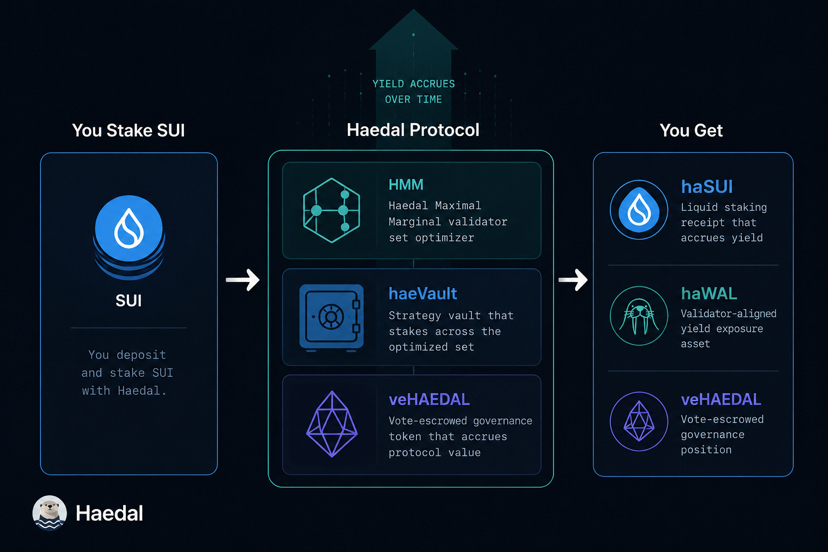
The part that makes it more than a staking wrapper
Liquid staking tokens are only useful if there are places to use them. Haedal understood early that haSUI sitting idle in a wallet doesn’t change the fundamental problem.
Potential integrations and utilities for haTokens include decentralized exchanges, lending and borrowing protocols, collateralized debt position protocols, and options trading platforms. Haedal is integrated with protocols like Cetus, Scallop, Navi, and others across the Sui ecosystem, which means haSUI has actual markets and lending desks behind it, not just theoretical utility.
But the more interesting move was building their own market-making infrastructure instead of just relying on external venues.
HMM: the in-house market maker
The Haedal Market Maker, or HMM, is an automated market maker designed to support haSUI and related pairs on Sui. Rather than relying on external liquidity providers, HMM uses protocol-owned liquidity to ensure tighter spreads, more reliable trading depth, and yield enhancement for haSUI holders.
The design solves a real problem. External liquidity providers have no particular reason to show up for haSUI markets when more profitable opportunities exist elsewhere. Protocol-owned liquidity removes that dependency.
HMM concentrates its liquidity within the most active trading ranges, minimizing slippage for traders and making capital work more efficiently than in traditional AMM pools. High-frequency price feeds keep pool pricing aligned with external markets, helping to limit impermanent loss.
HMM charges a 0.04% trading fee. Half of those fees are allocated to incentives that help boost haSUI yields. The rest splits between HAEDAL token buybacks and the protocol treasury. By February 2026, HMM had processed over $1.2 billion in cumulative trading volume and ranked as the third-largest AMM on Sui by daily volume.
haeVault: institutional strategies for regular users
haeVault brings professional-grade CEX market-making strategies to DeFi, allowing users to participate in sophisticated liquidity provisioning across decentralized exchanges.
The pitch is simple: the kind of concentrated liquidity management that professional market makers run on centralized exchanges is too technically demanding and time-intensive for most retail users to run themselves. haeVault packages those strategies and lets anyone deposit into them.
TVL in haeVault reached $7.2 million, with the product designed to make advanced yield strategies accessible without requiring active position management.
veHAEDAL: the governance and rewards layer
Users can obtain veHAEDAL by locking their HAEDAL tokens for a period ranging from 1 week to 52 weeks. The longer the lockup period, the higher the initial veHAEDAL amount received. At maximum lockup of 52 weeks, 1 HAEDAL equals 1 veHAEDAL at the time of locking. veHAEDAL balances decay linearly over time as the lockup approaches its end.
The decay mechanic matters. It means influence in the protocol is tied to ongoing commitment, not to a one-time decision. People who lock for longer have more voting weight and it decreases as their lockup winds down, creating a natural pressure to either extend or step back.
Every week, Haedal allocates 50% of its protocol yields, from liquid staking fees, HMM fees, and haeVault’s net profits, to buy back #HAEDAL tokens from secondary markets. One hundred percent of those bought-back tokens are distributed to veHAEDAL stakers proportionally to their balance.
That’s the flywheel they’re going for. Protocol revenue generates buybacks, buybacks go to committed stakers, committed stakers have governance power over the parameters that affect revenue.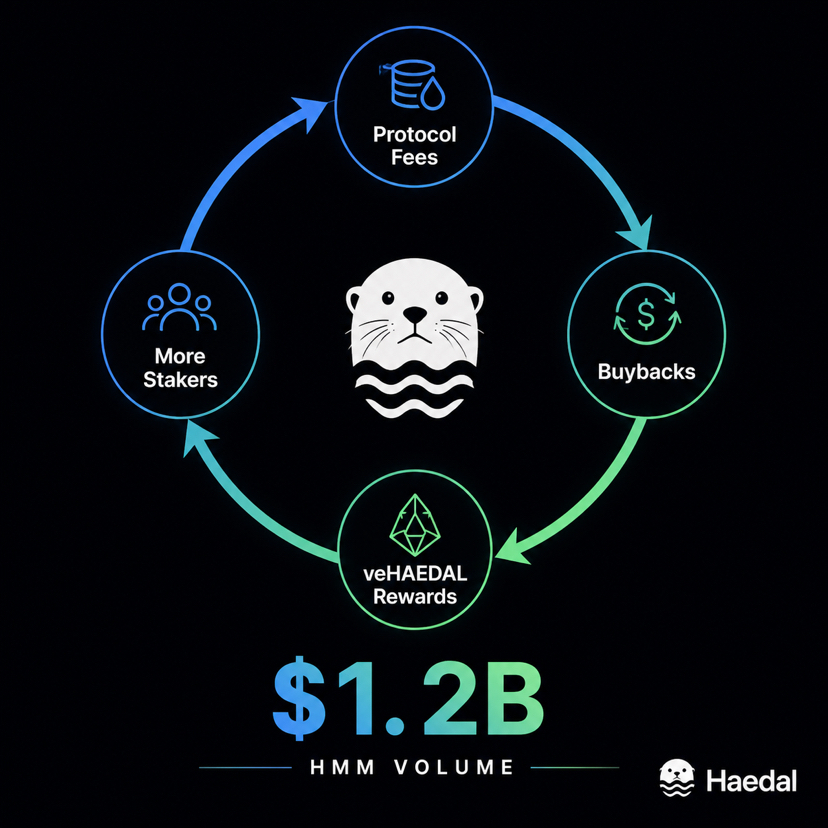
The token and the numbers
HAEDAL has a total supply of 1 billion units and a 7-year release schedule. The token launched via Binance HODLer Airdrop in late April 2025, with the TGE on April 29, 2025. The listing on Binance followed on May 21, 2025, triggering a 50%+ move from the $0.12 to $0.13 base to roughly $0.20. HAEDAL peaked at $0.30 on July 17, 2025.
By December 2025, the token had dropped below $0.04. A brief bounce in early January 2026 faded quickly, and HAEDAL set a new all-time low near $0.023 on February 6, 2026. The factors cited were the broader small-cap DeFi correction, continuous token unlocks adding supply pressure, and the structural reality that haSUI users don’t need to hold HAEDAL to stake, so the token’s value capture mechanism remains modest relative to the selling pressure from unlocks.
At the protocol level the numbers look different. As of May 2025, Haedal reported a TVL of over $200 million, more than 850,000 participating accounts, and over $3 million in rewards distributed to users through haSUI.
Backing and positioning
Haedal secured seed funding in January 2025 from Hashed, OKX Ventures, the Sui Foundation, and Animoca Ventures. That’s a credible list of Sui-adjacent investors who have a reason to want liquid staking infrastructure to succeed on the network, not just generic crypto VCs writing checks.
The protocol’s positioning is straightforward: if Sui grows as an ecosystem, demand for yield-bearing SUI derivatives grows with it. haSUI is already embedded in the major lending and DEX venues on the network. The bet is that being the dominant LST on an expanding L1 compounds over time the same way stETH compounded alongside Ethereum’s DeFi growth.
Whether the #HAEDAL token captures enough of that value to reward long-term holders, given the unlock schedule and the fact that staking doesn’t require holding the token, is the honest question hanging over the protocol. The infrastructure itself is real. The question is just what the token is worth once all the supply enters circulation.