
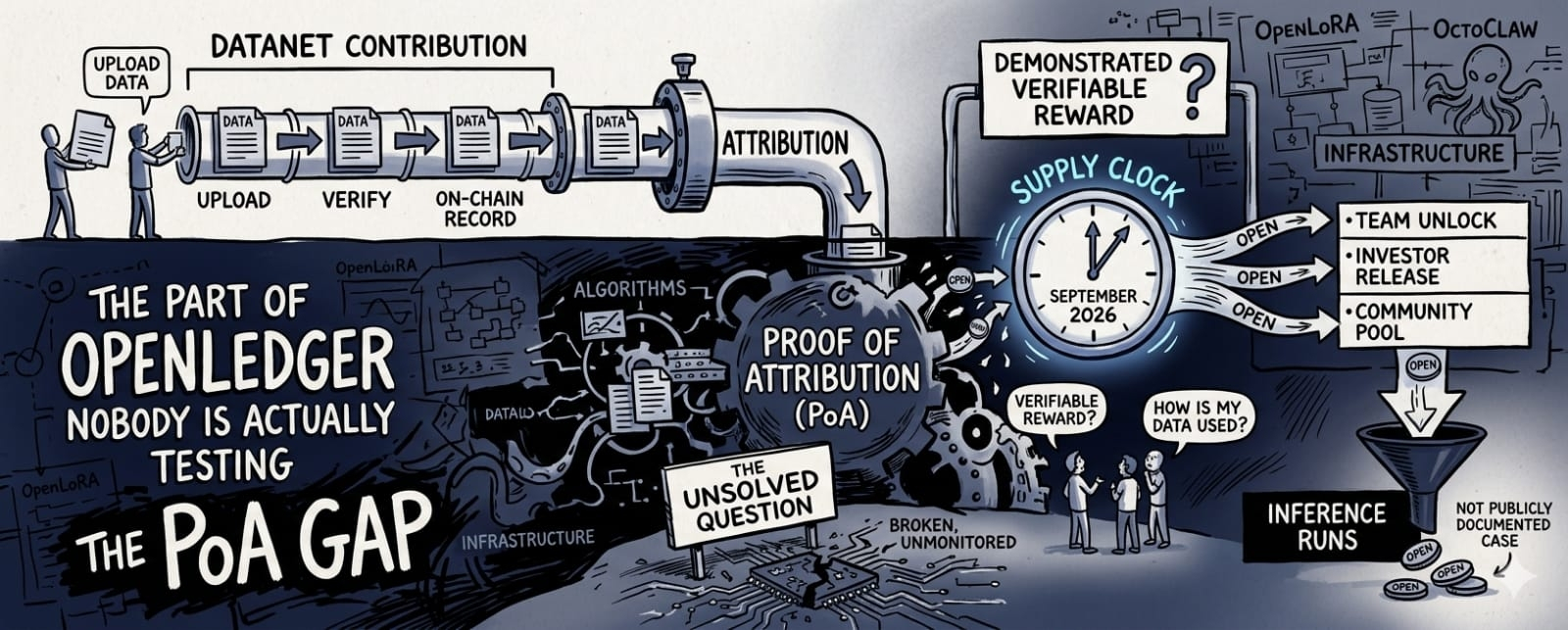
I spent an hour inside the Datanet contribution flow before I started writing this. Not the whitepaper. The actual product. And the thing that stopped me wasn't complexity it was the opposite. Contributing data is almost frictionless. Upload, verify, record on-chain, wait for attribution. Clean. Maybe too clean. Because the moment you ask what happens after the attribution how the system decides your specific data moved a specific model output in a specific direction the answer gets quiet in a way that feels important.
That quietness is what this piece is about.
Proof of Attribution is the load-bearing mechanism of everything OpenLedger is building. Not the chain. Not OpenLoRA. Not OctoClaw. PoA is the reason a data contributor has any economic reason to participate, the reason a developer should trust the reward distribution, the reason the OPEN token has utility beyond gas and governance. The whitepaper published in June 2025 describes two approaches to attribution scoring influence-function approximations for smaller models, and suffix-array token attribution for larger ones. Both are real techniques. Both have known limitations at scale. What keeps bothering me is that the live ecosystem has not yet produced a single publicly documented case of PoA running on a real inference run and distributing a traceable, verifiable reward back to a named contributor. That gap between a technically described mechanism and a demonstrated one is the part of OpenLedger the market hasn't priced correctly in either direction.
Here's why the supply structure makes this gap urgent rather than theoretical. Right now, 21.55% of OPEN's total 1 billion token supply is circulating. The community and ecosystem pool 61.71% of supply is unlocking linearly from month one across 48 months. That's ongoing, predictable sell-side pressure from recipients who have no operational attachment to the protocol. Then around September 2026 roughly four months from now the team and investor allocations clear their 12-month cliff and begin monthly linear release across 36 months. Two unlock streams converging. The only thing that absorbs that pressure cleanly is usage-driven demand: developers paying OPEN for inference, enterprises accessing Datanets, contributors earning and recycling rewards back into the ecosystem. That demand is not scheduled. It has to be built. And it can only be built if PoA works well enough that contributors believe their data is being rewarded fairly and predictably. The mechanism and the supply clock are running simultaneously. One of them is already moving.
What I noticed in the distribution pattern matters here too. OPEN reached a huge number of wallets fast airdrop campaigns, simultaneous listings across major venues, HODLer distributions to passive holders who never touched the product. Wide distribution, fast. That's usually read as a strength. I'm less interested in the distribution width than in what happened after it. The testnet showed 6 million nodes and 25 million transactions numbers that look like adoption until you remember that testnet participation in a points-farming environment selects for a specific type of user: someone optimizing for token allocation, not someone building on the infrastructure. The MC/FDV ratio sits at roughly 0.22, meaning the market is currently pricing only about 22% of the fully diluted network value. That could mean undervaluation. It could also mean the market is rationally discounting the 78% it hasn't seen earn its existence yet. I keep coming back to the fact that both readings are live simultaneously, and the one that turns out to be correct depends almost entirely on whether PoA can be demonstrated publicly, traceable, at scale before the unlock pressure compounds.
What I currently believe is this: OpenLedger is structurally more serious than its price behavior suggests, and also more fragile than its product narrative admits. The fragility isn't in the chain architecture or the token design both are thoughtful. It's in the single unsolved question underneath everything else. If PoA works the way the documentation describes, the entire incentive loop closes: contributors get reliable rewards, Datanets grow, model quality improves, inference demand increases, OPEN velocity rises, and the flywheel turns. If it doesn't if attribution turns out to be approximate enough that contributors can't predict or verify their earnings then participation thins, Datanets stagnate, and what remains is a technically impressive L2 with no reason to use the token for anything a stablecoin couldn't replace. The specific thing I'm watching for over the next two quarters isn't a price candle. It's one credible, on-chain verifiable account of a contributor earning a real OPEN attribution reward from a mainnet inference run, traceable back through the model to their actual data. That single data point would tell me more about OpenLedger's real trajectory than everything else combined and the fact that it doesn't exist publicly yet is either the most important oversight in how this project communicates, or something more uncomfortable than that.
