
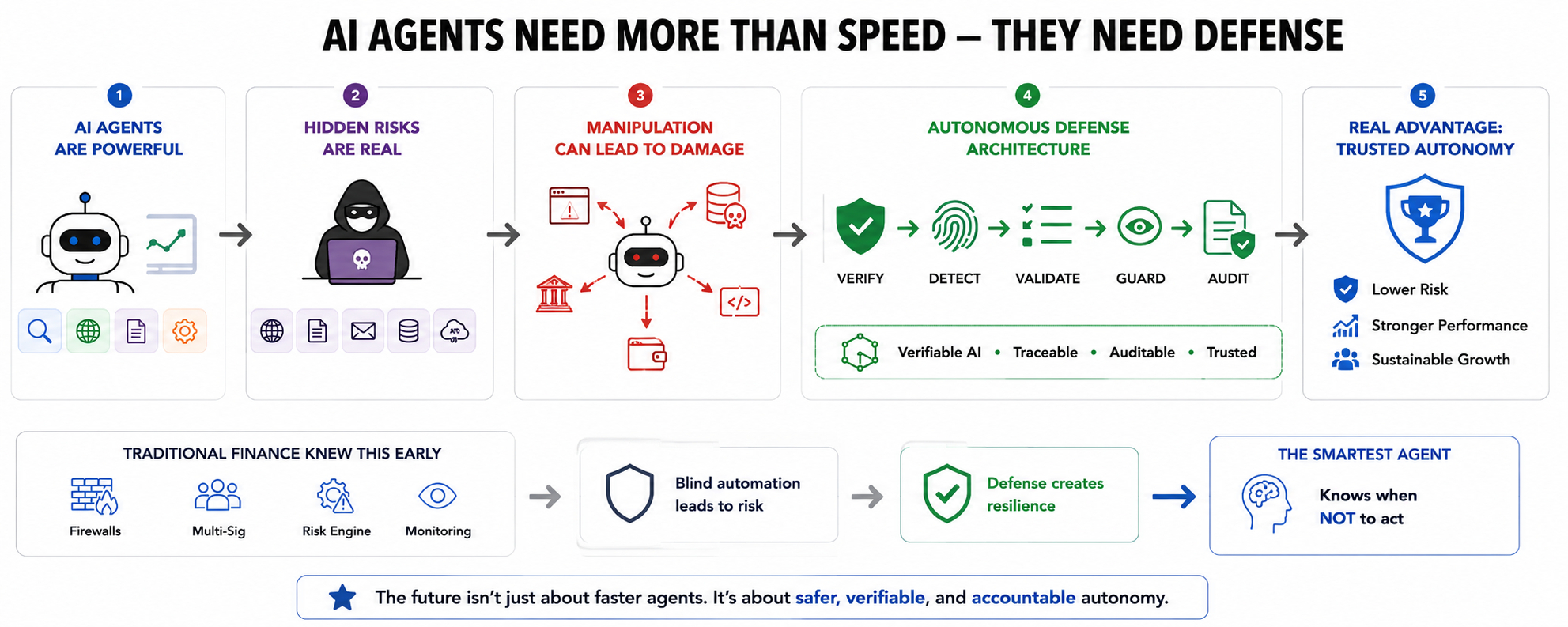
Over the last few months I’ve been experimenting with different AI agent tools, reading protocol updates, and watching how quickly this sector is evolving. Honestly, the progress feels unreal sometimes. Agents can now scan sentiment, read market conditions, interact with smart contracts, and even execute tasks with very little human input. Fast. Efficient. Scalable.
But while testing small agent workflows myself, one uncomfortable question kept returning.
What happens when the agent makes the wrong decision?
Not because the model is “bad.” Not because the code completely breaks. Just one manipulated input. One poisoned data feed. One hidden instruction buried inside external content. That is enough.
And yes… this is becoming a real discussion in AI security now.
In March 2026, @OpenLedger AI published research around designing AI agents that resist prompt injection attacks. Their security teams openly acknowledged something important: the more capable an agent becomes, the larger the attack surface becomes too. Prompt injection is no longer a theoretical problem. It is becoming one of the defining risks for autonomous systems.
For people outside AI development, the term sounds technical. But the idea is actually simple.
A prompt injection attack happens when hidden instructions manipulate an AI agent into doing something unintended. Sometimes those instructions are buried inside websites, PDFs, emails, APIs, or external datasets. The dangerous part? The agent may believe those instructions are legitimate.
Now imagine that same agent connected to wallets, liquidity pools, or automated trading systems.
That changes everything.
I think the market is still underestimating this layer of risk. Most discussions today focus on capability. Faster execution. Better reasoning. Smarter automation. But capability without defense creates an incomplete system.
Traditional finance already learned this lesson decades ago. Firewalls. Multi-signature approvals. Risk engines. Transaction monitoring. None of those systems exist to slow innovation. They exist because blind automation eventually becomes dangerous when real money is involved.
AI agents are approaching the same reality.
This is why I keep paying attention to projects exploring verification and autonomous defense architecture alongside agent development. OpenLedger is one of the few names that repeatedly appears in this conversation. Their infrastructure focuses heavily on verifiable AI, Proof of Attribution, auditable outputs, and collective validation systems. The protocol describes itself as an AI blockchain designed for trusted intelligence and transparent agent coordination.
What caught my attention is not hype. It is the direction of thinking.
OpenLedger’s ecosystem discussions increasingly focus on traceability, validation, MCP layers, and real-time auditable AI execution rather than simply “making agents smarter.” Their June 2025 technical discussions around RAG and MCP integrations also highlighted how agent systems may require verifiable data coordination instead of isolated execution models.
That matters more than many traders realize.
Because in real markets, agents do not fail dramatically at first. They fail quietly.
A manipulated oracle.
A poisoned webpage.
A compromised dataset.
A fake governance signal.
A hidden prompt.
Then suddenly liquidity moves where it should not move.
We already saw parts of this risk emerge across AI security research during late 2025 and early 2026. Multiple security researchers warned that prompt injection may never be fully “solved” in the traditional sense. Even OpenAI admitted this category of attack behaves more like social engineering than normal software bugs.
That changes how builders should think.
Maybe the future is not about creating a perfect autonomous agent.
Maybe the future is about creating systems that assume agents can be manipulated sometimes then designing architecture that limits the damage before value moves on-chain.
That is a very different philosophy.
And honestly… I think it is the more realistic one.
For traders and investors, this becomes increasingly important as more capital flows into agent-driven protocols. Right now most systems still operate with limited permissions or controlled environments. But as AI agents gain access to larger liquidity layers, cross-chain execution, and treasury management, the absence of independent verification becomes a serious structural risk.
The market still rewards speed more than resilience. That is normal during early innovation cycles. We saw the same pattern during early DeFi and GameFi phases too. But eventually infrastructure matters more than excitement.
Trust becomes the real product.
And trust does not come from autonomy alone. It comes from safeguards, verification, accountability, and systems capable of questioning their own outputs before irreversible actions happen.
I keep coming back to the same thought after following this sector closely.
The smartest AI agent may not be the one that moves fastest.
It may be the one that knows when not to act.
