

I’ve been watching the AI narrative inside crypto for a while now, and honestly, most of it still feels backwards.
Every cycle has that one sector where people become obsessed with labels before utility. This time it’s “AI agents.”
The funny part is that a lot of these so-called agents are basically chatbots wearing luxury branding. They summarize documents, answer questions, maybe automate one or two simple tasks, and suddenly people start acting like we’re living inside a sci-fi movie.
But I think most people are missing the more important shift happening underneath.
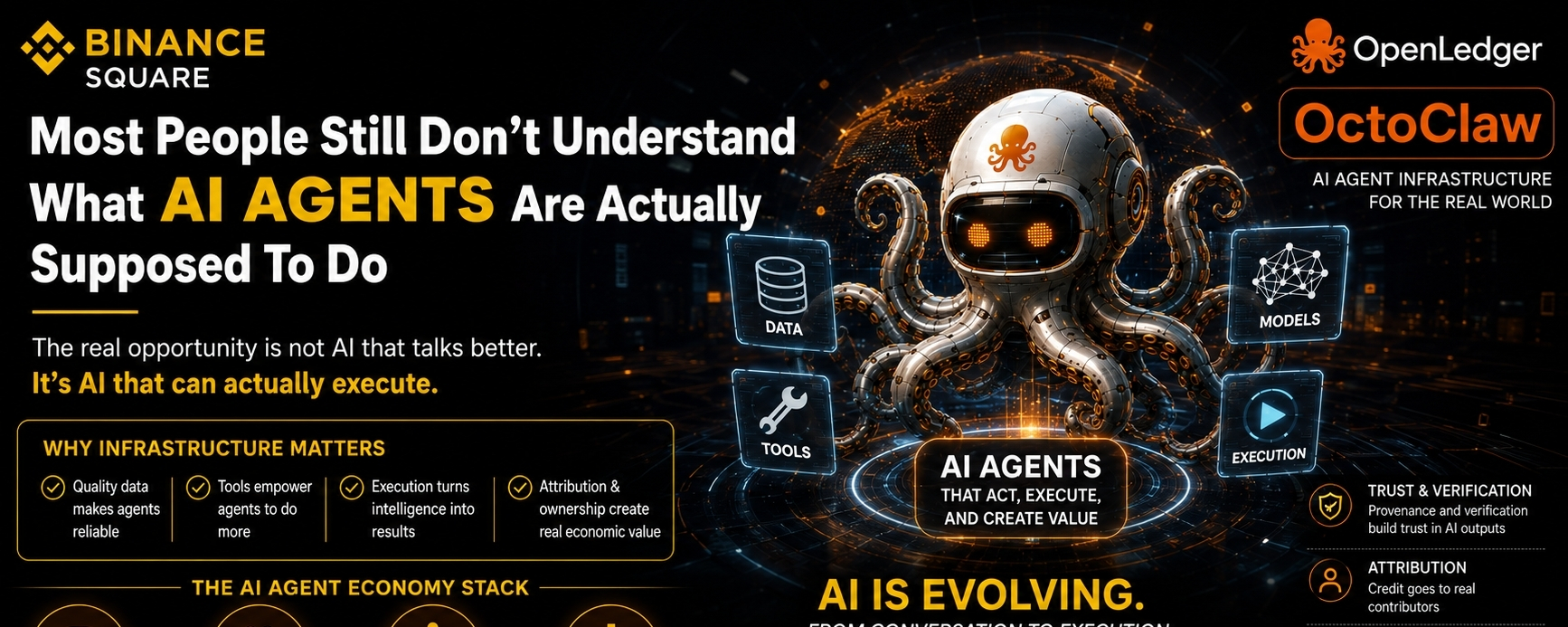
The real opportunity is not AI that talks better.
It’s AI that can actually execute.
That’s why OpenLedger’s OctoClaw caught my attention more than most AI launches recently. Not because I think every AI agent launch automatically deserves hype, but because it touches something the market has been quietly moving toward for months.
Infrastructure that lets AI become economically useful.
That part matters more than people think.
A lot of traders still approach AI projects the same way they approached meme coins during peak mania. Find ticker first. Ask questions later. But narratives don’t survive long-term without functionality underneath them. We already saw that with GameFi, metaverse tokens, and half the “AI coins” that pumped only because they added AI somewhere in the bio.
The market eventually asks a brutal question:
“Okay… but what does this thing actually do?”
That’s where I think OpenLedger is trying to position itself differently.
The interesting part isn’t only OctoClaw itself. It’s the ecosystem idea around it. OpenLedger keeps talking about data, models, attribution, monetization, and agents working together instead of existing separately.
Most people overlook how important that connection is.
Because AI agents alone are not enough.
An agent without quality data becomes unreliable.
An agent without tools becomes limited.
An agent without execution becomes entertainment.
And an agent without ownership or attribution becomes economically useless for the people contributing value to the system.
That last part is massively overlooked by the market right now.
Everyone talks about smarter AI. Very few people talk about who owns the outputs, who supplies the training data, who gets rewarded, or how value flows back into the ecosystem.
That’s where OpenLedger’s infrastructure narrative becomes more interesting to me than the usual “AI assistant” narrative.
They are not only trying to build AI.
They are trying to build an economy around AI activity.
That changes the conversation completely.
Because once agents start executing tasks instead of just generating text, the importance of attribution, trust, and monetization increases fast.
If an AI agent researches, automates workflows, interacts with tools, or even helps businesses operate, then suddenly data provenance matters. Verification matters. Incentives matter.
That is where blockchain actually starts making sense for AI.
Not for the buzzword.
For the coordination layer.
And honestly, this is the part most people in crypto still underestimate. They think AI adoption will mostly come from people chatting with bots all day. I don’t think that’s the biggest opportunity anymore.
I think the bigger opportunity is AI becoming invisible infrastructure.
Quietly handling workflows.
Quietly automating execution.
Quietly reducing friction.
The winners might not even be the loudest AI products. They may be the systems powering the agent economy behind the scenes.
That’s why I think OctoClaw could matter more as a narrative bridge than as just another product release.
Most people don’t understand AI data attribution.
Most people don’t care about decentralized model infrastructure.
But they do understand this:
“An AI that can actually get things done.”
That narrative is simple. And simple narratives spread faster than technical ones.
From a trader perspective, this matters a lot.
Because markets move when complex technology becomes easy to explain.
Ethereum simplified smart contracts.
Solana simplified speed.
DeFi simplified yield.
And now AI agents are simplifying the idea of AI execution.
That doesn’t mean every agent project wins, obviously. Most will probably disappear after the hype cycle cools down. Execution risk is still huge here. AI agents can fail in hilarious ways. Sometimes they overcomplicate basic tasks like they’re trying to solve world hunger with a calculator.
But direction matters more than perfection early on.
And the direction is becoming clearer.
The AI market is slowly moving away from passive interaction and toward autonomous action.
That’s the real shift I’m watching.
Not “Which AI token trends today?”
But “Which ecosystem can support AI work at scale?”
That is a much bigger question.
And honestly, I think most people are still too distracted by short-term hype to notice it.
The more I look at projects like OpenLedger and OctoClaw, the more I think the real value won’t come from AI sounding intelligent.
It will come from AI becoming economically productive.
Data becomes the fuel.
Models become the reasoning layer.
Agents become the execution layer.
And the infrastructure connecting all three may end up being the most valuable part of the entire stack.
That’s the piece I think the market is still underpricing.
