
Which model predicts faster. Which algorithm finds the next move first. Which AI can forecast market direction more accurately.
But in fragmented onchain markets, prediction alone is becoming less important.
The real differentiator is execution.
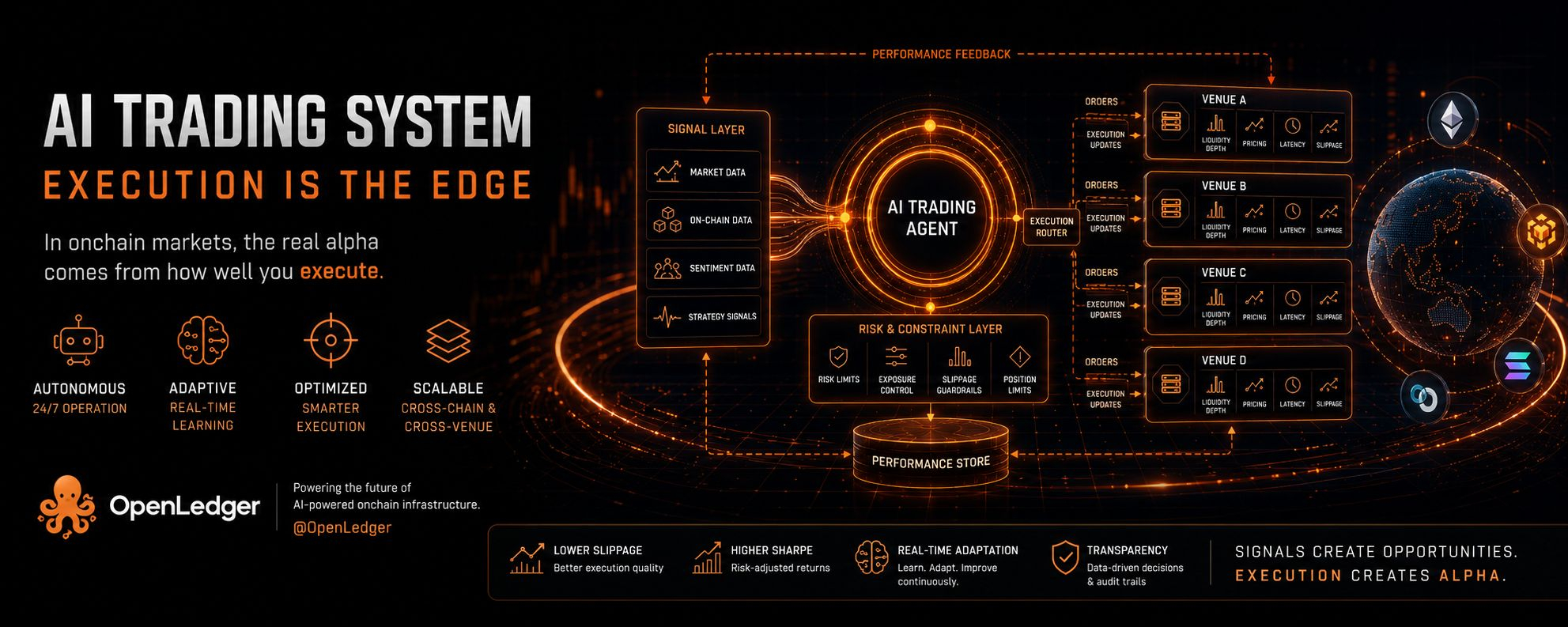
As autonomous trading systems continue to evolve, the focus is shifting away from pure forecasting and toward infrastructure capable of acting intelligently in real time. Modern AI trading stacks are no longer just signal generators — they are becoming adaptive execution engines built for constantly changing liquidity conditions across chains and venues.
That shift changes everything.
The next wave of AI-driven trading is increasingly centered around:
• Real-time signal ingestion
• Adaptive risk controls
• Smart routing logic
• Cross-venue coordination
• Dynamic liquidity optimization
• Continuous feedback and self-improvement
In crypto markets, especially onchain environments, inefficiency exists everywhere. Liquidity is fragmented. Slippage changes rapidly. Latency matters. Execution quality can determine whether a strategy is profitable or completely ineffective.
Two systems may identify the exact same opportunity.
The one that executes better wins.
That is why execution is no longer just a backend process.
It is becoming part of the alpha itself.
The most advanced autonomous systems are designed to react instantly, rebalance dynamically, route orders efficiently, and manage exposure without emotional bias. Instead of relying only on prediction accuracy, they optimize every layer between signal detection and trade completion.
This is where the industry is clearly heading.
Projects like [@OpenLedger](https://www.binance.com/en/square/profile/openledger are contributing to this broader evolution of AI-powered onchain infrastructure, where coordination, execution efficiency, and intelligent automation are becoming increasingly important for scalable trading systems.
As the ecosystem matures, the winners may not be the systems with the boldest predictions.
They will likely be the systems that:
• Process information faster
• Adapt to market conditions instantly
• Execute across fragmented venues efficiently
• Minimize slippage and latency
• Operate continuously without emotional friction
In traditional markets, execution has always mattered.
In onchain markets, it may become the entire edge.
The narrative around AI trading is evolving from “Who predicts best?” to “Who executes best?”
And that shift could define the next generation of crypto infrastructure.