

A new space is emerging where artificial intelligence meets blockchain. Two powerful technologies, often discussed separately, are finding common ground.. OpenLedger sits at this intersection. Not as a spectator. As an architect.
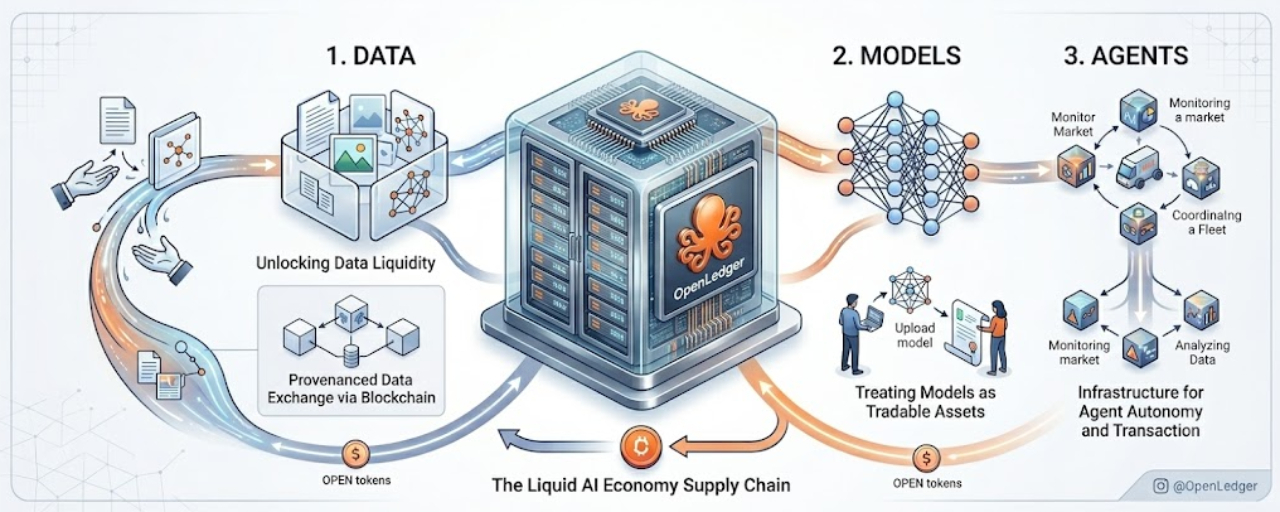
OpenLedger is an AI blockchain designed to unlock liquidity for data, models, and agents. Those three words data, models, agents carry the weight of a new economy. An economy where value is not just created but exchanged freely between machines, developers, and users.
Let me break this down from the beginning.
Blockchain technology has always been about value transfer. Bitcoin transferred currency. Ethereum transferred program logic through smart contracts. OpenLedger transfers something different. It transfers the building blocks of artificial intelligence itself.
Data is the first pillar.
Every AI system runs on data. Massive amounts of it. Text. Images. Numbers. Behavior patterns. Training data. Fine-tuning data. Validation data. Without data, AI models cannot learn. Without quality data, AI models cannot perform.. Yet data remains trapped. Siloed inside corporations. Locked behind APIs. Owned by platforms that decide who accesses what.
OpenLedger changes this dynamic. It creates a marketplace where data becomes liquid. Owners can list their datasets. Developers can browse, evaluate, and purchase access. Blockchain ensures provenance. Smart contracts handle payments. The result? Data stops sitting idle. Data starts moving to where it creates the most value.
The second pillar is models.
An AI model is a mathematical system trained on data to perform specific tasks.. Recognize images. Generate text. Predict outcomes. Classify information. Building a good model requires expertise, computing power, and time. Yet most models built today serve only their creators.. They sit on private servers. They answer only to one owner. They never reach their full potential.
OpenLedger treats models as tradable assets. A developer who trains a model can list it on the blockchain. Other developers can license or purchase access. Payment flows automatically. Usage gets recorded transparently. The model that once served one person now serves many. Value multiplies.
The third pillar is agents.
Agents are autonomous programs that act on behalf of users. An agent can monitor a market, execute trades, respond to messages, analyze data streams, or coordinate other agents. This is where AI becomes active, not passive.. Agents do not just process information. They act on it.
OpenLedger provides infrastructure for agents to operate, transact, and collaborate. Agents pay for data. Agents license models. Agents negotiate with other agents. Human oversight remains possible, but the economy moves faster when machines talk directly to machines...
Now consider how these three pillars connect.
A data owner uploads a dataset to OpenLedger. A model builder purchases that data, trains a model, and lists the model on the same blockchain. An agent discovers the model, licenses it, and uses it to perform tasks for a user. Each step creates value. Each step leaves a transparent record. Each step involves payment that flows through smart contracts without intermediaries.
This is not just a marketplace. This is a supply chain for artificial intelligence.
The term "liquidity" appears in the official description for good reason. In traditional finance, liquidity means how easily an asset converts to cash without affecting its price. In OpenLedger, liquidity means how easily data, models, and agents move between owners, users, and applications.
Today, most AI assets are illiquid. A dataset owned by a startup cannot be accessed by a researcher across the world. A model trained by a university cannot be licensed by a small business. An agent built by an individual cannot scale because no payment rails exist for machine-to-machine transactions.
OpenLedger solves all three problems. Data becomes liquid through transparent markets. Models become liquid through license exchanges. Agents become liquid through autonomous payment channels.
The blockchain choice matters here. Not every network can handle AI workloads. Speed matters. Cost matters. Programmability matters. OpenLedger builds its own layer designed specifically for this use case. High throughput. Low fees. Smart contracts optimized for data and model exchange.
What makes OpenLedger different from general purpose blockchains? Focus. General purpose networks handle everything from DeFi to gaming to NFTs. OpenLedger specializes. Every feature exists to serve AI asset liquidity. Nothing more. Nothing less. This focus allows deeper optimization for the specific needs of data, models, and agents.
The OPEN token sits at the center of this economy. Not as a speculative vehicle. As a utility. Data purchases use OPEN. Model licenses use OPEN. Agent transactions use OPEN. Governance uses OPEN. The token aligns incentives across all participants. Buyers spend. Earners earn. Holders vote.
Early use cases already emerge. Research labs could share datasets without losing control. AI startups could license models without building everything from scratch. Enterprises could deploy agents that pay for resources automatically. Open source communities could monetize contributions while keeping code free.
OpenLedger focuses on all three assets simultaneously data, models, and agents rather than just one or two. This integrated approach creates a complete ecosystem where each pillar supports the others.. A data marketplace without models has limited value. Models without data cannot train. Agents without models cannot act. OpenLedger brings all three together.
Challenges exist. Adoption takes time. Developers must learn new tools. Data owners must trust blockchain provenance. Regulators may ask questions about AI asset trading. No serious project ignores these risks. OpenLedger addresses them through transparent design and community governance.
What stands out about OpenLedger is the removal of friction. Today, a developer with a good model cannot easily monetize it. A researcher with valuable data cannot easily share it. An agent cannot easily pay for resources because no infrastructure exists. OpenLedger removes these barriers one by one.
The long term vision extends beyond simple marketplaces. Data could flow continuously to where it creates most value. Models could compete and improve through open access. Agents could form temporary partnerships to solve complex tasks. Human participants could oversee, fund, and benefit from automated economies.
This is early. OpenLedger launches into a world that is just beginning to understand what AI plus blockchain means. The technology works. The economics make sense. The team appears focused on execution rather than hype.
For anyone watching AI and blockchain separately, OpenLedger offers a place where they converge. Not as a theoretical exercise. As a working infrastructure for the next generation of intelligent applications.
Data, models, and agents. Liquid, tradable, useful. That is OpenLedger.
