

A few years ago, when people in crypto talked about infrastructure, the conversation was almost embarrassingly simple. Faster chains. Cheaper transactions. More throughput. Then AI arrived and somehow we copied the same mental shortcut. Bigger models. More GPUs. Lower inference costs. Same reflex, different sector.
I understood that instinct at first.
If something computationally expensive becomes commercially important, naturally the market looks at compute as the bottleneck. That’s clean. Easy to price. Investors like clean stories.
But the longer I watch how AI systems are actually evolving, the less convinced I am that compute is the hardest economic problem.
I think attribution might be worse.
Not the vague “credit the creator” kind of attribution people casually mention online. I mean actual economic attribution. The uncomfortable question nobody really wants to unpack because it gets messy fast: when an AI-generated output creates value, who exactly deserves to be paid?
That question sounds theoretical until real money is involved.
Imagine a healthcare AI trained partly on licensed clinical datasets, partly on internal hospital records, then fine-tuned by a third party before being deployed through some enterprise interface. A doctor uses it. Productivity improves. Revenue exists somewhere in that chain.
Who earned what?
The hospital? The model provider? The inference layer? The data contributors? The deployment company?
People pretend this will sort itself out naturally. Markets usually do that when they don’t yet have infrastructure for something awkward.
I’ve seen this before in different forms.
Digital advertising spent years arguing over attribution because everyone wanted credit for conversion events. Finance built entire settlement systems because nobody trusts vague accounting once capital scales. Music streaming still gets attacked over royalty opacity. The technical product may be innovative, but eventually the economic plumbing becomes the real story.
AI feels like it’s drifting toward that same wall.
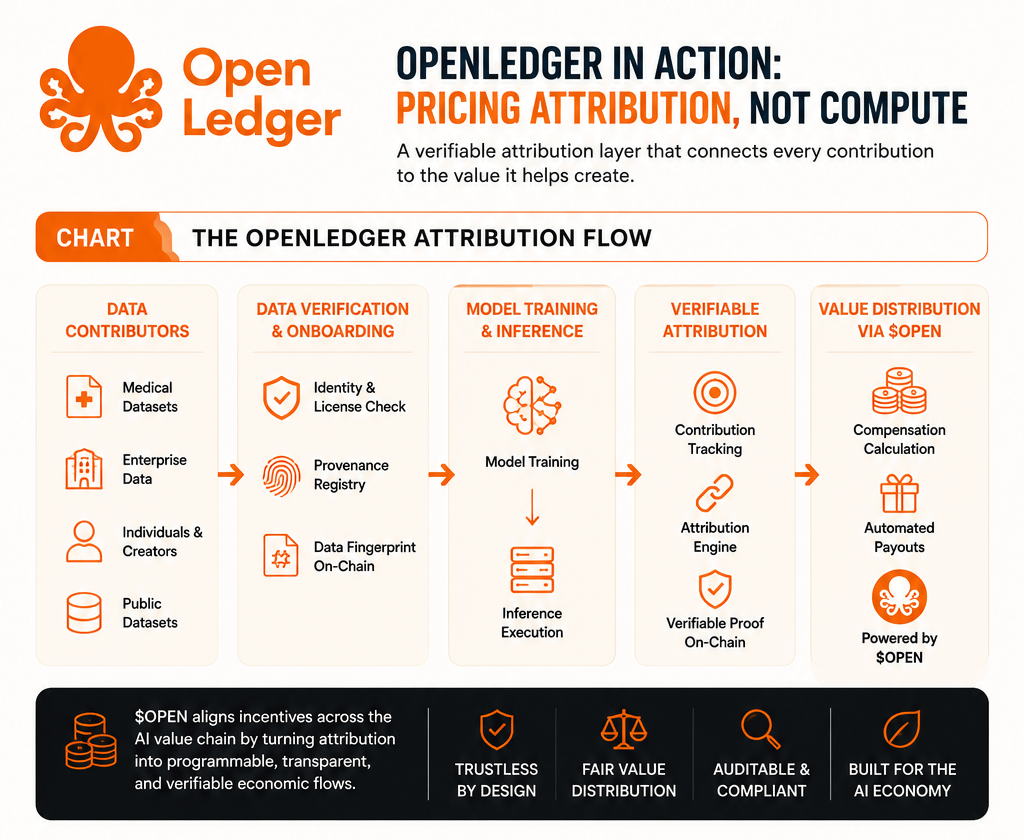
Which is why I think OpenLedger is more interesting than the typical “AI blockchain” label suggests.
Honestly, calling it just another AI chain misses the weird part.
Because if you look past the surface branding, OpenLedger doesn’t feel like a project obsessing over compute scarcity. It feels more like an attempt to build attribution infrastructure for AI economies.
That’s a very different thing.
Compute is easy to conceptualize. You consume machine resources, you pay for them. Cloud pricing already trained the market to understand this. Expensive? Yes. Complicated? Operationally, sure. Conceptually? Not really.
Attribution is uglier.
Because attribution requires provenance.
Plain English version: where did something come from, what influenced it, and can anyone verify that story without trusting a single party?
That sounds manageable until you apply it to AI.
Models don’t behave like neat accounting ledgers. They absorb patterns probabilistically. Influence gets blurred. Outputs aren’t straightforward composites where you can point at exact ingredients like recipe labels.
So now you have a commercial system creating value from black-box intelligence, while the economic contributors underneath may be invisible.
That’s not a compute issue.
That’s an accounting crisis waiting to mature.
And I think this is where $OPEN becomes more intellectually interesting.
Most AI-related tokens get framed like utility fuel. Pay for access. Pay for execution. Pay for infrastructure usage. Standard crypto reflex.
But what if $OPEN’s deeper role is not computational access?
What if it’s economic attribution infrastructure?
That changes the conversation completely.
Because then the token is less about machine power and more about economic legitimacy inside AI workflows.
Who contributed? Who can prove it? Who gets compensated? Under what logic?
Suddenly you’re not valuing compute cycles. You’re valuing trusted economic coordination.
That’s subtle, but markets eventually care about subtle things when money gets serious.
Enterprise adoption especially.
Retail users love capability demos. Enterprises ask uglier questions.
Where did this output originate?
Can we audit the process?
Can legal teams explain this system?
If compensation disputes emerge, what evidence exists?
I’ve sat through enough infrastructure conversations to know performance gets attention early, governance gets attention later, and accountability becomes painfully important once actual budgets show up.
Regulation will push some of this whether builders like it or not.
Europe’s AI governance direction already points toward explainability and accountability in higher-risk use cases. Even outside formal regulation, internal compliance teams behave conservatively. Nobody wants opaque liability.
And that creates an opening.
If OpenLedger can make attribution economically usable—not theoretically elegant, actually usable—that becomes meaningful.
But here’s the part where crypto usually gets romantic and I don’t think that helps.
This is hard.
Really hard.
AI attribution is not clean science.
A model may be influenced by millions of data interactions. Determining exact economic contribution can quickly become philosophical theater disguised as engineering. If anyone suggests perfect attribution, I’d immediately become skeptical.
Then there’s adoption behavior.
Developers do not reward ideological beauty.
If attribution tooling slows deployment, complicates integrations, or adds operational friction, teams will ignore it and move to whatever works faster. Crypto veterans should know this by now. Elegant infrastructure dies quietly all the time.
Token economics create another question.
Even if the conceptual thesis is strong, does $OPEN actually become necessary for recurring workflows?
That’s where many infrastructure narratives break.
Interesting architecture is not the same as durable token demand.
And coordination… that’s another beast entirely.
Attribution systems only matter if multiple participants trust the framework. Data providers, builders, enterprises, maybe even regulators. That kind of legitimacy takes time. Sometimes years.
Still, I can’t dismiss the thesis.
Because the market may be looking at AI exactly the way it looked at cloud infrastructure too early—through raw capacity metrics instead of economic governance.
Compute gets headlines.
But accounting systems quietly determine who captures value.
That’s why OpenLedger catches my attention.
Not because “AI plus blockchain” is exciting. Honestly, that framing has become lazy.
But because if AI becomes a genuine economic network instead of just software products, attribution becomes unavoidable.
And if attribution becomes unavoidable, the infrastructure that prices trust may end up mattering more than the infrastructure that merely provides horsepower.
Maybe that’s what $OPEN, is really trying to become.
Not fuel.
A financial grammar for AI value distribution.
That’s a much stranger bet.
Which is probably why it’s worth thinking about.
#OpenLedger #open $OPEN @OpenLedger