

most people ask “what does OpenLedger do?” before asking “why does it need its own blockchain?” the second question is the one worth sitting with.
general-purpose blockchains can’t handle what OpenLedger is trying to do. AI workloads need high throughput, very low fees, and a verifiable way to track massive amounts of data in real time. Ethereum mainnet is too slow and too expensive for this at scale. so they built a Layer 2 — and the specific architectural choices they made are not obvious ones.
the foundation is OP Stack. Optimism’s standardized framework for Layer 2s — transactions batch and process off-chain, settle on Ethereum mainnet. the result is throughput and fees that make AI-scale operations viable while inheriting Ethereum’s security. EVM compatibility means any Solidity developer can deploy on OpenLedger without changing their tooling. no new language. no unfamiliar environment. the onboarding friction is close to zero by design.
but the choice I keep thinking about is EigenDA.
data availability is the part of blockchain infrastructure almost nobody talks about until it breaks. when a transaction happens, the network needs to guarantee that the underlying data is actually accessible and verifiable — not just that a hash exists on-chain. traditionally this meant posting full data to Ethereum, which is expensive. EigenDA decouples data availability from execution and consensus entirely. data lives off-chain across a distributed network of operators who have staked ETH via EigenLayer, with cryptographic proofs guaranteeing accessibility and integrity without touching Ethereum’s storage layer.
for OpenLedger this isn’t an optimization. it’s a prerequisite.
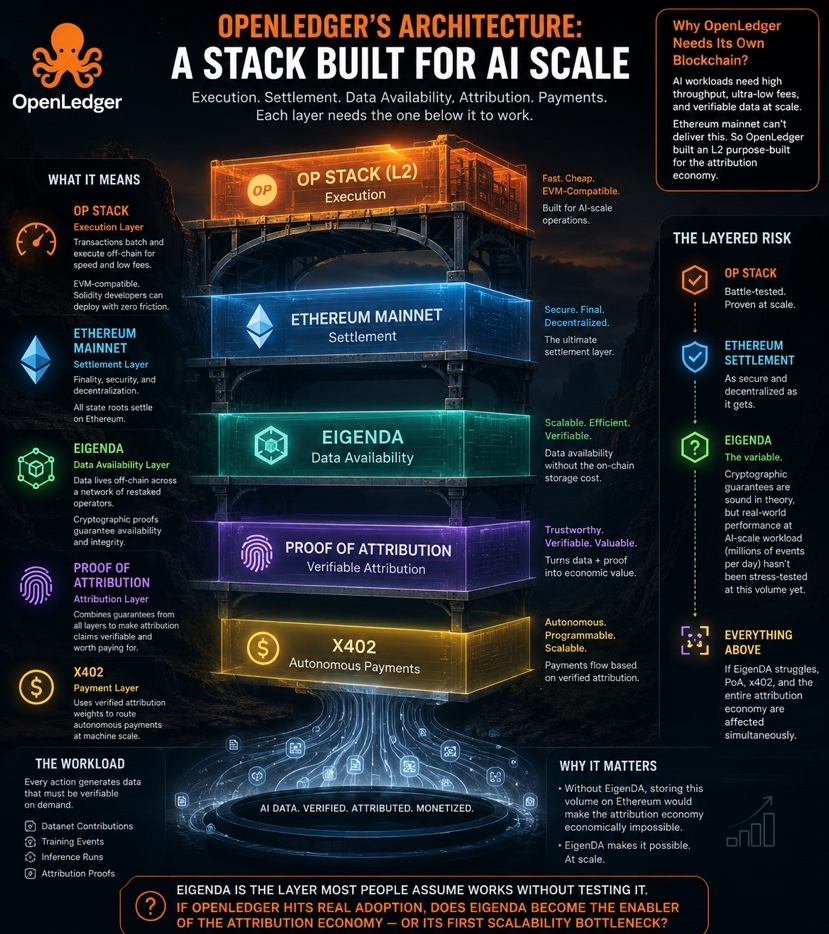
every Datanet contribution, every training event, every inference run, every attribution proof — all of it generates data that needs to be verifiable on demand. without EigenDA, storing that volume on Ethereum would make the attribution economy economically impossible before it even got started. EigenDA cuts those storage costs dramatically while keeping the verifiability guarantees that PoA depends on to function.
the architecture is layered deliberately. OP Stack handles execution — fast, cheap, EVM-compatible. Ethereum mainnet handles settlement — secure, final, decentralized. EigenDA handles data availability — scalable, cost-efficient, cryptographically verifiable. Proof of Attribution sits on top of all three, using the guarantees each layer provides to make attribution claims trustworthy enough to actually pay out on. x402 sits on top of PoA, using those verified attribution weights to route autonomous payments.
each layer needs the one below it to work. that’s not a weakness — that’s how good infrastructure is supposed to be designed. but it does mean the risk is also layered.
OP Stack is battle-tested. Ethereum settlement is about as proven as anything in crypto gets. EigenDA is the variable. the cryptographic guarantees are sound in theory — restaking via EigenLayer is a real security model. but production performance at the scale OpenLedger needs — potentially millions of attribution events per day across thousands of concurrent Datanets and model inferences — hasn’t been stress-tested at that volume in the real world yet.
this is the part most technical writeups gloss over. they describe the architecture correctly and stop there. but “architecturally sound” and “production-ready at scale” are different claims. EigenDA scaling under OpenLedger’s specific workload profile is still an open question. and if EigenDA has issues at production volume, everything above it — PoA, x402, the attribution economy, the entire monetization layer — is affected simultaneously.
I don’t think this is a fatal risk. EigenDA has serious teams and serious capital behind it, and the restaking model has held up under significant pressure. but it’s the layer I’d watch most carefully as OpenLedger scales from testnet to production load.
the bet here isn’t just on OpenLedger’s product. it’s on three infrastructure layers working together at a scale none of them have been tested at simultaneously. that’s a different kind of technical risk than most people factor in when they read “built on OP Stack and EigenDA” and move on.
knowing what the stack is made of is step one. understanding where the seams are is what actually matters.
EigenDA is the layer most people assume works without testing it. do you think it can handle OpenLedger’s attribution workload at production scale — or is this the part that breaks first? 👇
