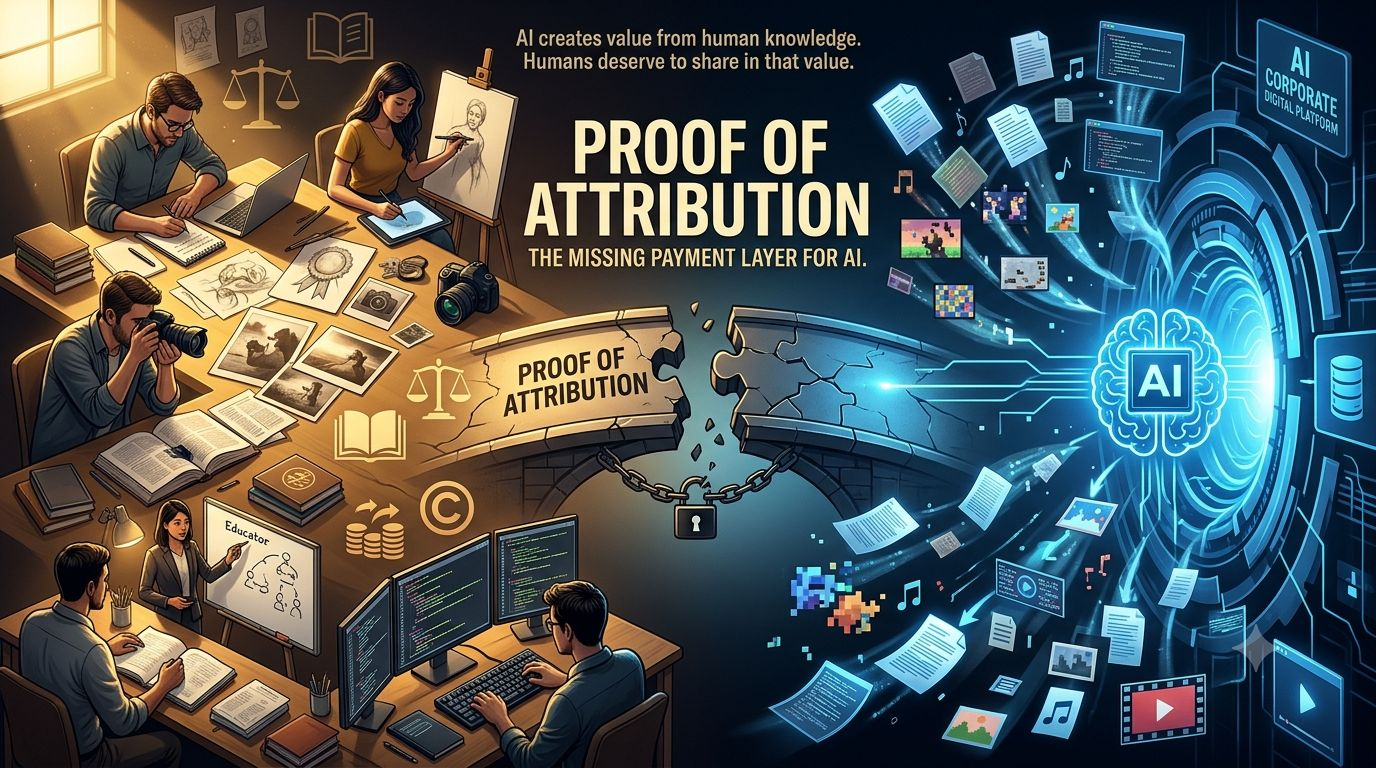
Proof of attribution may sound like a technical subject, but I see it as something very human. It’s about one simple question: when someone’s work helps create value, should that person be remembered and rewarded?
AI has made this question impossible to ignore. These tools can write, design, summarize, code, explain, translate, and create in seconds. On the surface, it feels effortless. You type a prompt, and an answer appears. But that answer didn’t come from nowhere. Behind it are years of human effort: articles people wrote, images people created, research people published, code developers shared, lessons teachers recorded, and ideas communities discussed online.
That’s what we often forget. AI may produce the final response, but humans built the ground it stands on.
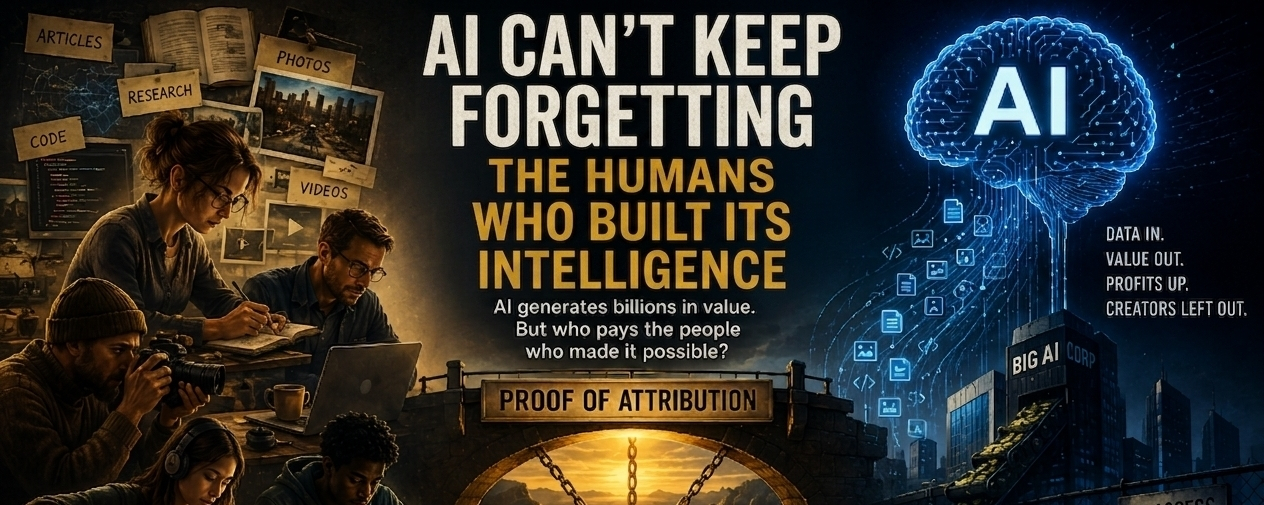
Right now, the AI economy pays almost everyone except the people who made much of that knowledge possible. Cloud companies get paid. Chip companies get paid. AI platforms get paid. Subscription tools get paid. Investors expect returns. But the writer, artist, journalist, researcher, teacher, or developer whose work helped train or guide these systems often receives nothing. Sometimes they don’t even get a mention.
That doesn’t feel sustainable. It also doesn’t feel fair.
The old internet had problems, but it still gave creators some visibility. If you searched for something, you clicked a link. If you read an article, you knew the source. If you used someone’s code, you could find the repository. If you watched a tutorial, you saw the person teaching you. There was still a path back to the original human.
AI often removes that path.
A chatbot can answer so completely that the user never visits the website. An AI writing tool can summarize a report so well that the original work becomes invisible. An image generator can imitate patterns shaped by thousands of artists without naming any of them. A coding assistant can offer a solution built from the habits of countless developers who may never know their work mattered.
The result is convenient, but it’s also unsettling. The answer appears. The people behind it disappear.
That’s why proof of attribution matters. It’s not just about giving credit. Credit is important, but credit alone doesn’t pay bills. A citation doesn’t fund a newsroom. A footnote doesn’t support an artist. A link doesn’t maintain open-source software. Attribution needs to become connected to value. It should help show who contributed, how their work was used, and whether they deserve compensation.
Copyright law can help in some cases, but it can’t solve the whole problem. AI doesn’t always copy one clear paragraph, image, song, or line of code. Often, it learns from millions of examples and produces something new that still depends on those examples. So the real question isn’t only, “Was this copied?” It’s also, “Who helped make this possible?”
That’s a harder question, but it’s the one we need to answer.
Big licensing deals won’t be enough either. Large publishers and media companies can negotiate with AI companies. But the internet wasn’t built only by big companies. It was built by small creators too: independent writers, local journalists, open-source developers, researchers, designers, teachers, photographers, and ordinary people sharing useful knowledge. If only the biggest players get paid, AI will repeat the same unfair pattern we’ve seen before. The powerful will negotiate, and everyone else will be absorbed.
Citations alone won’t fix it. Sometimes AI tools show sources, and that’s useful. But a citation can become decoration if it doesn’t change the economics. An answer might list two or three sources while being shaped by thousands of unseen works. That may look transparent, but it doesn’t truly reward the people behind the knowledge.
Watermarking also has limits. It can tell us something was made by AI, but it doesn’t tell us whose work helped the AI become capable of making it. A watermark says, “This came from a machine.” Proof of attribution should say, “These humans helped create the value behind this.”
A real attribution system would need to answer practical questions. Where did the data come from? Was it allowed to be used? Was it used for training, search, summarization, or generation? Did it help create a commercial output? Did someone make money from it? Should part of that money go back to the source?
That sounds complicated because it is. But complicated systems already exist when industries care enough to build them. Banks track transactions. Music platforms calculate royalties. Ad systems track clicks and influence. Supply chains follow products across countries. None of these systems are perfect, but they exist because accounting matters.
AI companies have built tools that can write code, pass exams, generate images, and analyze complex documents. It’s hard to believe they can do all that but can’t build better ways to track contribution. The real issue may not be ability. It may be willingness.
Some forms of attribution would be easier than others. If an AI assistant uses a specific article, research paper, book, legal document, or database to answer a question, that source should be logged and shown. If the answer creates commercial value, payment should be possible. That’s not impossible. It’s a design choice.
Training data is harder, of course. Once information is inside a model, it’s difficult to trace every influence. But difficulty shouldn’t become an excuse for doing nothing. We can still build dataset registries, licensing pools, audits, and payment models. We can still separate direct use from general influence. We can still create systems that are imperfect but much fairer than silence.
We don’t need perfect attribution. We need honest attribution.
That distinction matters. Human creativity has always been influenced by other people. Every writer reads. Every artist studies. Every developer learns from someone else’s code. Culture builds on culture. Knowledge builds on knowledge. No one wants a world where every idea is locked behind a payment demand.
But there’s a big difference between a person learning from others and a commercial AI system absorbing massive amounts of public work to build profitable products. Scale changes responsibility. When value is extracted at machine speed, compensation needs to become machine-readable too.
Technology may help. Content credentials, dataset registries, digital identity, cryptographic records, and even blockchain could play a role if they solve real problems. But they shouldn’t become buzzwords. Creators don’t need more complexity for the sake of it. They need control, visibility, and fair payment. The technology should serve that purpose.
At the center of all this is trust. Creators don’t trust AI companies because many feel their work was taken first and discussed later. AI companies fear endless claims and legal risk. Users don’t always trust AI answers because sources are unclear. Businesses worry about using content that may have uncertain rights. Everyone is circling the same problem: we need proof.
Proof that work was used properly. Proof that creators had a choice. Proof that platforms followed rules. Proof that value didn’t disappear into a black box.
There’s also a dignity issue here. People don’t only want money. They want to know their work mattered. A writer wants their ideas recognized. An artist wants their style respected. A journalist wants original reporting to keep its worth. A developer wants open-source labor to be sustainable. A teacher wants their explanations to remain connected to them. These are not extreme demands. They’re normal human expectations.
No one wants to spend years building something only to watch it vanish inside someone else’s product.
If we ignore this, the open internet may become more closed. Creators will stop sharing freely. Publishers will block AI crawlers. Artists will hide their work. Researchers will restrict access. Communities will move into private spaces. More knowledge will sit behind paywalls. People won’t do this because they hate technology. They’ll do it because they don’t want to be mined without respect.
That would hurt everyone. AI depends on human knowledge. If it weakens the people and institutions producing that knowledge, it weakens itself.
The smarter path is to build an AI economy where contribution is visible and value flows both ways. Creators should be able to decide how their work is used. Platforms should be able to license content clearly. Users should be able to see where answers come from. Companies should be able to reduce legal uncertainty. And the people who create knowledge should have a real stake in the systems built from it.
The best AI companies should not treat attribution as a burden. They should treat it as a sign of quality. A model built on traceable, licensed, high-quality data will be easier to trust. An AI tool that can show its sources will be more useful. A platform that pays contributors may attract better content. In the future, users may not only ask which AI is most powerful. They may ask which AI is most trustworthy.
That’s why proof of attribution could become the missing payment layer for AI. It connects machine intelligence back to human contribution. It reminds us that behind every polished answer is a world of people who wrote, researched, designed, taught, corrected, and shared.
AI doesn’t need to erase those people to succeed. It can become stronger by respecting them.
The future shouldn’t be a place where every idea is locked away. But it also shouldn’t be a place where human work is treated as free fuel for machines. There has to be a better balance. Attribution is the beginning of that balance.
Because AI is not magic. It is built on human effort, human language, human creativity, human mistakes, and human experience. If we forget that, we may build systems that look intelligent but feel empty.
The next big breakthrough in AI may not be a larger model, a faster chip, or another impressive app. It may be something quieter but more important: a fair way to prove who helped create value and to pay them for it.
That may not sound as exciting as the next wave of artificial intelligence. But it may matter more.
Because intelligence without memory is dangerous. And an AI economy that forgets the humans behind it won’t stay healthy for long.