
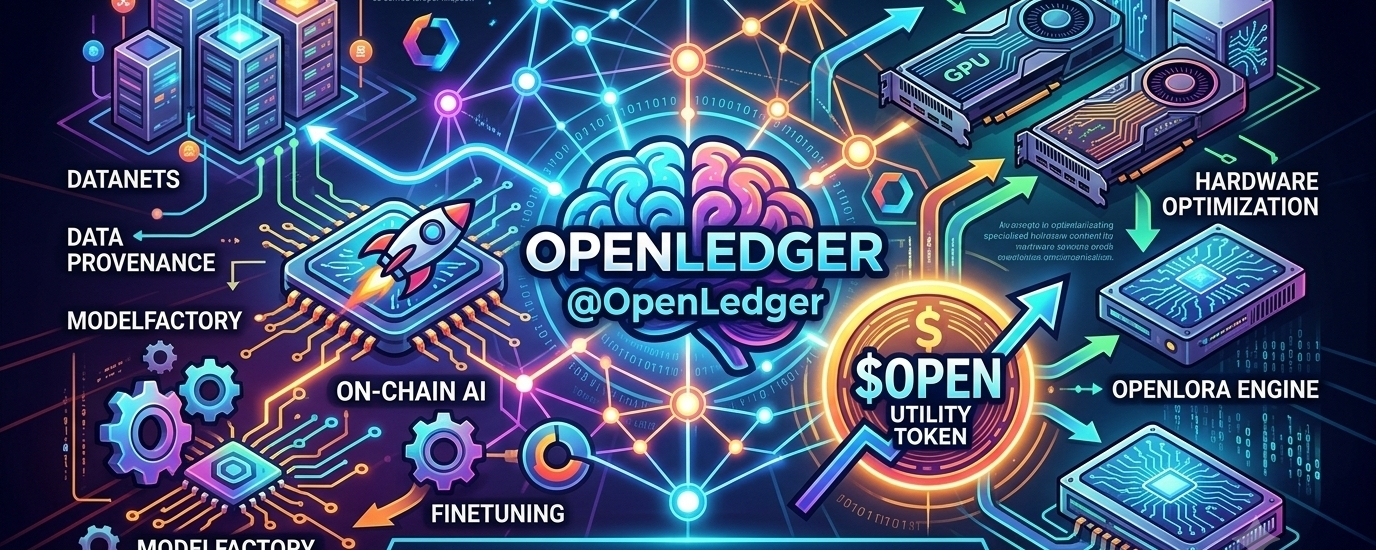
The intersection of Web3 and Artificial Intelligence has seen its fair share of superficial integrations, but a deeper look at the architecture of @OpenLedger reveals a highly functional framework addressing AI's biggest bottleneck: verifiable data provenance and data attribution.#BinanceSquareFamily
As an independent trader navigating the fast-evolving decentralized AI sector, identifying projects with clear network utility is paramount. Here is a structural breakdown of what makes this ecosystem compelling for long-term outlooks, and why the native token $OPEN sits at the center of its execution layer.
The Architecture: Solving the AI Data Black Box
In traditional AI development, data providers and contributors rarely receive fair compensation or clear traceability for their work. @OpenLedger r leverages a modular, EVM-compatible infrastructure (built via the OP Stack) to establish what it terms a "Payable AI" economy.
The network relies on three core operational layers:
Datanets: Specialized, decentralized storage and data organization layers where contributors can share specific datasets (e.g., cybersecurity threat patterns or linguistic variations).
ModelFactory: A specialized no-code dashboard that enables developers to easily fine-tune large language models (LLMs) using the structured data provided by Datanets.
OpenLoRA: An incredibly resource-efficient execution engine that optimizes hardware distribution, allowing thousands of customized low-rank adaptation (LoRA) models to run on single enterprise-grad iie GPUs.By anchoring the entire data supply chain onto the blockchain, every model call or dataset utility is backed by cryptographic proof. This guarantees that contributors are rewarded relative to the direct performance impact of their data.
Understanding the Economic Vector of open
Rather than functioning purely as a speculative asset, the token $OPEN drives actual transactional mechanics across the layer. Within this decentralized ecosystem, the token functions as:
Gas & Settlement Fees: Powering smart contract executions, model calls, and cross-chain data verification.
Resource Access: Essential for deploying models via OpenLoRA or purchasing access to proprietary datasets within the upcoming 2026 AI Marketplace.
Liquidity & Network Integrity: Anchored by recent fundamental updates, including an upcoming 4,000,000 $OPEN enterprise revenue-driven buyback initiative, which signals structural health and active ecosystem revenue streams.
With massive multi-chain interoperability powered by LayerZero across 130+ networks and more than 22 million transactions recorded on-chain, the platform is rapidly capturing real developer activity. For traders and builders analyzing the Decentralized Physical Infrastructure (DePIN) and AI landscapes, monitoring the growth of actual on-chain model deployment on this network will be the ultimate tell of its valuation.
Stay grounded, stick to the technicals, and track the on-chain data metrics closely.