What struck me most after spending time studying autonomous on-chain infrastructure wasn’t the intelligence of the agents themselves. It was the invisible hesitation beneath them. From the outside, modern DeFi automation often looks clean and almost mechanical in its certainty. Treasury vaults rebalance between Ethereum L2 ecosystems, staking positions migrate toward higher yield environments, liquidation engines execute before human traders can even react, and cross-chain routers continuously shift liquidity through bridges, rollups, and fragmented pools as if the system has developed its own instinct for capital efficiency. But the deeper I looked, the less I saw autonomy as the real story. What I started noticing instead was the enormous amount of silent skepticism operating underneath every supposedly independent machine decision.
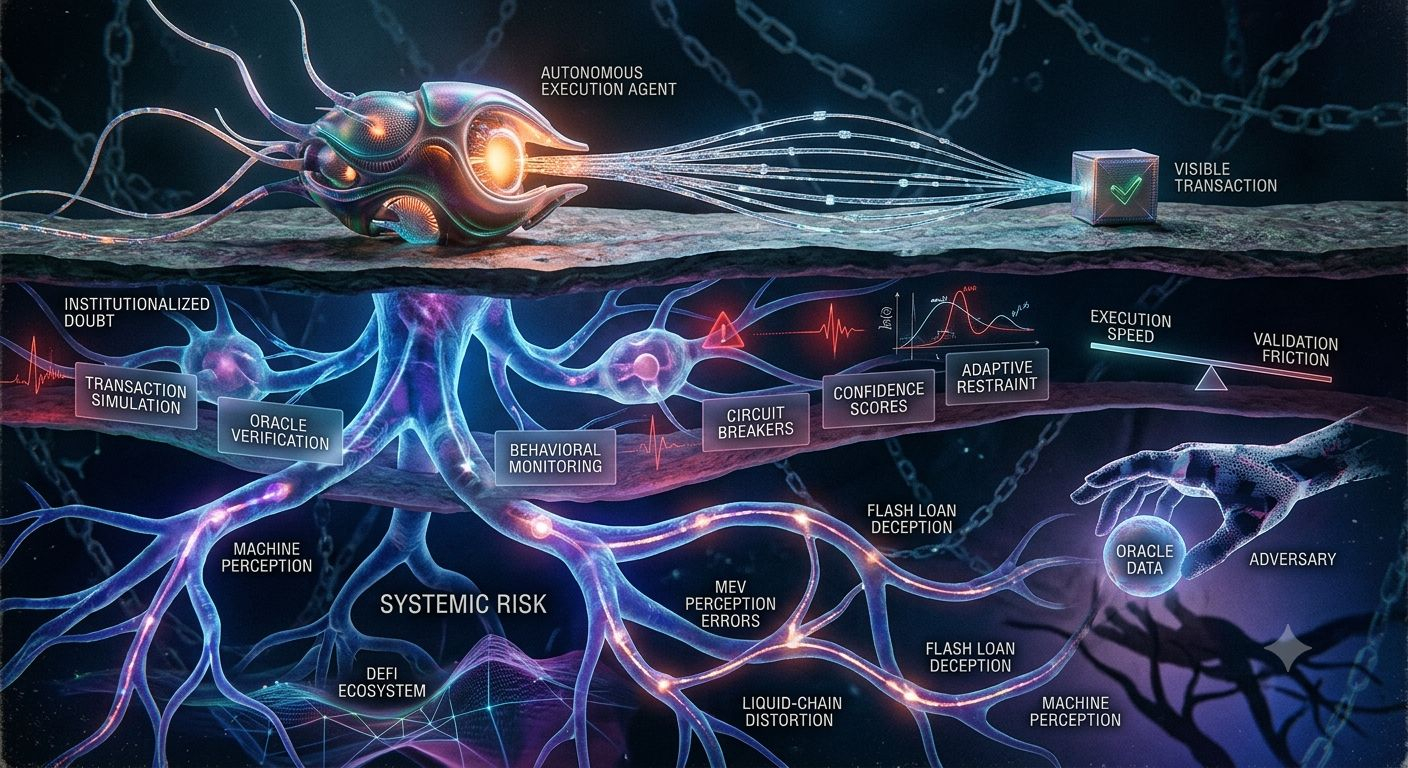
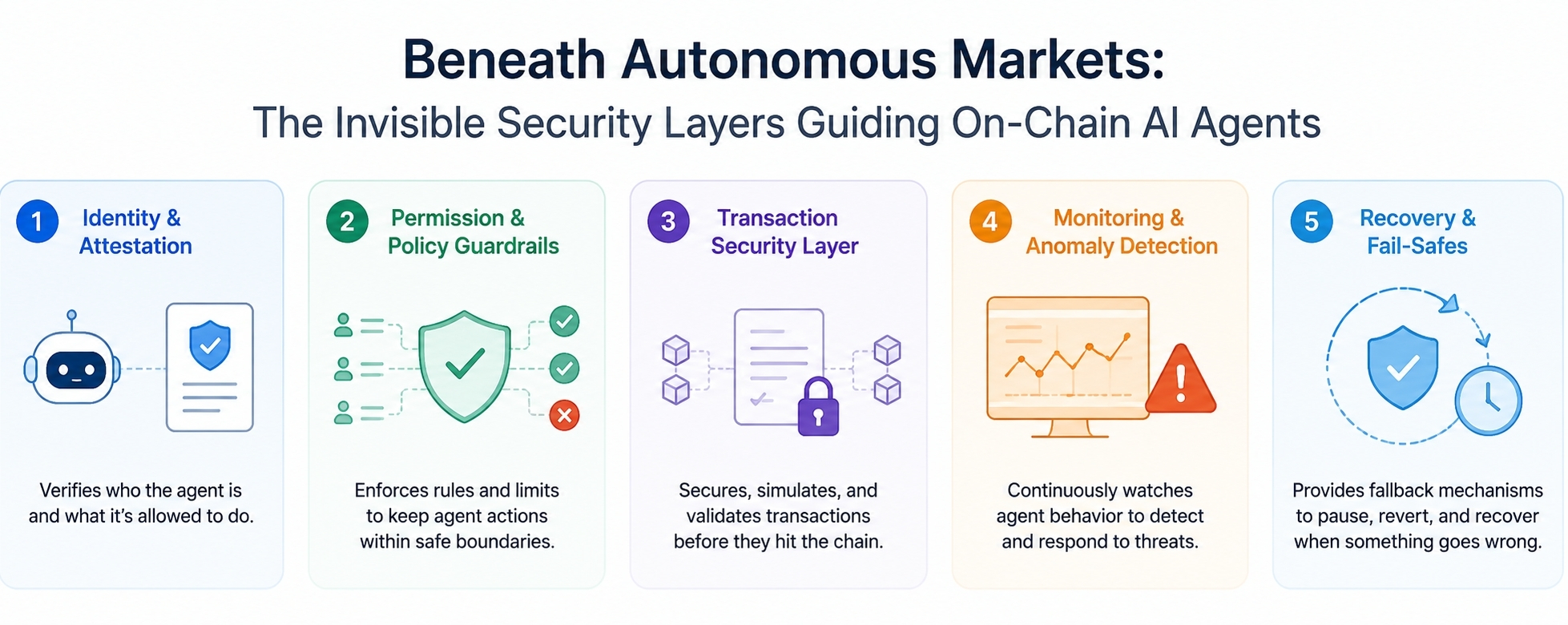
I noticed this especially while watching AI-assisted execution tooling interact with volatile liquidity conditions across chains. An autonomous agent may appear to simply route assets from one protocol into another, but beneath that surface action there are layers of invisible systems constantly asking whether the action itself should even be trusted. Transaction simulations replay state transitions before execution. Oracle verification layers compare price confidence across multiple feeds. Behavioral monitoring systems flag abnormal routing behavior against historical transaction fingerprints. Circuit breakers wait silently in the background, prepared to freeze execution if volatility exceeds probabilistic thresholds. To me, the infrastructure increasingly resembled a nervous system rather than software. The visible transaction was only the final expression of a much larger internal debate happening underneath.
The more time I spent observing treasury automation and cross-chain coordination systems, the more I realized that autonomous agents do not simply create isolated risks. They compound interconnected risks across multiple protocols simultaneously. A single machine interpretation can cascade through staking systems, lending markets, liquidity pools, governance voting structures, and bridge mechanisms within seconds. In older crypto environments, exploits often targeted individual weaknesses directly. A vulnerable smart contract could be drained. A flawed bridge could be manipulated. But what struck me now was how adversarial environments are evolving away from pure code exploitation and toward manipulation of machine perception itself. Modern attacks increasingly resemble attempts to distort what autonomous systems believe reality looks like.
Flash loans amplified this realization for me. They introduced a world where temporary liquidity distortion can manufacture entirely synthetic market conditions long enough to influence machine behavior. Oracle manipulation no longer feels like an isolated exploit category; it feels like environmental deception. In highly fragmented liquidity ecosystems spread across Ethereum mainnet, rollups, appchains, and interoperable liquidity layers, autonomous systems depend on interpreting constantly shifting data conditions with incomplete certainty. The deeper I looked into MEV environments and validator ordering behavior, the more fragile machine interpretation started to feel. Transaction ordering itself becomes part of the attack surface. Liquidity visibility becomes probabilistic. A routing agent may believe it is responding rationally to market conditions while unknowingly reacting to manipulated liquidity states engineered only for a few blocks.
What stayed with me most was the tension between speed and validation. Every autonomous system is competing against latency. Arbitrage agents race against other arbitrage agents. Liquidation systems compete for milliseconds. Treasury coordinators attempt to reposition assets before volatility expands. Governance automation reacts to rapidly shifting on-chain incentives. But every additional validation layer introduces friction. Every simulation consumes time. Every confidence threshold delays execution. And yet without those delays, the systems become dangerously vulnerable to manipulated state environments. I started realizing that much of modern crypto infrastructure is quietly built around managing this contradiction. The fastest system is rarely the safest one, but the slowest system may not survive competitive execution environments either.
This is where modern security began feeling less like protection and more like behavioral intelligence to me. Static defense assumptions no longer appear sufficient inside autonomous financial ecosystems. Hardcoded rules cannot fully adapt to adversarial liquidity behavior that evolves in real time. What I noticed emerging instead were probabilistic mitigation systems designed not to guarantee certainty, but to constantly evaluate uncertainty itself. Confidence scoring models, adaptive monitoring systems, anomaly detection engines, private mempool routing, and dynamic transaction throttling all seem to reflect the same philosophical shift: the infrastructure no longer assumes it fully understands the environment it operates within.
That realization changed the way I think about autonomous agents entirely. The visible automation layer receives most of the attention because it appears intelligent, but the real sophistication increasingly exists in the invisible restraint mechanisms beneath it. I started paying less attention to what agents were capable of executing and more attention to the systems determining whether execution should proceed at all. In many ways, the most advanced component of modern crypto infrastructure may not be automation itself, but institutionalized doubt embedded directly into machine behavior.
To me, this becomes even more important as AI-driven execution systems continue integrating across DeFi coordination layers. Once autonomous agents begin interacting with one another across fragmented ecosystems, the distinction between local and systemic risk starts disappearing. A distorted oracle on one chain can influence routing behavior elsewhere. A manipulated governance signal can trigger treasury movement across multiple protocols simultaneously. A temporary MEV-induced state distortion can propagate through automated strategies faster than humans can even recognize what happened. The infrastructure increasingly resembles an interconnected organism where perception errors spread faster than exploits themselves.
What stayed with me after studying these systems was not fear, but a strange respect for the invisible caution quietly emerging beneath the industry’s obsession with efficiency. Beneath every autonomous transaction, there are systems simulating outcomes, questioning assumptions, monitoring behavioral anomalies, comparing realities across data sources, and deciding whether the environment itself can still be trusted. Most users never see those layers. They only see the completed transaction. But the deeper I looked, the more I realized those invisible mitigation systems may ultimately matter far more than the agents executing the trades.
And honestly, I think that may define the next era of crypto infrastructure. Not machines acting more independently, but systems becoming more skeptical of the realities presented to them. Because in adversarial financial environments shaped by MEV extraction, liquidity distortion, validator incentives, and probabilistic market behavior, the greatest vulnerability may no longer be execution failure. It may be false perception. The future of autonomous on-chain intelligence, at least to me, feels increasingly dependent not on how aggressively machines can automate decisions, but on how carefully the systems beneath them learn to question the reality they believe they are observing.