
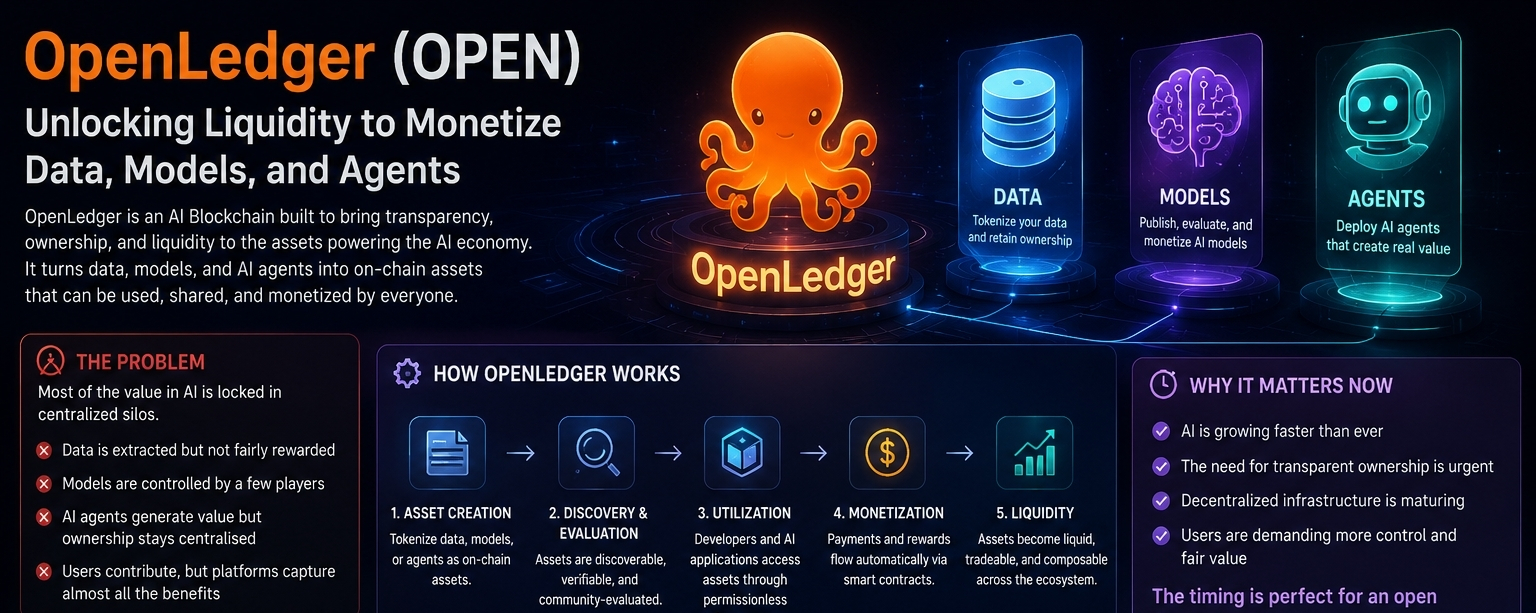
I’ve been thinking about how AI and crypto keep drifting closer to each other, not in a loud or dramatic way, but in a slow and almost uncomfortable realization that both are trying to solve parts of the same problem from different angles.
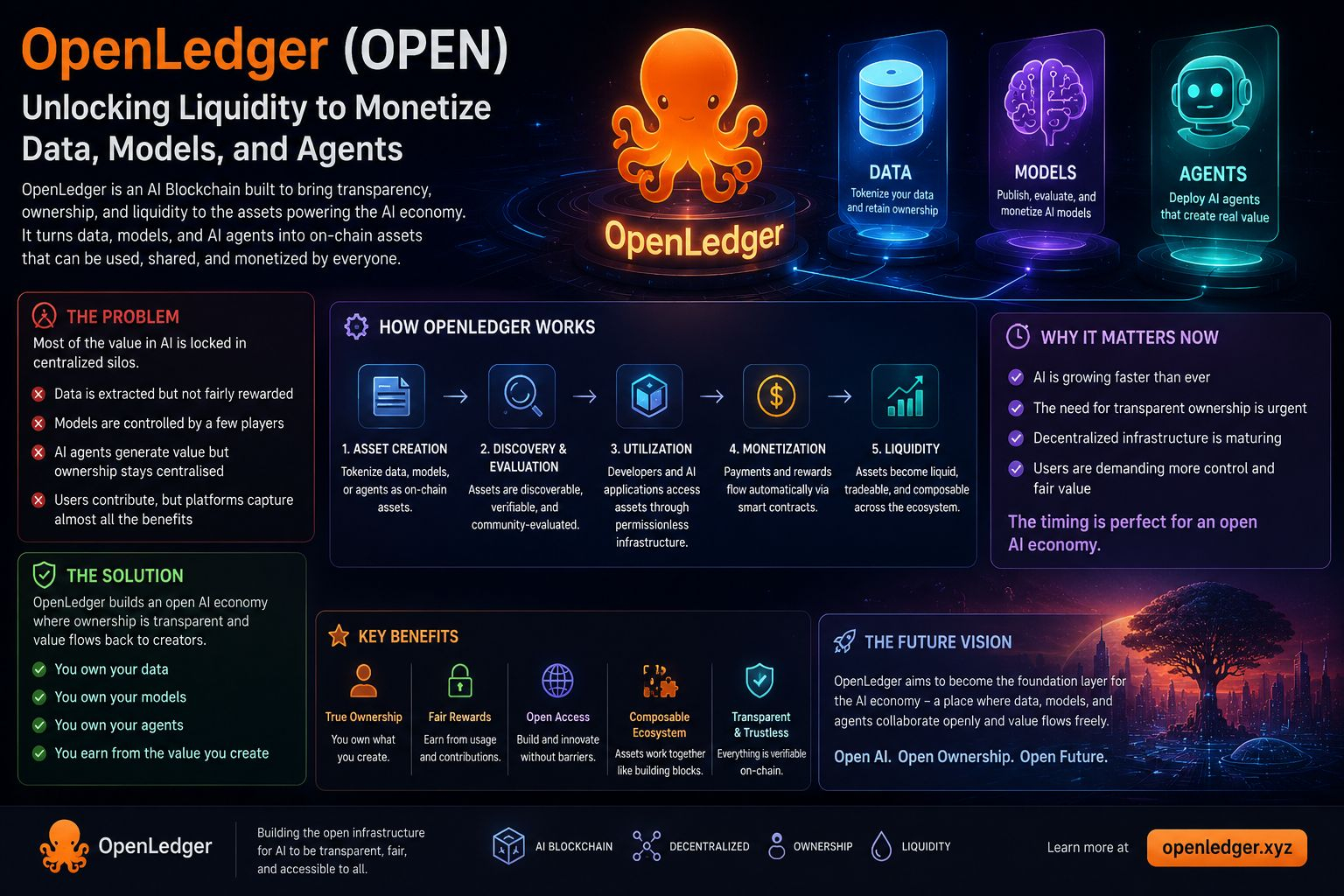
When I look at OpenLedger, I don’t see it as just another project trying to attach itself to the AI narrative. I see it more as a response to something that has already happened in the background of the internet. AI has already taken shape in a way where value is created continuously through data, models, and automated systems, but the ownership of that value feels strangely concentrated.
We live in a world where almost everything we interact with feeds some kind of model. Every search, every message, every interaction becomes part of a larger system that improves intelligence somewhere else. But the benefit of that improvement rarely comes back to the people or smaller systems that helped create it. It is not necessarily hidden, it is just not shared in a way that feels balanced.
That is where OpenLedger sits in this broader conversation. It is trying to explore whether the value created by data, AI models, and agents can be made more open and usable instead of being locked inside closed environments. The idea is not just about blockchain for the sake of blockchain, but about whether ownership and value distribution can be restructured in a way that feels more direct.
I keep coming back to this feeling that the internet has changed faster than its economic structure. We moved from simple websites to platforms, from platforms to AI driven ecosystems, but the way value is distributed still feels like it belongs to an older version of the internet where a few companies naturally sit at the center of everything.
What makes this moment interesting is that AI is no longer theoretical or experimental. It is active. It is shaping decisions, content, business processes, and even human behavior at scale. And once something becomes this embedded, the question of ownership becomes unavoidable. Not in a philosophical way, but in a practical one.
Who owns the data that trains these systems, who owns the output they generate, and who benefits when these systems improve over time. These are not new questions, but they are becoming more visible because AI has made the value of data more obvious than ever before.
OpenLedger is trying to step into that gap between creation and ownership. It is suggesting that data, models, and agents should not just exist as static resources inside closed systems, but as something that can be tracked, shared, and potentially monetized in a more fluid way. In theory, this creates a more open economy around intelligence itself.
But I also think it is important not to get carried away with the idea alone. The crypto space has seen many versions of this vision before. Data marketplaces, AI integrations, decentralized intelligence layers, all of them sound meaningful when described in isolation. The real challenge has always been adoption, not imagination.
People do not change how they use systems just because a new model of ownership exists underneath. They change when the experience becomes simple enough that they do not need to think about the infrastructure at all. That is usually where many ideas struggle. The concept works in theory, but the user never feels it in practice.
This is why execution matters more than narrative. In crypto especially, narratives can travel fast, but they do not sustain anything on their own. At some point, there has to be real usage, real activity, and real reason for someone to stay inside the system without being pushed by incentives alone.
What I find interesting about the current market environment is that the focus is slowly shifting again. The excitement around AI is still there, but underneath it, there is a quieter conversation forming around ownership, value distribution, and control. It is less about what AI can do and more about who it ultimately benefits.
Timing in this kind of shift is extremely delicate. If a project arrives too early, it feels abstract and unnecessary. If it arrives too late, the market has already settled into something else. The space in between is where most meaningful systems are actually built, but it is also the hardest space to navigate.
OpenLedger is positioned in that uncertain middle. It is responding to a problem that is real but still evolving. The value of data and AI output is already enormous, but the structure around how that value is shared is still unsettled. That creates both opportunity and risk at the same time.
There is also a broader shift happening in how we think about AI agents. They are no longer just tools that respond to prompts. They are starting to behave more like participants in systems, generating outputs continuously and interacting with other systems in ways that resemble economic activity. Once that reality becomes normal, ownership of those agents and their outputs becomes a much more serious question.
Still, I remain cautious because the gap between concept and real adoption in crypto is always wider than it looks from the outside. Many ideas feel inevitable when discussed in theory, but only a small number survive when exposed to actual user behavior, market pressure, and competition.
So when I think about OpenLedger, I do not see certainty. I see a direction that feels aligned with where both AI and crypto are naturally heading, but still unproven in terms of execution. The idea of making data and model value more liquid and accessible makes sense in a world where intelligence itself is becoming a core economic layer, but the real test will always be whether people actually use it without friction.
In the end, what feels most important is not whether this specific project succeeds or fails, but what it represents. A shift in thinking where data is no longer treated as something silently consumed by systems, but as something that carries ownership, value, and participation. And that shift, whether slow or fast, already feels like it has started.
