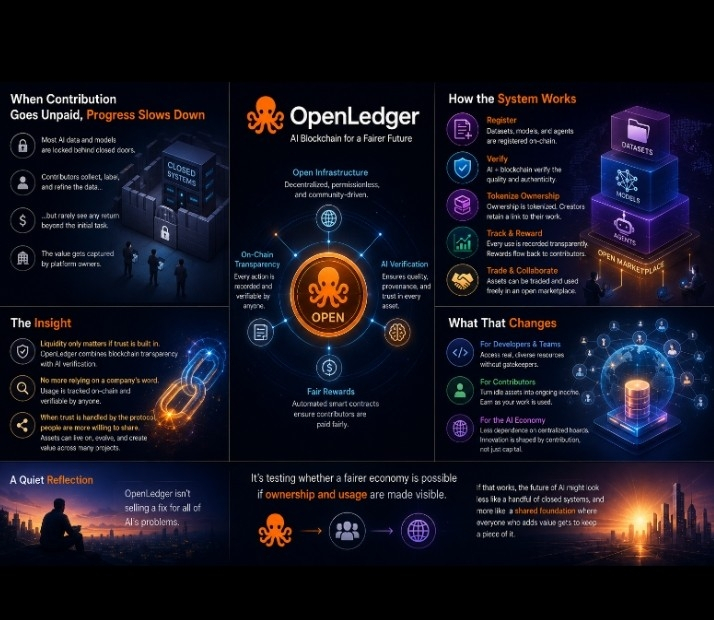
(OPEN) is an AI-powered blockchain ecosystem designed to unlock liquidity for data, models, and intelligent agents. In today’s digital world, massive technology companies control most AI systems and profits, while the people who contribute valuable data often receive nothing in return. OpenLedger aims to change this by creating a decentralized infrastructure where contributors can truly own and monetize their AI assets.
The platform combines blockchain transparency with artificial intelligence, allowing developers, businesses, and users to securely trade datasets, AI models, and autonomous agents in an open marketplace. Through tokenized ownership and decentralized verification, OpenLedger creates trust between creators and users while reducing dependence on centralized platforms.
One of the most important ideas behind OpenLedger is liquidity. Traditionally, AI data and models are difficult to value or trade efficiently. OpenLedger transforms these assets into programmable and tradable resources, enabling creators to generate ongoing rewards from their contributions. This creates a fairer digital economy where innovation is rewarded directly.
As artificial intelligence continues to reshape industries, OpenLedger positions itself as a foundation for the future AI economy — one where ownership, transparency, and decentralization empower everyone, not just large corporations.*When Contribution Goes Unpaid, Progress Slows Down*
Right now, most of the data and models that power AI live behind closed doors. The people who collect it, label it, and refine it rarely see any return beyond the initial task. The value gets captured further down the line by whoever owns the platform.
OpenLedger (OPEN) treats this as an infrastructure problem. It’s an AI-powered blockchain where datasets, models, and agents can be registered, verified, and traded directly on-chain. Ownership is tokenized, so creators keep a link to their work even after it’s shared. Every use is recorded transparently, and rewards flow back to the contributor without a central platform deciding the split.
The goal isn’t to replace existing AI tools. It’s to make the underlying assets programmable and tradable, so they can move freely between developers, businesses, and users in an open marketplace.
Liquidity only matters if trust is built in. OpenLedger handles that by combining blockchain transparency with AI verification. Instead of relying on a company’s word that usage is tracked correctly, the record lives on-chain and can be checked by anyone.
When trust is handled by the protocol, people are more willing to share. A dataset built for one project doesn’t have to die after that project ends. A model trained for a niche use can become a building block for someone else.
For developers and smaller teams, it means access to real, diverse resources without negotiating with gatekeepers. For contributors, it turns idle assets into ongoing income. A model or dataset you built months ago can still generate value as others build on it.
For the broader AI economy, it reduces dependence on centralized data hoards. Innovation stops being gated by who has the most capital, and starts being shaped by who contributes useful work
OpenLedger isn’t selling a fix for all of AI’s problems. It’s testing whether a fairer economy is possible if ownership and usage are made visible.