
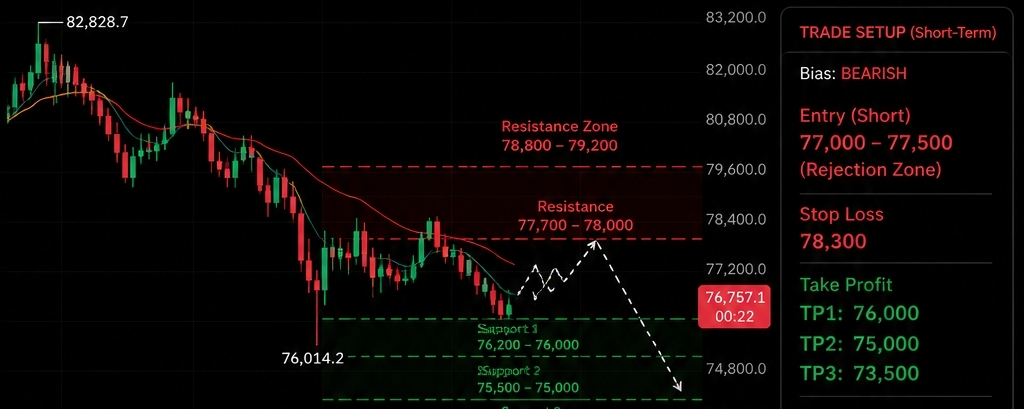


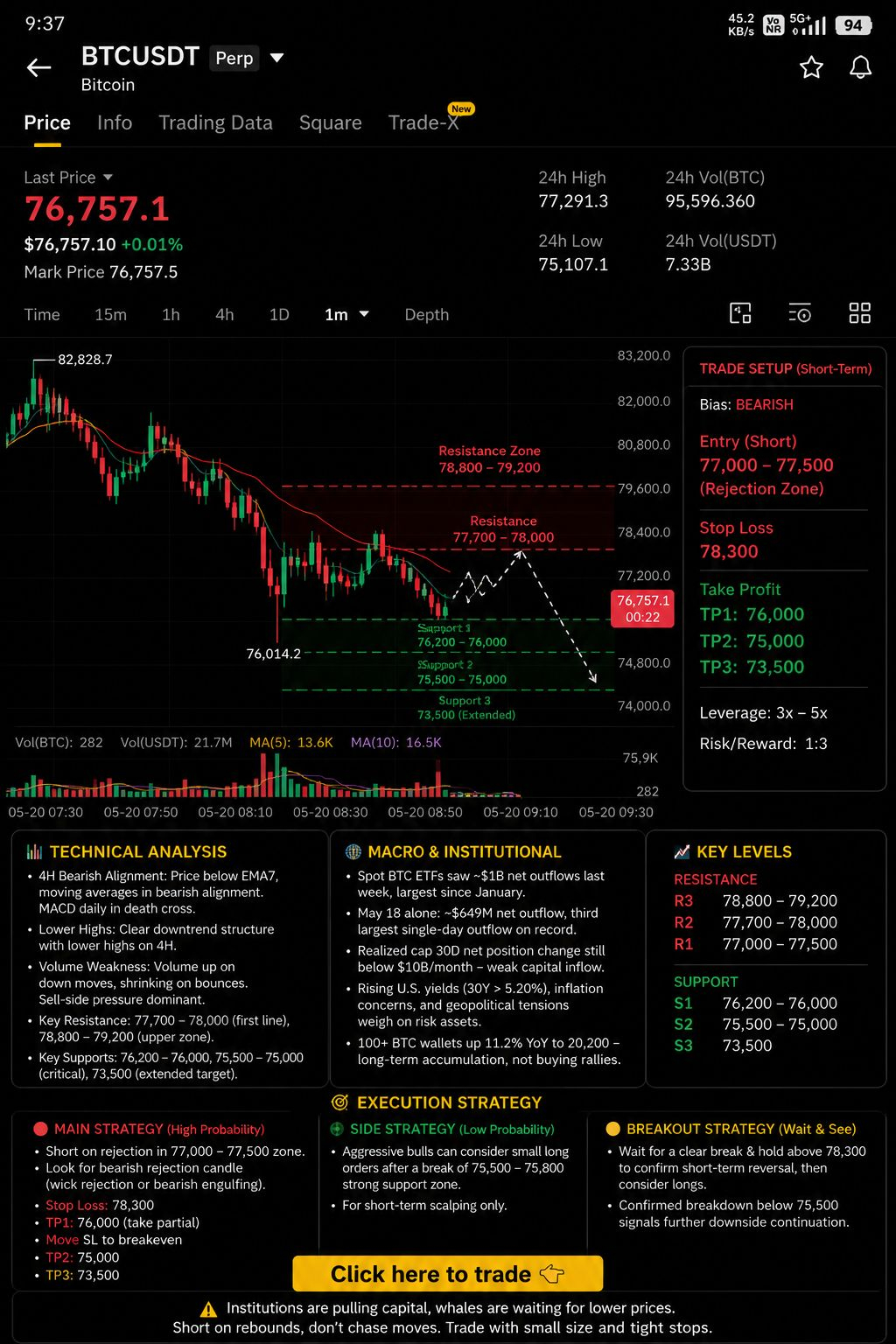
 As of May 20, Bitcoin is trading around $76,757, stuck in a weak consolidation phase after failing to reclaim higher resistance levels. Despite occasional bounce attempts, the broader market structure still favors the bears, and traders are becoming increasingly cautious as both technical and macroeconomic pressures continue to build.
The current market environment reflects a classic “weak rebound inside a bearish structure” scenario where short-term recoveries lack conviction, volume remains thin, and sellers continue to dominate every relief rally.
BTC/USDT — Short-Term Trade Setup
🔴 Main Setup: Short the Rebound
Entry Zone: 77,000–77,500
Stop Loss: 78,300
Leverage: 3–5x
Risk/Reward: Up to 1:3
🎯 Take Profit Targets
TP1: 76,000
TP2: 75,000
TP3: 73,500
The strategy is simple: wait for Bitcoin to test the resistance zone and show signs of rejection before entering short positions.
Market Structure Remains Bearish
Bitcoin’s recent price action has not shown enough strength to confirm a meaningful reversal. Instead, the market continues to print:
Lower highs on the 4H chart
Weak recovery candles
Declining buy-side volume
Stronger selling pressure during breakdowns
This structure suggests that current rebounds are more likely “distribution moves” rather than genuine bullish accumulation.
Every time BTC pushes upward, sellers quickly step in near resistance zones, preventing momentum from developing further.
Key Technical Signals Traders Are Watching
1. Bearish Moving Average Alignment
On the 4-hour timeframe, moving averages remain positioned in bearish order, while price continues to struggle below short-term EMA resistance.
This signals:
Weak trend strength
Lack of bullish control
Continued downside pressure
The inability to reclaim and hold above short-term averages is one of the clearest signs that bulls remain defensive.
2. MACD Death Cross on Daily Timeframe
The daily MACD has already formed a bearish crossover (“death cross”), while the histogram remains below the zero line.
Although downside momentum is slowing slightly, there is still no confirmed reversal signal.
This means:
The trend remains bearish overall
Momentum still favors sellers
Any rebound remains vulnerable to rejection
3. Resistance Zones Continue to Reject Price
Immediate Resistance:
77,700–78,000
This zone contains:
4H mid-band resistance
Previous intraday highs
Short-term supply pressure
Major Resistance:
78,800–79,200
A breakout above this range would invalidate the current bearish setup and potentially trigger a stronger recovery rally.
Until that happens, traders continue to view rallies as selling opportunities.
Support Levels That Matter Most
Immediate Support: 76,200–76,000
This area has acted as short-term support several times already, but repeated testing weakens any support zone over time.
A clean break below this range could accelerate downside momentum quickly.
Critical Trend Defense: 75,000–75,500
This is currently the most important support region on the chart.
Historically, Bitcoin has reacted strongly from this area, making it a likely battlefield between buyers and sellers.
However, if BTC loses this level decisively, the market could enter a much deeper correction phase.
Fibonacci Target: 75,613
The 0.236 Fibonacci retracement level around 75,613 is acting as a major downside magnet and aligns closely with the broader support cluster.
This confluence increases the probability of price revisiting the area before any sustainable recovery attempt.
Institutional Capital Is Flowing Out
Technical weakness alone is not driving the current decline.
Institutional flows have also turned sharply negative.
Recent spot Bitcoin ETF data shows one of the largest weekly outflow periods since January, ending a six-week streak of positive inflows.
This shift matters because ETFs have become one of the strongest demand drivers for Bitcoin in 2025.
Now, instead of supporting price growth, they are adding pressure to the downside.
Why ETF Outflows Matter
When institutional money exits aggressively:
Liquidity weakens
Momentum slows
Market confidence declines
Retail traders become more cautious
The recent outflows suggest institutions are not willing to chase BTC at current prices and may prefer waiting for lower levels before re-entering.
This explains why rebounds continue failing despite oversold conditions.
Macro Conditions Are Also Hurting Risk Assets
Bitcoin is also facing pressure from broader macroeconomic conditions.
Several factors are reducing investor appetite for risk:
Rising U.S. Treasury yields
Stronger rate hike expectations
Sticky inflation concerns
Geopolitical tensions
Tightening liquidity conditions
As bond yields rise, investors tend to move capital away from speculative assets like crypto and into safer income-generating assets.
This environment makes sustained Bitcoin rallies harder to maintain.
Long-Term Holders Are Still Accumulating
Despite short-term weakness, long-term whale behavior remains interestingly bullish.
The number of wallets holding at least 100 BTC has continued rising year-over-year, suggesting larger players are still accumulating over time.
However, these investors are accumulating patiently at lower prices rather than aggressively buying current rallies.
That distinction is important.
It suggests long-term confidence in Bitcoin still exists but short-term momentum remains weak.
Execution Strategy Going Forward
🔴 High Probability Setup
The preferred strategy remains:
Wait for BTC to revisit resistance
Look for rejection candles
Enter shorts on failed breakouts
Protect capital with tight stop losses
This approach follows current market structure instead of attempting to predict reversals prematurely.
🟢 Aggressive Bullish Scalping Setup
For aggressive traders only:
Small long positions may become attractive if BTC sharply flushes into the 75,500–75,800 support region and shows strong reaction buying.
However, this remains a countertrend trade and carries higher risk.
🟡 Breakout Confirmation Strategy
Two confirmations would shift market bias:
Bullish Confirmation:
A strong breakout and hold above 78,300
Bearish Confirmation:
A confirmed breakdown below 75,500
Until one of these scenarios happens, Bitcoin remains trapped inside a fragile bearish consolidation structure.
Final Outlook
Right now, Bitcoin is showing signs of exhaustion rather than strength.
Institutional outflows, weak technical structure, and worsening macro conditions are creating a difficult environment for bulls.
Unless BTC can reclaim higher resistance levels with strong volume, the market may continue drifting toward the critical $75K support region.
For short-term traders, the current environment favors:
Patience
Smaller position sizing
Tight risk management
Selling failed rebounds instead of chasing breakouts
The trend remains vulnerable, and volatility could increase sharply if key support levels fail.
#PolymarketNasdaqPredictionMarketPartnership $BTC
