
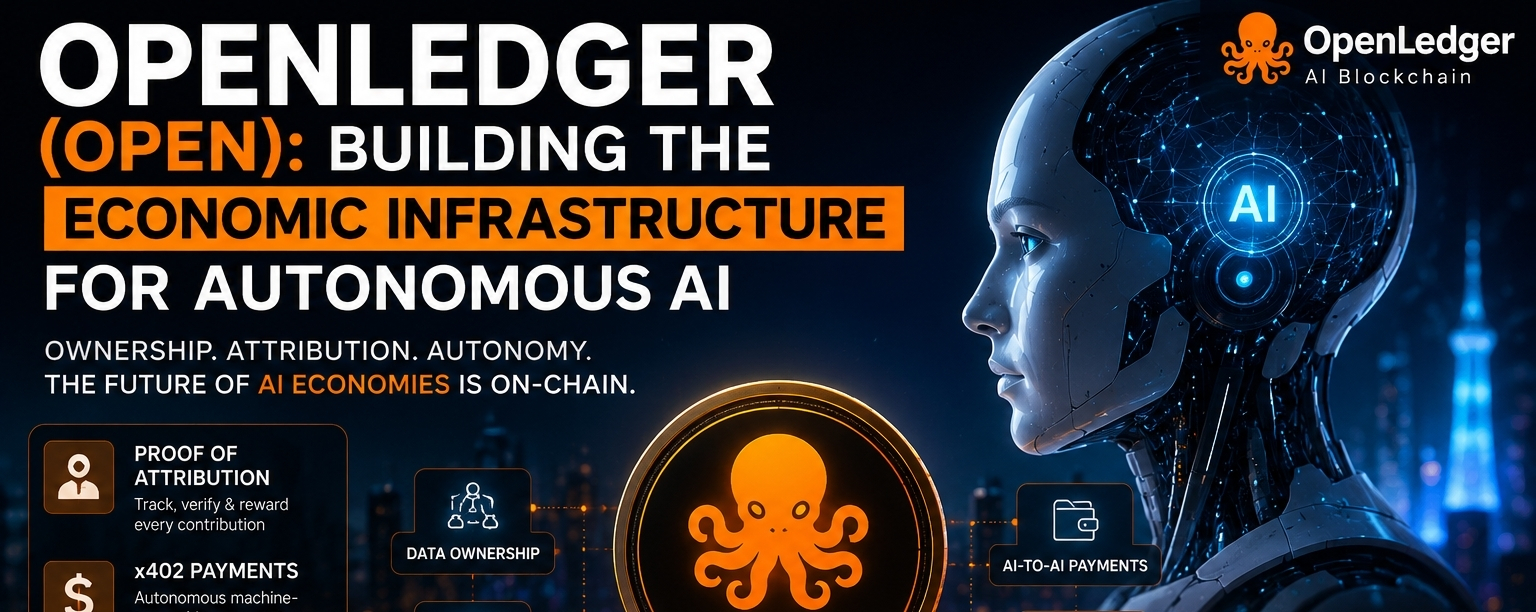
OpenLedger is entering the market at a time when artificial intelligence is expanding faster than the systems designed to govern it. Every week new AI models appear, billions of dollars flow into infrastructure, and companies race to automate industries, yet one fundamental issue remains unresolved: ownership. Who owns the data feeding these models? Who receives compensation when an AI system generates value? Who controls the economic activity created by autonomous agents operating online? Most projects avoid these questions because solving them requires more than another chatbot or blockchain narrative. It requires building an entirely new economic framework for intelligence itself. That is the direction OpenLedger appears to be pursuing.
What initially separates OpenLedger from most AI-focused crypto projects is that the ecosystem is not centered around speculation or short-term hype mechanics. Instead of positioning itself purely as an AI chain, the project is developing infrastructure that allows AI models, datasets, APIs, and autonomous agents to become verifiable economic participants. The protocol’s long-term vision revolves around programmable ownership, transparent attribution, and machine-native financial systems where artificial intelligence can transact independently without relying on centralized intermediaries. That changes the conversation dramatically because it pushes AI beyond content generation and into autonomous economic coordination. (mpost.io)
The current AI industry operates on a highly centralized structure. Large corporations collect user data, train proprietary models, monetize outputs, and retain nearly all revenue generated from those systems. Contributors rarely know how their information is used, creators receive no transparent attribution, and developers remain dependent on closed ecosystems controlled by a handful of companies. OpenLedger is attempting to challenge that structure by introducing verifiable ownership mechanisms directly into AI infrastructure. Through its Proof of Attribution framework, the network records contributions from datasets, developers, model creators, and agents on-chain so economic rewards can be distributed transparently across participants. Instead of invisible extraction, the ecosystem aims to create traceable value flows inside AI economies. (chainwire.org)
That attribution layer may ultimately become one of the project’s most important innovations because the global debate around AI ownership is intensifying rapidly. Governments are already examining copyright violations, unauthorized data usage, and the legal accountability of generative AI systems. Large enterprises deploying AI at scale also require auditability before integrating autonomous decision-making into sensitive operations. OpenLedger’s infrastructure directly addresses those concerns by embedding transparency into the architecture itself. Every contribution can theoretically be tracked, verified, monetized, and audited in real time. In a future where AI regulation becomes unavoidable, accountability infrastructure could become as valuable as the models themselves. (chainwire.org)
The ecosystem’s recent expansion through x402 infrastructure represents another major step toward that vision. x402 transforms the outdated HTTP 402 “Payment Required” response into an autonomous payment mechanism for AI agents and APIs. While that may sound technical on the surface, the implications are enormous. Today most digital services depend on subscriptions, API keys, billing systems, centralized payment processors, and manual approvals. OpenLedger’s architecture allows AI agents to access services programmatically, receive payment requests automatically, settle transactions on-chain, and continue execution without human involvement. This creates the foundation for machine-to-machine commerce where software agents can independently purchase resources, data access, compute power, or digital services in real time. (mpost.io)
That shift matters because AI systems are evolving from passive assistants into autonomous operators. The next generation of AI agents will not simply answer prompts. They will schedule workflows, negotiate contracts, analyze financial markets, coordinate logistics, manage digital assets, and communicate with other agents across networks. Once intelligence becomes autonomous, traditional payment infrastructure becomes inefficient. Human-centered systems were never designed for billions of machine-level microtransactions occurring every second. OpenLedger appears to recognize that early and is building financial rails specifically for autonomous intelligence economies. (mpost.io)
Another reason the project has started attracting attention is the growing conversation around agentic economies. The concept sounds futuristic, but the technological foundation is already forming. Imagine an AI research agent paying another specialized agent for real-time data analysis. Imagine autonomous customer service systems renting temporary compute resources during traffic spikes. Imagine AI trading agents purchasing predictive datasets before executing financial strategies. These interactions require programmable ownership, instant settlement, identity systems, and transparent attribution. OpenLedger’s infrastructure stack is gradually aligning around those exact requirements. (openledger.xyz)
The emergence of Octoclaw orchestration infrastructure reinforces that direction further. OpenLedger is no longer just discussing AI coordination theoretically; it is building tooling that enables multi-agent execution environments. Octoclaw introduces orchestration systems where autonomous agents can coordinate workflows, execute tasks across networks, and interact through programmable infrastructures. That moves the ecosystem closer to operational machine economies rather than isolated AI utilities. The significance of this transition cannot be overstated because interoperability will likely determine which AI ecosystems survive long term. A fragmented AI economy where agents cannot coordinate efficiently across networks would severely limit scalability. OpenLedger’s architecture appears designed to prevent that fragmentation from the start. (octoclaw.ai)
One of the strongest aspects of the OpenLedger thesis is that the project focuses on infrastructure instead of temporary consumer trends. Many AI tokens experience rapid price appreciation simply by associating themselves with artificial intelligence narratives, but very few are building systems capable of supporting actual economic activity between autonomous entities. OpenLedger’s emphasis on payment rails, attribution systems, orchestration layers, and verifiable ownership positions the ecosystem closer to a foundational protocol than a speculative application. If AI economies eventually scale into trillion-dollar industries, the infrastructure coordinating value exchange may become significantly more valuable than individual consumer-facing products.
The OPEN token itself functions as the economic coordination mechanism inside that ecosystem. Token utility extends beyond simple transaction fees because the network integrates incentives across attribution rewards, ecosystem participation, validator coordination, agent execution, and settlement infrastructure. Contributors providing useful datasets or models can theoretically receive compensation tied directly to network activity. Developers deploying AI infrastructure can monetize usage transparently. Autonomous agents operating within the ecosystem can execute economic activity using programmable payment systems. The token becomes intertwined with machine-level coordination rather than existing solely as a speculative asset. (docs.openledgerfoundation.com)
Market momentum surrounding OPEN has accelerated recently as investors begin recognizing the broader implications of AI-native financial infrastructure. Over the last 24 hours alone, the token gained more than 4% amid ecosystem announcements and reward campaigns designed to increase visibility and retail engagement. Momentum indicators briefly pushed into overbought territory before stabilizing, reflecting heightened speculative attention following infrastructure updates. While short-term price movements always carry volatility, the larger story revolves around whether OpenLedger can establish itself as a core infrastructure layer before competitors attempt similar architectures.
Retail campaigns and exchange incentives are helping increase awareness, but institutional interest may eventually matter far more. Large enterprises integrating AI systems increasingly require transparent audit trails, verifiable ownership records, and programmable economic structures. OpenLedger’s infrastructure directly addresses those enterprise-level concerns. In many ways the project sits at the intersection of two massive technological shifts: decentralized finance and autonomous artificial intelligence. If those sectors converge successfully, protocols capable of coordinating ownership and payments between intelligent systems could become foundational internet infrastructure.#
However, the project also faces serious risks that investors should not ignore. One of the largest concerns involves future token unlock schedules. Approximately one-third of the total supply remains allocated to team members and early investors with linear unlock mechanisms beginning later in 2026. If ecosystem growth fails to outpace distribution pressure, the market could face sustained selling activity over extended periods. Tokenomics remain one of the most critical variables for long-term sustainability, especially for infrastructure projects requiring years of development before mass adoption materializes. (docs.openledgerfoundation.com)
Governance concentration also creates potential long-term issues. Decentralization remains a central narrative across blockchain ecosystems, but heavy insider allocations can influence protocol direction significantly during early stages. If governance becomes overly centralized, OpenLedger risks undermining the very transparency principles it promotes. Balancing operational efficiency with distributed decision-making will likely become increasingly important as the ecosystem expands.
Technical vulnerabilities present another challenge. Autonomous financial systems operating without human oversight require extremely secure infrastructure because failures can cascade rapidly across interconnected networks. Researchers have already identified concerns surrounding authorization systems and replay protection mechanisms connected to x402 implementations. While vulnerabilities are common during early infrastructure development, OpenLedger’s ambitions involve machine economies executing transactions automatically at scale. That environment leaves little room for security weaknesses. Robust auditing, emergency response systems, and decentralized safeguards will become absolutely critical if the ecosystem is expected to support real-world autonomous financial activity. (cryptonewsnavigator.com)
Competition also remains intense. Nearly every major blockchain ecosystem is now exploring AI integrations, decentralized compute systems, or agent infrastructure. Larger networks possess significantly greater capital, developer resources, and user bases. OpenLedger’s advantage lies in specialization. Instead of competing broadly across every AI vertical, the project focuses specifically on ownership infrastructure, attribution, and autonomous economic coordination. Whether that specialization becomes a competitive advantage or a limiting factor will depend largely on adoption over the next few years.
Still, the broader macro narrative supporting AI infrastructure remains extremely powerful. Artificial intelligence is rapidly moving beyond experimentation into economic integration. Businesses increasingly depend on AI systems for automation, optimization, analysis, and decision-making. As autonomous agents become more capable, demand for machine-native financial systems will likely increase dramatically. Existing internet infrastructure was designed for humans interacting through centralized platforms. OpenLedger is building infrastructure for software agents interacting autonomously through decentralized systems.
The philosophical implications are equally important. The project is essentially challenging assumptions about ownership in digital economies. Traditionally platforms capture most economic value while users contribute data passively without compensation. OpenLedger proposes a model where value attribution becomes transparent and programmable. Contributors, developers, datasets, models, and agents can all participate economically according to verifiable activity. If implemented successfully, that framework could reshape how digital economies distribute revenue generated by artificial intelligence.
What makes the project particularly compelling is that its long-term vision extends beyond cryptocurrency speculation entirely. OpenLedger is not simply attempting to build another DeFi application or AI token. The ecosystem is designing infrastructure for a future where intelligence itself becomes an economic actor. Autonomous systems will require payment rails, ownership verification, attribution tracking, governance coordination, and interoperable execution environments. OpenLedger’s architecture appears intentionally constructed around those future requirements rather than current market trends.
The coming years will likely determine whether decentralized AI economies become mainstream reality or remain experimental concepts. Adoption will depend on scalability, security, regulatory clarity, developer participation, and real-world utility. OpenLedger still operates at an early stage, and substantial uncertainty remains around execution. Yet the project’s direction feels notably different from many AI narratives dominating crypto markets today. Instead of focusing on speculative excitement, the ecosystem is attempting to solve foundational structural problems surrounding intelligence ownership and autonomous economic coordination.
That distinction may ultimately define its long-term relevance. Artificial intelligence is no longer just a software trend; it is becoming an economic layer integrated into every industry. Once intelligence begins operating autonomously, ownership and value distribution become unavoidable questions. OpenLedger is positioning itself directly at that intersection between AI, finance, and decentralized infrastructure.
Whether the ecosystem succeeds or fails, the problems it is addressing are real and increasingly important. Who owns AI-generated value? How are contributors compensated? How can autonomous systems transact securely without centralized intermediaries? How do regulators audit machine-level economic activity? Those questions will shape the next phase of digital economies far more than short-term speculation cycles.
Right now OpenLedger remains early, volatile, and highly experimental. But the infrastructure being developed underneath the surface suggests the project is aiming far beyond ordinary blockchain applications. It is attempting to build the economic architecture for autonomous intelligence itself. And if machine economies eventually become a major part of the global digital system, protocols solving attribution, ownership, and autonomous settlement may become some of the most important infrastructure layers of the next decade.