

i don’t think the internet is changing in the way most people imagine.
everyone keeps talking about faster AI smarter agents better models but the bigger shift might not be the intelligence itself.
it might be the structure underneath it.
because if you really look at how the internet works today, almost everything still revolves around platforms.
platforms collect attention. platforms collect data. platforms organize visibility. platforms decide distribution.
users move inside systems they don’t really control… feeding them constantly through clicks, prompts, uploads, conversations, behavior.
and over time those systems become more intelligent from everyone participating inside them.
but something strange happens there.
the intelligence grows while the people contributing to it slowly disappear into the background.
that’s why i keep wondering if the next version of the internet won’t actually be platform-based anymore.
maybe it becomes network-based instead. not social networks intelligence networks.
systems where value doesn’t just come from hosting users but from coordinating intelligence itself.
and honestly, OpenLedger feels closer to that direction than most AI projects i’ve seen.
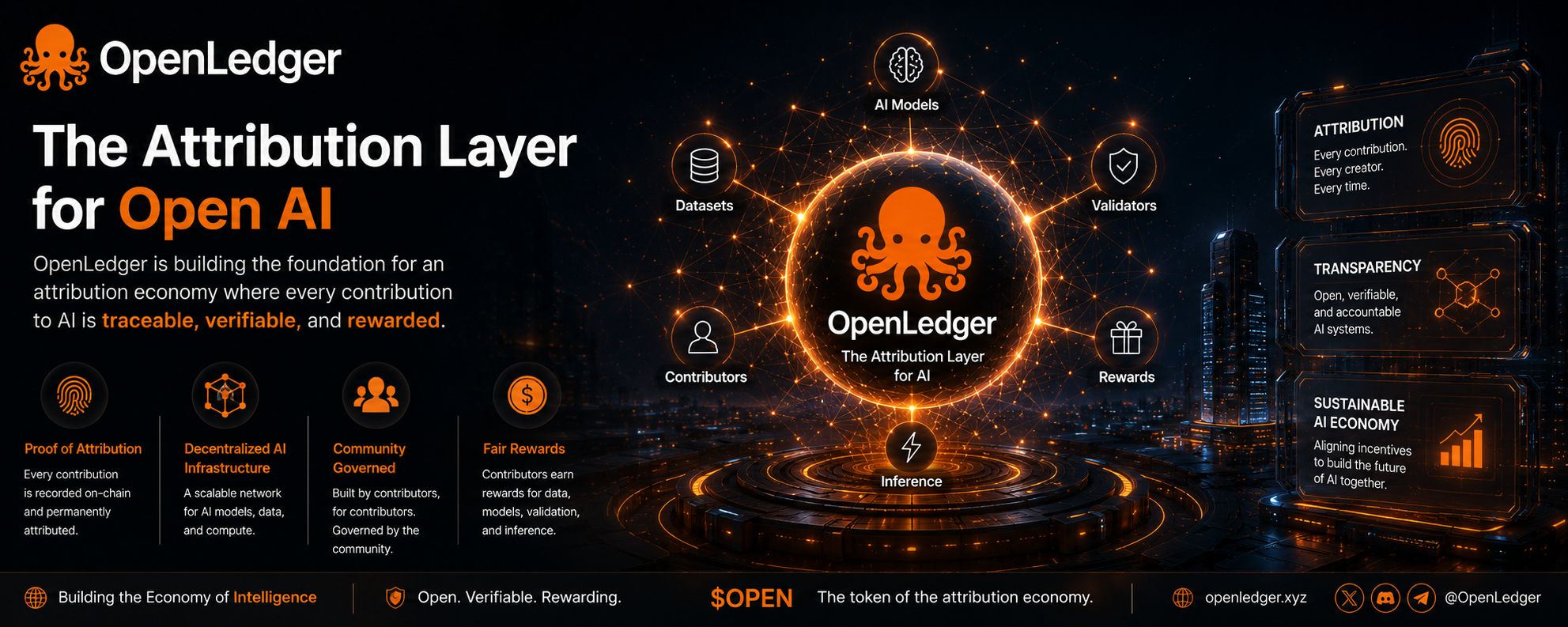
because it doesn’t just treat AI like software. it treats intelligence like an ecosystem made from contributors, datasets, validators, models, agents, feedback loops, inference activity
almost like every interaction becomes part of a living structure.
that changes the feeling of the internet completely.
because platforms mostly extract. they centralize visibility and monetization.
but intelligence networks would need something else: attribution, traceability, economic coordination, shared ownership, verifiable contribution.
otherwise the whole thing collapses back into invisible labor again.
and maybe that’s why OpenLedger keeps focusing so heavily on Proof of Attribution.
at first it just sounds technical but the more i think about it, the more it feels economic.
because if intelligence becomes the most valuable infrastructure online then the biggest question becomes:
who gets remembered inside it?
who trained the models? who improved them? who provided the useful data? who shaped outputs through feedback? who actually contributed to the intelligence people are consuming?
right now most of that disappears behind APIs and interfaces.
but if future systems start recording contribution directly on-chain… the internet stops behaving like a collection of websites.
it starts behaving more like an intelligence economy.
and maybe that changes trust too.
instead of trusting platforms because they’re big, people may start trusting systems because contribution is transparent.
that’s a very different model.
because platforms control access but intelligence networks coordinate participation.
and once AI agents start interacting with each other, sharing models, requesting inference, feeding data back into systems, governing updates, rewarding contributors
the internet itself may stop looking human-centered in the traditional sense.
not because humans disappear but because intelligence becomes the layer everything else starts organizing around.
which honestly feels strange to think about.
because maybe the next internet won’t be built around apps at all.
maybe it’ll be built around systems constantly learning from everyone inside them while blockchain quietly becomes the memory layer keeping track of who shaped the intelligence in the first place.
and if that happens
then platforms may end up looking like the early version of something much larger that was trying to emerge underneath the whole time.
