
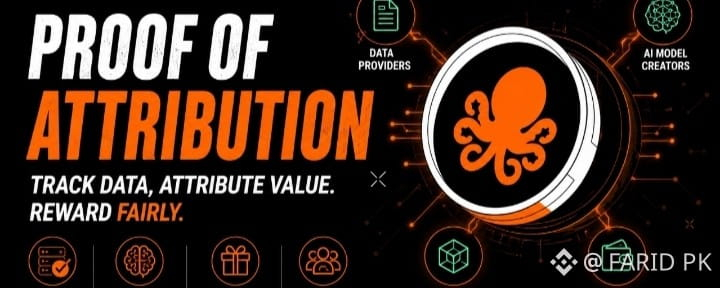
When I first read about Proof of Attribution (PoA) inside OpenLedger, I paused. Not because it sounded flashy — it didn’t. It sounded almost administrative. Attribution. Tracking. Reward routing.
But the more I looked at it, the more I realized that attribution might be the entire economic hinge of AI infrastructure.
We talk endlessly about model performance. We rarely talk about who trained the model, whose data shaped its outputs, and whether those contributors ever see ongoing value. PoA is OpenLedger’s attempt to answer that gap — structurally, not rhetorically.
It’s less about “AI on-chain” and more about “value tracing on-chain.”
The Core Problem: AI Attribution Is Blurry
AI models don’t create intelligence from nowhere. They absorb patterns from data — often layered, mixed, aggregated across thousands of contributors.
Once trained, though, attribution becomes murky.
If a logistics model improves route optimization, which dataset deserves credit? The most recent one? The largest? The most performance-improving?
Off-chain, this attribution is typically invisible. Platforms collect data. Models generate revenue. Contributors rarely participate beyond initial compensation.
PoA attempts to formalize contribution tracking at the infrastructure level.
That’s ambitious. And delicate.
How Proof of Attribution Works (Structurally)
OpenLedger’s PoA framework is designed to:
Record data contributions on-chain
Track model training dependencies
Attribute output usage back to inputs
Route tokenized rewards proportionally
In theory, every dataset uploaded into the ecosystem carries a cryptographic identity. When a model trains on that data, dependency records are stored. When the model is deployed — say via an AI agent — and generates revenue, PoA calculates contribution weights.
Those weights determine reward distribution.
That’s the mechanical loop: Data → Model → Usage → Revenue → Attribution → Reward.
But that loop only holds if attribution metrics are credible.
And that’s where this gets interesting.
Incentives: Why This Changes Behavior
In traditional AI systems, data providers are paid once — if at all.
Under PoA, they potentially earn continuously as long as their contribution influences model outputs.
That shifts incentives significantly.
For example, imagine a medical dataset contributor deciding whether to upload highly structured, labeled data versus loosely formatted bulk records.
If PoA rewards measurable performance contribution, then higher-quality structured data would earn more over time.
That creates a rational incentive: Better data → Stronger attribution weight → More sustained token rewards.
On the model creator side, incentives also shift.
Instead of hoarding datasets privately, developers may integrate verified on-chain data sources because doing so signals traceable contribution history — potentially increasing trust and adoption.
But here’s the critical question:
How accurately can performance contribution be isolated in complex multi-dataset training environments?
Because attribution errors would distort incentives quickly.
A Practical Example
Let’s ground this in something concrete.
Suppose a financial analytics firm uploads proprietary macroeconomic data to OpenLedger. That dataset becomes part of a training corpus for a trading signal model.
Months later, that model is used by multiple AI agents providing automated portfolio adjustments. Users pay fees in OpenLedger tokens for these services.
Under PoA:
The model creator earns a share based on deployment usage.
The data contributor receives proportional rewards tied to attributed performance impact.
Now imagine the contributor noticing that their dataset’s reward flow decreases after a new competing dataset is added.
That’s observable behavior. They might respond by:
Improving their dataset quality.
Updating data more frequently.
Or withdrawing participation entirely.
PoA doesn’t just distribute rewards — it creates a feedback loop of strategic behavior.
That’s economically powerful.
But fragile.
Measuring Contribution: The Hard Part
Attribution isn’t trivial in AI.
Data isn’t modular like code libraries. Its impact is statistical, often nonlinear.
If two datasets overlap in information, how is marginal contribution calculated?
If model architecture changes, do previous datasets lose weight?
OpenLedger’s PoA must rely on:
Performance benchmarking
Contribution scoring algorithms
Possibly validation layers or staking mechanisms
If attribution scoring is transparent and verifiable, trust increases.
If it’s opaque or overly adjustable via governance, incentive alignment weakens.
And that tension matters.
Because economic systems collapse when participants believe scoring is arbitrary.
Token Mechanics and Economic Sustainability
From a token perspective, PoA adds structural demand and distribution logic.
Tokens flow through:
Model usage payments
Data contributor rewards
Model creator compensation
Possibly staking for validation
The logical incentive to hold tokens might emerge if:
Access to AI services requires token usage.
Staking improves attribution credibility or boosts participation eligibility.
Revenue-sharing yields ongoing distributions.
However, if token emissions exceed actual usage-based demand, inflation could dilute contributor rewards.
Sustainable PoA requires real AI utilization — not just token circulation.
This isn’t about speculation. It’s about economic throughput.
If usage grows slower than emissions, reward fairness becomes theoretical.
Strengths of Proof of Attribution
1. Structural Fairness Attempt
PoA acknowledges that AI value originates from multiple layers — and attempts to compensate accordingly.
2. Transparent Economic Trails
On-chain contribution records reduce ambiguity around reward distribution.
3. Behavioral Incentives for Quality
Contributors are incentivized to improve data continuously rather than submit once and disengage.
4. Long-Term Participation Model
Ongoing reward flow could increase retention compared to one-time payments.
Limitations and Risks
1. Attribution Complexity
Isolating true performance contribution in deep learning systems is inherently difficult.
2. Gaming Risk
If scoring mechanisms are predictable, actors may optimize for attribution weight rather than genuine quality.
3. Governance Sensitivity
Adjustments to attribution algorithms could disrupt participant trust.
4. Token Inflation Pressure
If rewards are emission-heavy without usage backing, long-term sustainability weakens.
Critical Structural Question
Here’s the question that lingers for me:
Can Proof of Attribution remain mathematically fair as models grow more complex and datasets multiply?
The more layered the system becomes, the harder attribution becomes to measure cleanly.
And if attribution credibility declines, incentive alignment unravels.
FAQs
1. What makes Proof of Attribution different from standard revenue sharing?
PoA attempts to trace model outputs back to specific data contributions using on-chain records, rather than distributing flat revenue shares.
2. Do contributors get paid immediately?
Compensation appears usage-based. Rewards depend on how often and how effectively models trained on their data are deployed.
3. Can model creators override attribution weights?
That depends on governance structure. Ideally, attribution rules are transparent and resistant to arbitrary modification.
4. Is PoA only for data providers?
No. It likely applies to model creators and possibly AI agent operators, depending on how revenue is routed.
A Reflective Pause
AI is increasingly automated. Revenue flows are increasingly digital.
But compensation structures still lag behind.
Proof of Attribution is essentially an experiment in economic accounting — not just technology.
It’s asking whether AI ecosystems can move from opaque value capture to measurable contribution economics.
That’s not a small shift.
Whether it scales or struggles will depend less on vision and more on mathematical honesty — and whether participants trust the scoring enough to keep contributing.
And that’s something no whitepaper alone can guarantee.@OpenLedger $OPEN
