
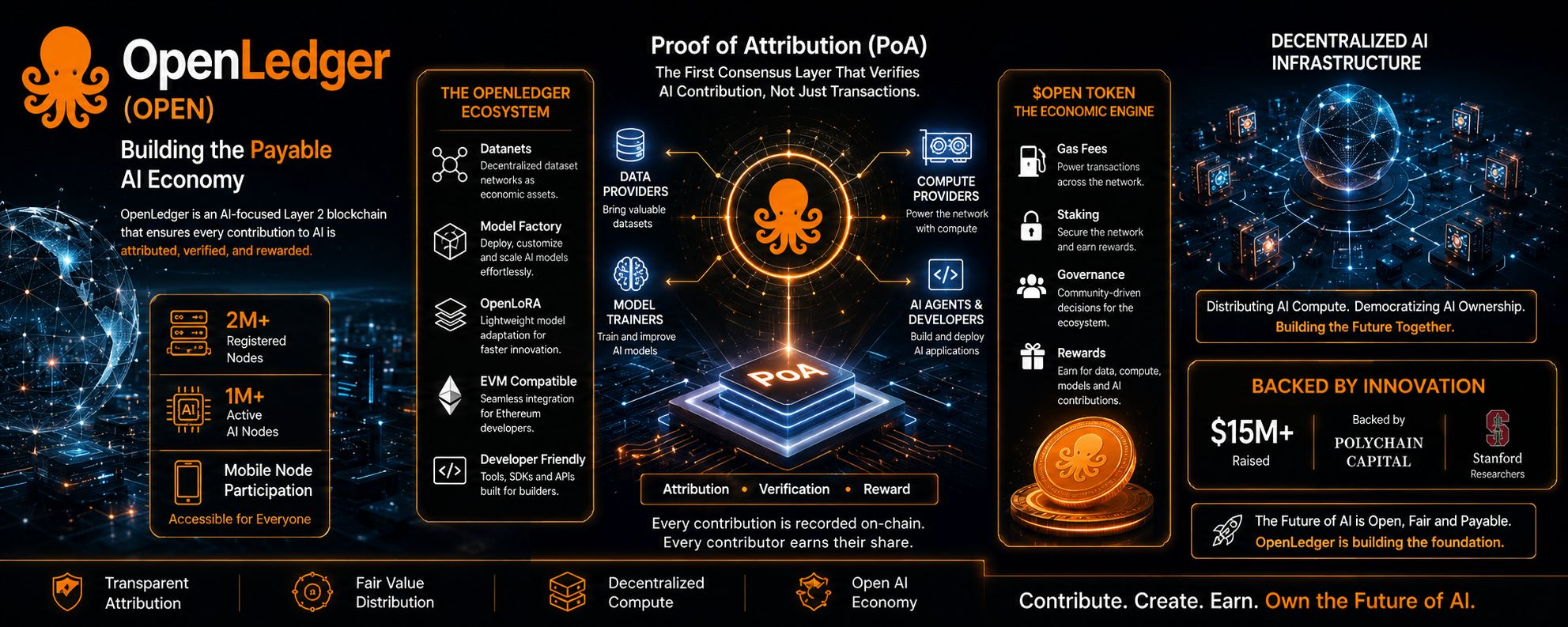
Artificial intelligence is evolving at a speed that almost feels unreal now. Every few days there is another breakthrough model, another AI assistant, another startup promising to automate entire industries. But while I have been exploring the AI sector more deeply, one thing keeps standing out to me: almost all of this innovation is still controlled by a very small group of companies. The infrastructure, the computing power, the datasets, and even the monetization systems mostly sit behind centralized walls. That is why projects trying to combine blockchain with AI are suddenly attracting so much attention, and among them, OpenLedger (OPEN) feels different from the usual trend-driven narratives.
What caught my attention first was not the token itself, but the idea behind the project. OpenLedger describes itself as an AI-focused Layer 2 blockchain built for what it calls the “Payable AI Economy.” At first, that phrase sounded ambitious, maybe even slightly futuristic, but the more I looked into it, the more I started understanding why the concept matters. The current AI economy depends heavily on data created by people, models trained by communities, and massive amounts of user interaction, yet most contributors receive nothing back from the value they help generate. OpenLedger is trying to change that structure entirely.
The project is built around a very simple but powerful belief: if data, models, and AI agents are creating value, then the people contributing to those systems should be able to participate in that value as well. That idea alone makes OpenLedger stand out in a market where most AI platforms still operate like closed ecosystems. Instead of AI remaining a black box owned by a few corporations, OpenLedger is trying to build an open economic layer where contribution can actually be tracked, verified, and rewarded on-chain.
I think this is where blockchain starts making real sense for AI. For years, many people questioned whether blockchain technology truly had practical use cases beyond finance and speculation. But AI changes the conversation because the industry desperately needs transparency, attribution, and ownership systems. Right now, huge AI models are trained on enormous datasets pulled from across the internet, often without clear permission, compensation, or accountability. Artists, writers, developers, researchers, and ordinary users are all feeding modern AI systems indirectly, yet very few have any visibility into how their contributions are being used.
OpenLedger appears to be targeting this exact problem through its Proof of Attribution system, often shortened to PoA. From what I see, this could become one of the most important ideas inside decentralized AI infrastructure. Instead of only verifying transactions like a traditional blockchain, OpenLedger attempts to verify contribution itself. If a dataset improves a model, if a contributor helps train a useful AI system, or if a network participant provides computing resources that power AI outputs, the ecosystem can potentially attribute value back to those sources. In simple terms, the network tries to create accountability inside AI economies.
The interesting part is that OpenLedger is not only focused on theory. The ecosystem includes multiple components designed to make decentralized AI development practical. One of them is the concept of Datanets, which are decentralized networks built around datasets. Rather than locking valuable data inside centralized servers owned by corporations, datasets can become structured economic assets connected to blockchain infrastructure. That opens possibilities for industries where specialized data is incredibly valuable, especially healthcare, finance, enterprise analytics, and research.
I also noticed that OpenLedger is heavily focused on developer accessibility, which is something many blockchain projects underestimate. A technically impressive ecosystem means very little if developers struggle to build on it. OpenLedger’s EVM compatibility makes onboarding much easier because Ethereum developers can integrate without rebuilding everything from scratch. That compatibility matters more than people realize because developers usually follow environments where deployment feels simple, scalable, and familiar.
The project also includes tools like Model Factory and OpenLoRA, both designed to simplify AI deployment and customization. OpenLoRA particularly stands out because lightweight model adaptation is becoming increasingly important in modern AI development. Instead of retraining massive models from zero, developers can fine-tune systems efficiently and deploy them faster. OpenLedger seems to understand that future AI ecosystems will require flexible infrastructure, not just raw computing power.
Another detail that makes the project interesting is its node network. OpenLedger has reported millions of registered nodes and over a million active AI nodes participating in the ecosystem. Whether someone looks at the numbers from an infrastructure perspective or from a community perspective, that level of participation suggests there is already meaningful interest in decentralized AI systems. The inclusion of mobile node participation also lowers the barrier to entry significantly. Instead of requiring expensive enterprise hardware, users can contribute to decentralized infrastructure more accessibly.
I think this reflects a much larger trend happening quietly in the background of the AI race. Centralized AI development is becoming incredibly expensive. Training large-scale models now requires enormous GPU clusters, cloud infrastructure, and financial resources. As those costs continue increasing, decentralized compute systems may become more attractive, especially if networks can distribute workloads across broader communities instead of relying entirely on centralized providers.
The OPEN token itself functions as the economic layer of the ecosystem. It powers gas fees, staking, governance, and network rewards, but what makes it more interesting is how deeply it is tied to participation. The token is not positioned only as a speculative asset. Instead, it is integrated into the mechanics of AI contribution and network coordination. Contributors providing data, operating nodes, or supporting AI applications may receive rewards through the ecosystem itself. That directly connects back to OpenLedger’s broader vision of building an economy where AI participation becomes financially measurable.
Funding and institutional support have also helped the project gain credibility. OpenLedger reportedly secured around $15 million in backing, including involvement connected to Polychain Capital, alongside researchers associated with Stanford. In crypto markets, funding alone never guarantees success, but strong technical backing often signals that a project is being taken seriously beyond social media hype cycles.
What I personally find most compelling is that OpenLedger does not feel like it is trying to replace AI companies. Instead, it is trying to build infrastructure underneath the next generation of AI applications. That is a very different strategy. Many projects chase attention by promising to become the next dominant AI platform, but infrastructure layers often end up becoming far more important over time because entire ecosystems depend on them.
The idea of a “Payable AI Economy” also feels surprisingly relevant when you think about where technology is heading. AI agents are becoming more autonomous, AI-generated content is spreading across every platform, and machine learning systems are increasingly shaping digital economies. But without transparent ownership systems, value distribution could become even more centralized than it already is. OpenLedger is essentially betting that future AI networks will require blockchain-based attribution and economic coordination to function fairly at scale.
Of course, the project still has a long road ahead. Building infrastructure is always harder than building narratives. Adoption, developer activity, ecosystem growth, and real-world AI integrations will ultimately determine whether OpenLedger becomes a meaningful layer inside Web3 and AI. But from what I have been observing, the project is targeting real structural problems instead of temporary trends, and that gives it a different kind of relevance.
The more I look at the future of AI, the more I believe ownership and attribution will become just as important as intelligence itself. The companies building AI models may dominate headlines today, but the systems controlling data rights, economic incentives, and decentralized participation could quietly shape the next phase of the internet. OpenLedger seems to understand that shift early, and that may ultimately become its biggest advantage.