

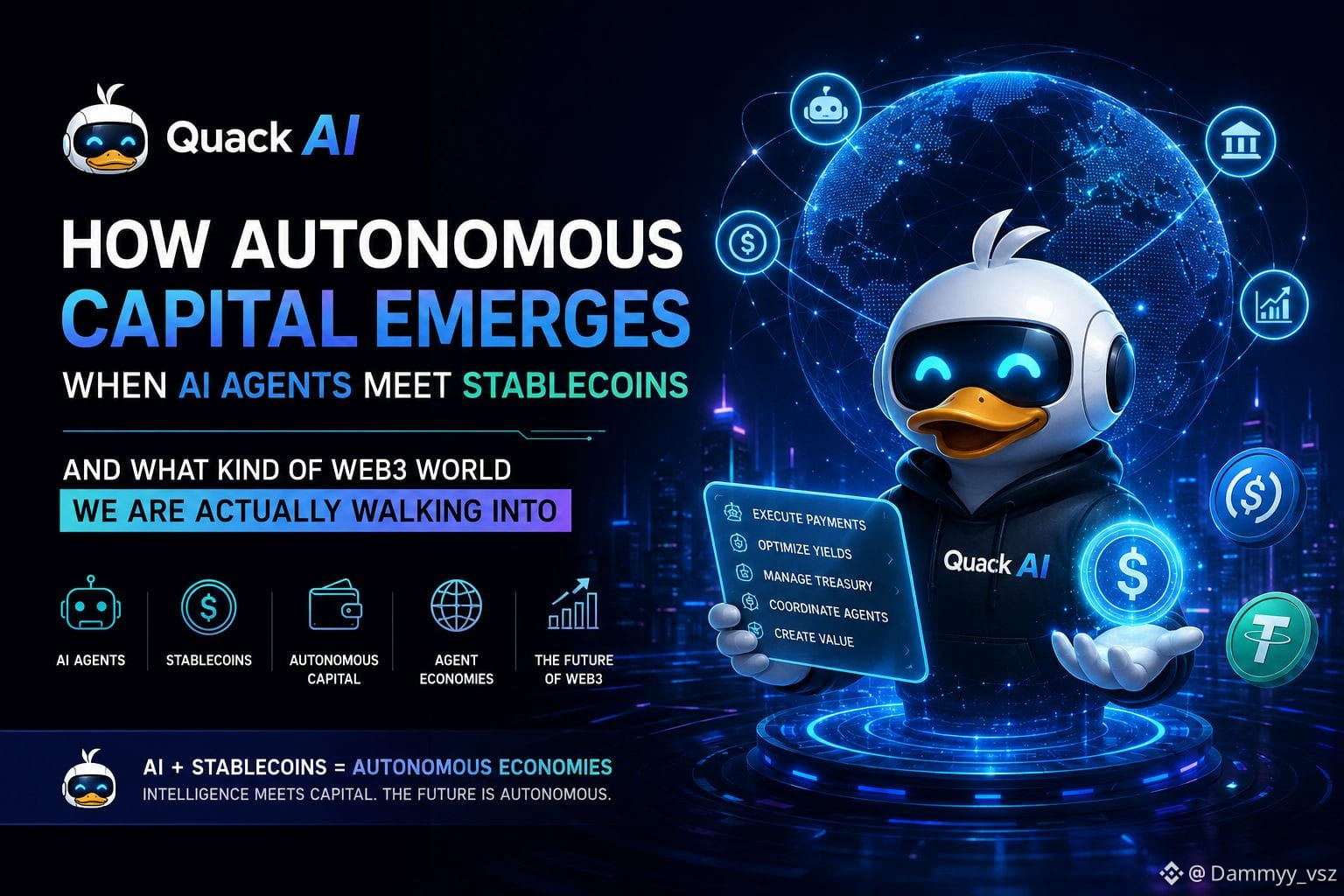
There’s a shift happening in crypto that most people still describe with the wrong language.
In the recent @QTalk episode, alot of narrative changelogs were discussed in regards to the kind of blockchain world we are stepping into and how QuackAI features is aligning into the current phase of the blockchain/web3 world.
For years, Web3 was centered around people interacting with protocols. Humans clicked buttons, approved wallets, bridged assets, traded tokens, signed transactions, and manually coordinated value across chains.
But the next era doesn’t revolve around humans being the primary operators anymore.
It revolves around AI agents.
Not chatbots.
Not gimmicky assistants.
Not “AI with a token.”
Real autonomous software entities capable of:
•√observing environments,
•√making decisions,
•√executing transactions,
•√coordinating with other agents,
•√and managing capital without constant human intervention.
Now combine that with stablecoins.
That’s where things become disruptive.
Because stablecoins give AI agents something the internet has never truly had before:
native programmable money with global liquidity and instant settlement.
And when intelligence meets programmable capital, a new economic layer starts forming.
That layer is autonomous capital.
The Internet Is Quietly Becoming Economically Alive
The internet originally connected information.
Web2 connected people.
Web3 connects value.
But AI + stablecoins?
That connects decision-making directly to money itself.
For the first time in history, software can:
•think,
•evaluate,
•earn,
•spend,
•coordinate,
•and reinvest capital autonomously.
Not someday.
Now.
An AI agent no longer needs a bank account, payroll department, office hours, or geographical identity.
It just needs:
a wallet,
liquidity access,
execution rails,
and intelligence.
That changes everything.
Because the moment AI agents can hold and move stablecoins, they stop being passive tools and start becoming active economic participants.
√Stablecoins Are the Fuel of Autonomous Economies
Crypto often talks about stablecoins like they’re just “digital dollars.”
That framing is too small.
Stablecoins are actually:
•√machine-friendly money,
•√borderless settlement infrastructure,
•√programmable liquidity,
•√and always-online financial primitives.
Humans use stablecoins because they’re fast.
AI agents use stablecoins because they’re compatible with automation.
•A human can sleep.
•A bank can close.
•An AI agent operating with stablecoins doesn’t stop.
Imagine agents that:
•automatically hedge treasury exposure,
•pay API providers in real-time,
•rebalance yield positions,
•distribute salaries globally,
•execute arbitrage strategies,
•purchase compute resources,
•or coordinate services with other agents.
None of that requires human timing anymore.
And this is exactly where platforms like Quack AI become important.
√ Quack AI and the Emergence of AI-Native Finance
The biggest misconception about AI in Web3 is that people think the value is in “AI-generated content.”
The real value is in AI-generated execution.
That’s the difference.
Projects like Quack AI are helping push toward a world where AI agents can actually interact with blockchain infrastructure in practical ways.
The future isn’t:
“Ask AI to explain crypto.”
The future is:
“Ask AI to execute crypto.”
That’s a completely different paradigm.
When users can say:
“Send 50 USDT to contributors,”
“Bridge liquidity to Ethereum,”
“Pay these wallets,”
“Optimize yield exposure,”
“Handle payroll,”
…and an AI system can securely coordinate those actions through blockchain rails, we move from static finance into autonomous financial orchestration.
This is where AI stops being conversational and becomes operational.
√ The Web3 World We’re Actually Walking Into
The future of Web3 probably won’t look like endless speculation cycles forever.
Instead, we’re moving toward:
AI-native applications,
autonomous commerce,
programmable organizations,
agent-to-agent coordination,
and invisible financial infrastructure.
Most blockchain infrastructure today still assumes humans are manually interacting with apps.
But AI agents require a different UX entirely:
•gas abstraction,
•instant execution,
•stablecoin-native flows,
•intent-based systems,
•and seamless cross-chain coordination.
The winners in this next cycle may not be the loudest protocols.
They may be the infrastructure layers that allow autonomous agents to safely transact at scale.
And this is why the intersection of AI + stablecoins matters more than most people realize.
Because once capital becomes autonomous, finance itself changes shape.
However, the convergence of AI agents and stablecoins may become one of the biggest structural shifts in internet history.
Not because it creates better chatbots.
But because it creates:
autonomous participants,
programmable economies,
and intelligent financial systems that operate without human bottlenecks.
This is the Web3 world we’re quietly walking into.
A world where:
wallets become identities,
stablecoins become machine money,
and AI agents become economic actors.
And platforms like Quack AI sit at the center of that transition — helping bridge the gap between conversational intelligence and executable on-chain action.
The next evolution of crypto may not be about humans using applications.
It may be about applications using capital themselves.
Find more details in the gitbook 👇
https://q402.quackai.ai