
A few years ago, when people talked about infrastructure, they usually meant roads, ports, power grids… maybe cloud servers if the conversation was technical enough.
Infrastructure was the boring layer. Necessary. Expensive. Invisible when it worked properly.
Then AI changed the language around it.
Suddenly GPUs became headline material. Compute clusters became market narratives. It started to feel like the entire AI race was simply about horsepower.
For a while, I believed that too.
But the more I watched AI become commercially useful, the more something uncomfortable stood out to me.
The real problem no longer looked like intelligence itself.
A model writing a bad poem is one thing.
A model influencing loan approvals, flagging compliance issues, evaluating insurance risk, assisting capital movement, generating legal drafts, or screening identities… that is a completely different category of problem.
At that point, nobody serious asks how fast the tokens were processed.
They ask a much uglier question.
Who is responsible if this goes wrong?
And honestly, that question still feels strangely absent from a lot of crypto AI conversations.
OpenLedger usually gets described as AI infrastructure. Technically, that description is fine.
But I think it hides the more interesting angle.
The market still treats attribution mostly like a rewards feature. A way to compensate contributors fairly. Nice narrative. Easy to market.
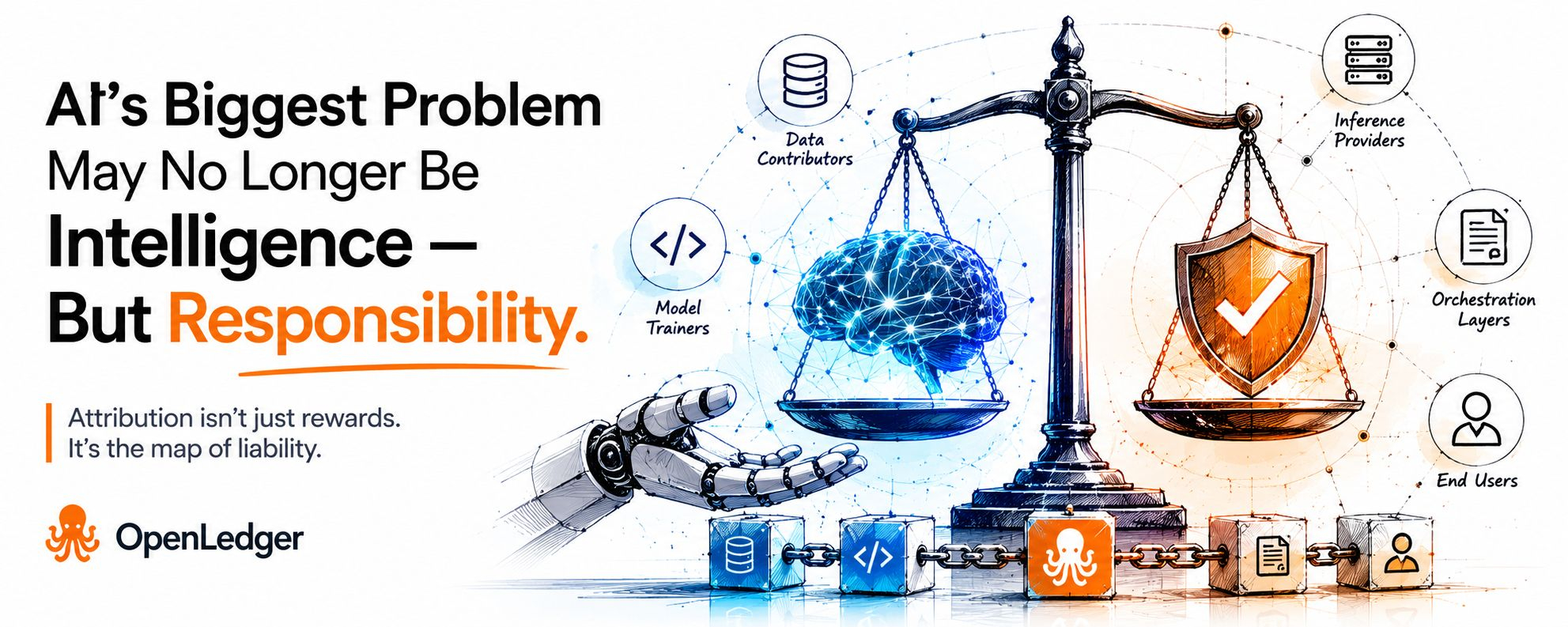
But once AI systems start operating inside environments that actually matter, attribution begins to look less like a rewards mechanism and more like a liability map.
That distinction changes everything.
I remember watching the early autonomous agent hype and feeling like people were skipping several steps ahead.
Not because the technology was fake.
But because coordination risk was being ignored.
Everyone talked about agents making payments, negotiating services, managing workflows, buying compute, operating autonomously.
Fine.
But if an agent acts on flawed training data, manipulated datasets, or questionable source logic… where exactly does responsibility land?
That answer becomes blurry very quickly.
Traditional software was strangely simpler.
A company shipped code. If something failed badly enough, accountability was structurally visible.
Messy, yes. But visible.
AI systems feel far more fragmented.
One party contributes data. Another fine-tunes the model. Another hosts inference. Someone else builds orchestration layers. Maybe retrieval systems inject external context halfway through. Maybe agent logic modifies behavior again at the final stage.
By the time an output reaches the user, responsibility feels smeared across half a dozen different actors.
And once responsibility becomes blurry, risk becomes difficult to price.
Markets hate that.
Institutions hate it even more.
Retail users can tolerate mystery if the product feels magical.
Enterprises do not behave that way. Banks definitely do not. Regulated environments absolutely do not.
Nobody in compliance meetings says, “the model vibes looked trustworthy.”
They ask for audit trails.
Source lineage.
Documentation.
Escalation paths.
Decision explainability — even when explainability itself is imperfect theater.
That is where OpenLedger becomes more interesting to me than the standard AI token narrative suggests.
Because if OpenLedger is genuinely building infrastructure around verifiable attribution, then maybe the more important question is not whether it helps AI scale.
Maybe it helps AI become governable.
That sounds less exciting, I know.
Governability does not pump like compute narratives.
But history has a habit of rewarding boring infrastructure for longer than people expect.
Financial markets followed a similar pattern.
First, speed mattered.
Then auditability mattered.
Then compliance architecture mattered.
Eventually the invisible control layers became just as valuable as the flashy execution layers.
AI may evolve the same way.
Not identically. Technology never repeats itself cleanly.
But it rhymes.
There is also a practical reality people underestimate.
Institutions are not allergic to innovation.
They are allergic to uncertainty they cannot operationalize.
That is different.
A procurement team evaluating AI integration does not really care about crypto-native storytelling.
They care whether someone can explain how decisions happened when legal starts asking questions later.
And legal always asks questions later.
Imagine something simple.
An AI workflow is being used for insurance risk assessment support. Not full automation. Just decision assistance.
But part of the underlying data pipeline was flawed or manipulated. The model produces biased outputs. A customer challenges the outcome. Regulators get involved. Internal governance teams start tracing dependencies.
Then what?
If nobody can meaningfully map contribution paths, governance turns into guesswork.
And guesswork becomes very expensive inside regulated environments.
That is where attribution stops being philosophical.
It becomes operational.
This is why I do not think the phrase “pricing model liability” is as dramatic as it sounds.
At least not yet in the strict legal sense.
Economic liability comes first.
Counterparty trust. Risk discounts. Confidence premiums. Willingness to integrate.
Markets start pricing those things long before courts establish formal frameworks.
If two AI ecosystems produce similar outputs, but one offers stronger provenance around how decisions were shaped, institutions may rationally prefer that environment even if performance is slightly worse.
That happens constantly in other industries.
Trusted supply chains outperform uncertain ones.
Auditable infrastructure beats opaque alternatives.
Boring trust layers quietly win budgets.
Still, there are good reasons to remain skeptical.
AI attribution is extremely hard.
People casually talk about tracing model influence as if models maintain neat ingredient lists.
They do not.
Training effects are diffuse. Signal blending is messy. Contribution weighting can easily become probabilistic fiction if implemented badly.
And fake accountability may actually be worse than obvious opacity.
Then crypto introduces its usual complications.
The moment economic incentives become attached to attribution, optimization behavior appears.
Spam datasets. Manufactured contribution claims. Sybil reputation games. Artificial trust farming.
Anyone who has spent enough time around crypto incentive systems understands this instinctively.
The system has to survive adversarial behavior, not cooperative demos.
And there is another question I keep coming back to.
Do enterprises actually want decentralized accountability?
Conceptually, it sounds elegant.
But in practice, some institutions may prefer centralized vendors precisely because accountability feels simpler there.
One provider. One contract. One escalation route.
Distributed responsibility can quickly become bureaucratic chaos if designed poorly.
Which means OpenLedger’s challenge is much bigger than technical implementation.
It has to make distributed attribution feel operationally useful, not just theoretically clever.
And that is probably a much harder product problem than most token markets currently appreciate.
Still, I cannot shake the feeling that AI infrastructure conversations remain stuck in phase one.
Everyone is still focused on making intelligence faster.
Maybe the next bottleneck is not intelligence.
Maybe it is consequence management.
Because intelligence without accountable lineage works fine for entertainment.
Less so for money.
Much less for regulated systems.
And if that shift becomes real, then maybe OPEN is not competing in the category most people think.
Not compute.
Not model access.
Something quieter.
The market for reducing uncertainty around machine decisions.
That is a far less glamorous thesis.
Which is exactly why it might matter.