
I have seen enough crypto narratives come and go that whenever a project says it is “unlocking liquidity” for something, I naturally slow down before getting excited. In crypto, almost everything has been described as an asset waiting to become liquid: attention, storage, compute, identity, reputation, even social influence. So when I look at OpenLedger, or OPEN, and its idea of monetizing data, models, and AI agents, my first reaction is not instant belief. It is curiosity mixed with caution.
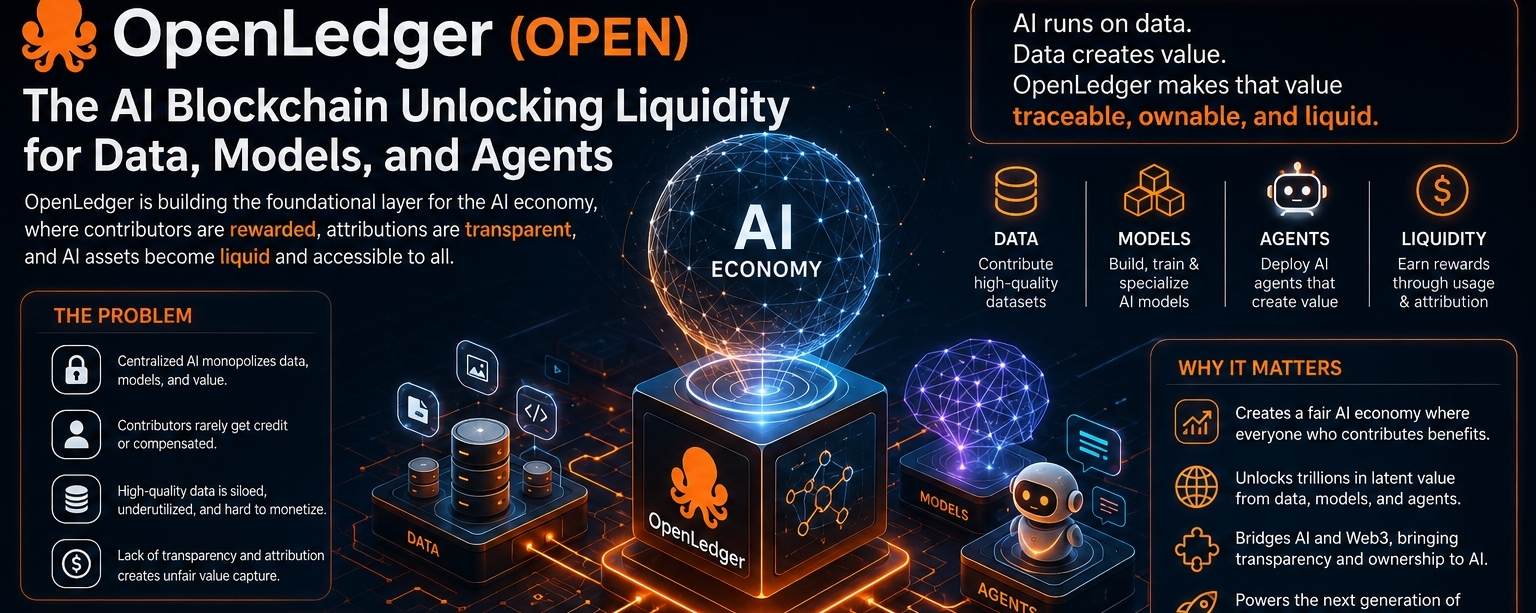
The core idea is easy to understand on the surface. AI needs data. Models are trained on data. Agents will increasingly use models and data to perform tasks. Yet the people or communities who provide useful data often receive little or nothing in return. OpenLedger seems to be asking a simple question: if data and models create value, why is that value not traceable, ownable, and rewardable?
That question matters. The current AI economy is heavily centralized. Large companies collect or access huge datasets, train powerful models, and capture most of the upside. Crypto, at least in theory, offers another path: transparent contribution, open markets, programmable ownership, and incentive systems. OpenLedger is trying to apply those ideas to AI infrastructure rather than just launching another token around the AI trend.
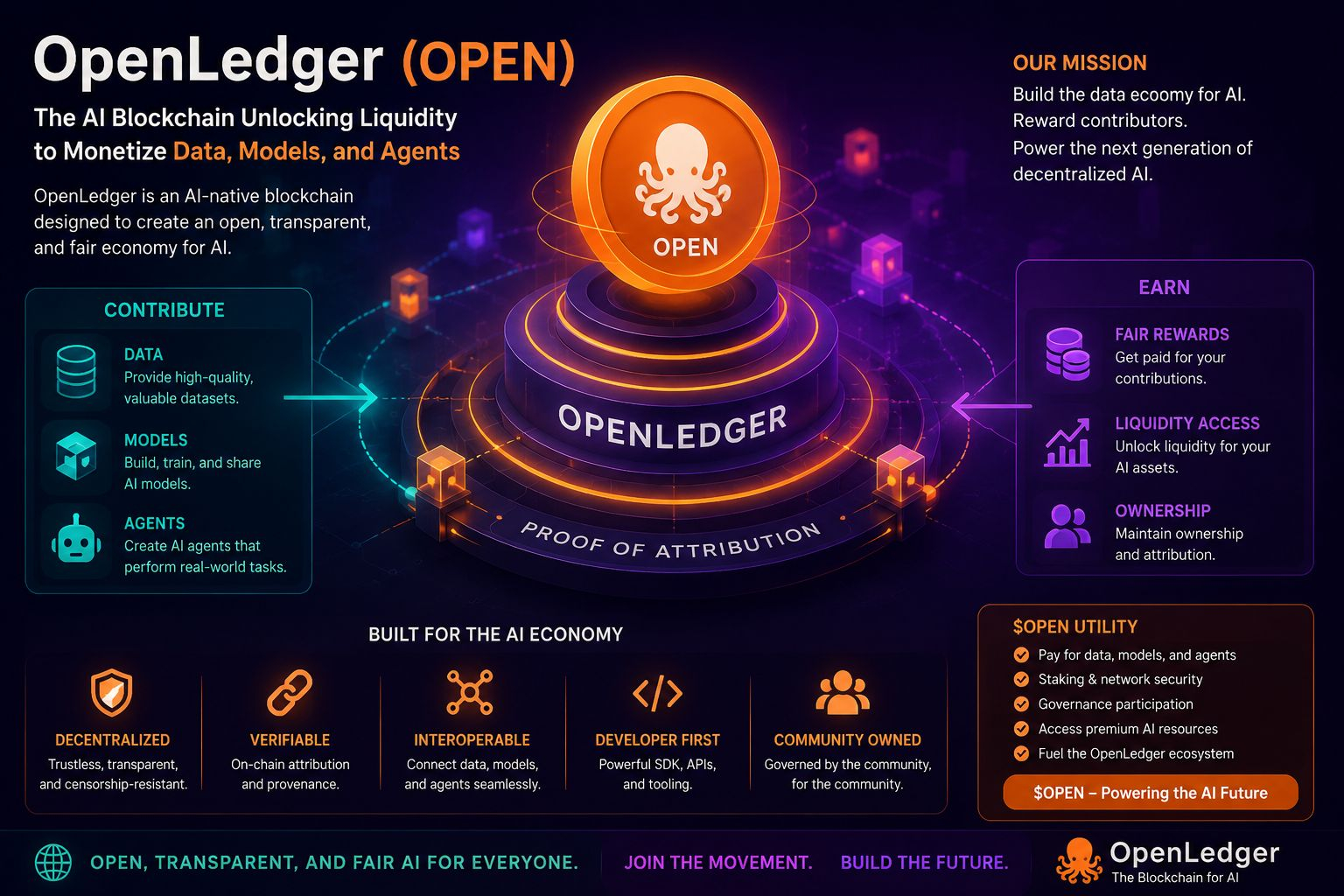
What I find interesting is that the project is not only talking about “AI on-chain” in a vague way. The architecture appears to revolve around data contribution, model creation, attribution, and monetization. Concepts like Datanets, model factories, specialized AI models, and proof of attribution suggest a system where contributors can provide data, developers can build models, and usage can be tracked so rewards flow back to the right participants.
That sounds meaningful, but it is also where my skepticism begins. Attribution in AI is not a small problem. It is difficult to prove exactly which dataset improved a model, how much it improved it, and whether that improvement deserves payment. In crypto, we often underestimate messy real-world complexity and overestimate what a token mechanism can solve. A blockchain can record claims, payments, and provenance, but it cannot magically guarantee data quality or usefulness.
Still, the problem OpenLedger is pointing at is real. If AI continues to grow, high-quality domain-specific data will become more valuable. General internet data is already crowded, noisy, and legally complicated. Specialized data from experts, communities, developers, researchers, and niche industries may become the next important layer. If OpenLedger can create a credible marketplace around that, it could be more than just another AI coin.
Where the industry usually gets things wrong is assuming that incentives alone create quality. They do not. Incentives can also create spam, fake data, low-effort farming, and short-term behavior. For OpenLedger to work, it would need strong validation, reputation, filtering, and real demand from model builders. Without that, the system risks becoming another reward farm where people contribute because tokens exist, not because the data is actually useful.
I also think the “agents” part is important but still uncertain. AI agents may become a major interface for software, finance, and work. If agents need verifiable data sources, payment rails, and model access, a blockchain-based coordination layer could make sense. But the market is still early. Many agent projects today feel more like demos than durable businesses. OpenLedger’s challenge is to connect its infrastructure to actual usage, not just future possibility.
What feels different about OpenLedger is the focus on the economic layer beneath AI. Instead of only saying “we use AI,” it is asking who owns the inputs, who gets paid, and how value moves through the system. That is a more serious question than most crypto-AI branding. But serious questions do not automatically create successful networks.
For me, OpenLedger sits in that uncomfortable but interesting zone: the idea is strong enough to watch, but the execution risk is high. It needs real developers, real data demand, reliable attribution, and token economics that do not collapse into speculation. If those pieces come together, OPEN could represent a meaningful experiment in making AI value more open and measurable. If not, it may become another project with the right narrative at the right time, but without enough practical gravity.
I would not look at OpenLedger as a finished answer. I would look at it as a test. Can crypto actually help AI become more transparent and fair, or will it simply wrap another complex industry in tokens and slogans? That is the question I keep coming back to. And maybe that is why OpenLedger is worth studying: not because it guarantees the future, but because it touches one of the most important tensions in technology right now who creates value, who controls it, and who gets paid when machines learn from human work.