
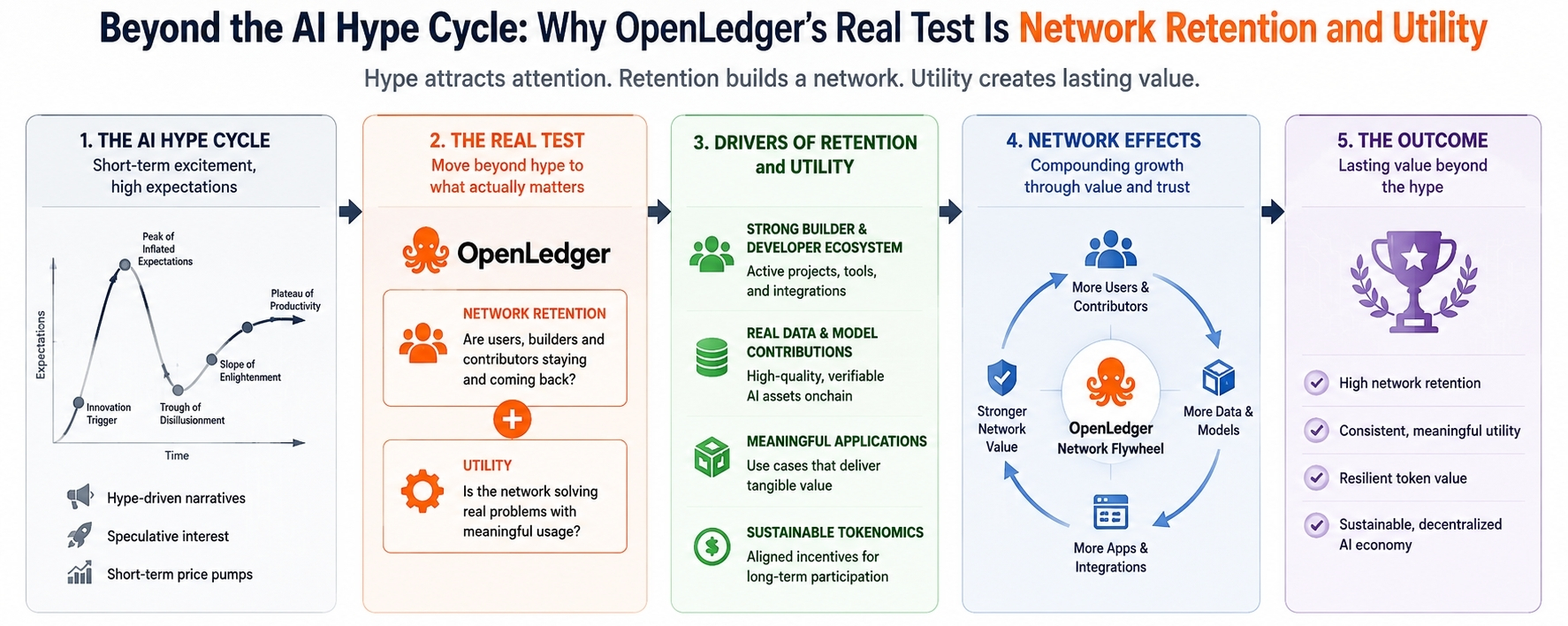
I still remember the first night I went deep into OpenLedger. It was late, charts were open on one screen, token unlock dashboards on another, and I kept asking myself the same question I’ve asked with almost every AI-related crypto project lately: is this actual infrastructure, or just another cycle built around excitement and liquidity?
The reason I hesitated at first is simple. I’ve watched the market reward AI narratives aggressively over the last couple of years. The formula usually looks the same. A project launches, social engagement explodes, exchange listings arrive, trading volume spikes, influencers push the “future of AI” angle, and suddenly the token moves faster than the actual product development. For a while, price action becomes the story. Then the incentives slow down, emissions hit the market, attention rotates elsewhere, and you find out very quickly whether people were there for the technology or just the volatility.
That’s why I approached OpenLedger carefully.
What kept pulling me back wasn’t the hype around “decentralized AI.” Honestly, that phrase alone doesn’t impress me anymore. What interested me more was the infrastructure layer they seem to be building around attribution and contribution tracking. Most AI systems today are still incredibly opaque. Data contributors rarely know how their information is used, model outputs often lack clear provenance, and contributors are usually disconnected from the value they help create.
OpenLedger is trying to turn that into an economic system instead of a black box.
The more I studied it, the more I realized the project isn’t really trying to put all AI computation directly on-chain. And that matters. Running large-scale AI processes fully inside blockchain consensus would be painfully inefficient and expensive. Instead, OpenLedger appears to separate heavy off-chain computation from on-chain verification, settlement, and attribution. In simple terms, the AI work can happen externally while the proof of contribution, usage tracking, and economic accounting stay verifiable on-chain.
I actually think that design choice is one of the more intelligent parts of the entire architecture.
A lot of people underestimate how important operational efficiency becomes once projects try to scale beyond speculation. It’s easy to promise decentralized AI in theory. It’s much harder to build a system where developers, validators, model creators, and data contributors can all participate without the network becoming too slow or too expensive to use. OpenLedger at least seems aware of that trade-off.
Still, I’ve been around crypto long enough to know that good architecture doesn’t automatically create durable token value.
That’s the part I keep wrestling with.
The token structure itself immediately tells me this will probably remain a supply-sensitive market for a long time. OPEN has a maximum supply of 1 billion tokens, while circulating supply remains only a fraction of that. Low float structures often create strong early price expansion because the available supply on the market stays limited, but that same setup can become dangerous later when unlock schedules accelerate.
And honestly, I’ve seen this cycle too many times before.
When new unlocks hit the market, the psychology changes fast. Community incentives create temporary spikes in activity, wallet creation jumps, exchange transfers increase, and social sentiment suddenly looks bullish again. But underneath all of that, I always try to look for the same thing: repeated behavior.
Are people actually staying?
That question matters more to me now than almost any metric on Crypto Twitter.
Trading volume alone doesn’t convince me anymore either. I’ve watched projects with massive daily volume completely collapse once the speculative loop ended. Sometimes the activity is real. Sometimes it’s market makers, arbitrage routing, perpetual leverage, or users farming incentives before moving on to the next narrative. High turnover can create the illusion of adoption even when retention is weak.
That’s why I separate “attention” from “usage” in my own research.
OpenLedger clearly has attention right now. There’s growing visibility around AI infrastructure, on-chain attribution, and agent economies. Partnerships and ecosystem integrations have also expanded rapidly, which tells me the team understands how important network effects are at this stage of the market. But partnerships alone don’t mean much to me anymore unless they lead to actual recurring activity.
I care more about whether developers continue deploying after grants disappear.
I care more about whether validators can earn sustainable revenue without depending entirely on emissions.
And I care more about whether AI agents built inside the ecosystem generate repeated economic throughput instead of one-time speculative traffic.
That’s the real difference between infrastructure and narrative.
One thing I do think OpenLedger understands better than many competitors is that AI economies eventually need transparent attribution systems if they want long-term sustainability. If data contributors, model creators, and agent operators cannot prove participation or monetize usage fairly, centralized systems will probably dominate simply because they operate more efficiently. OpenLedger is basically betting that verifiable contribution tracking becomes valuable enough for developers and enterprises to care about.
That’s a very interesting bet.
But it’s still a bet.
There’s also the decentralization problem that every AI-focused blockchain eventually runs into. High-performance AI infrastructure naturally gravitates toward powerful operators with better hardware and larger compute capacity. If too much control concentrates around a small group of validators or infrastructure providers, the “open AI economy” narrative weakens quickly. But if the system pushes too aggressively toward decentralization at the expense of performance, costs rise and usability suffers.
Finding balance there is incredibly difficult.
From a broader market perspective, timing also matters. AI remains one of the strongest narratives in both crypto and traditional markets right now. Capital is actively searching for exposure to anything connected to machine intelligence, automation, and data infrastructure. That creates opportunity, but it also creates inflated expectations. The market sometimes prices future adoption years before the actual demand exists.
That’s why I’m still cautious even though I find the project genuinely interesting.
Personally, I think OpenLedger has a more thoughtful foundation than most AI narrative plays I’ve looked at recently. The project at least appears focused on solving a real coordination problem between AI participation, verification, and economic incentives. That already separates it from a large portion of the market that relies mostly on branding and speculation.
But I’m also realistic about what could go wrong.
Unlock pressure could weigh on price for a long time. Incentive-driven activity could disappear once rewards slow down. Developers could lose interest if user demand doesn’t materialize fast enough. Or centralized AI providers could simply outcompete decentralized systems through convenience and execution speed before networks like OpenLedger mature.
Right now, I’m watching for one thing above everything else: consistency.
Not one-week spikes. Not exchange listing hype. Not temporary social momentum.
I want to see whether usage continues when nobody is forced to participate.
Because in crypto, narratives can attract capital quickly, but only real utility keeps people around after the excitement fades.
