
Most people in crypto are tired. Not even angry anymore. Just tired. Tired of opening Twitter and seeing the same recycled posts every single day. “Revolutionary ecosystem.” “Game-changing technology.” “Next billion-dollar protocol.” Then three months later the volume dies, the community disappears, and everybody moves on to the next shiny thing pretending the last disaster never happened.
That cycle keeps repeating because too much of crypto stopped caring about building things people actually need. Somewhere along the way the entire space became obsessed with hype, fast money, fake engagement, and launching tokens before there’s even a working product behind them. Half the projects look like they were designed more for screenshots than actual users.
And honestly, the AI industry is slowly becoming the same kind of mess.
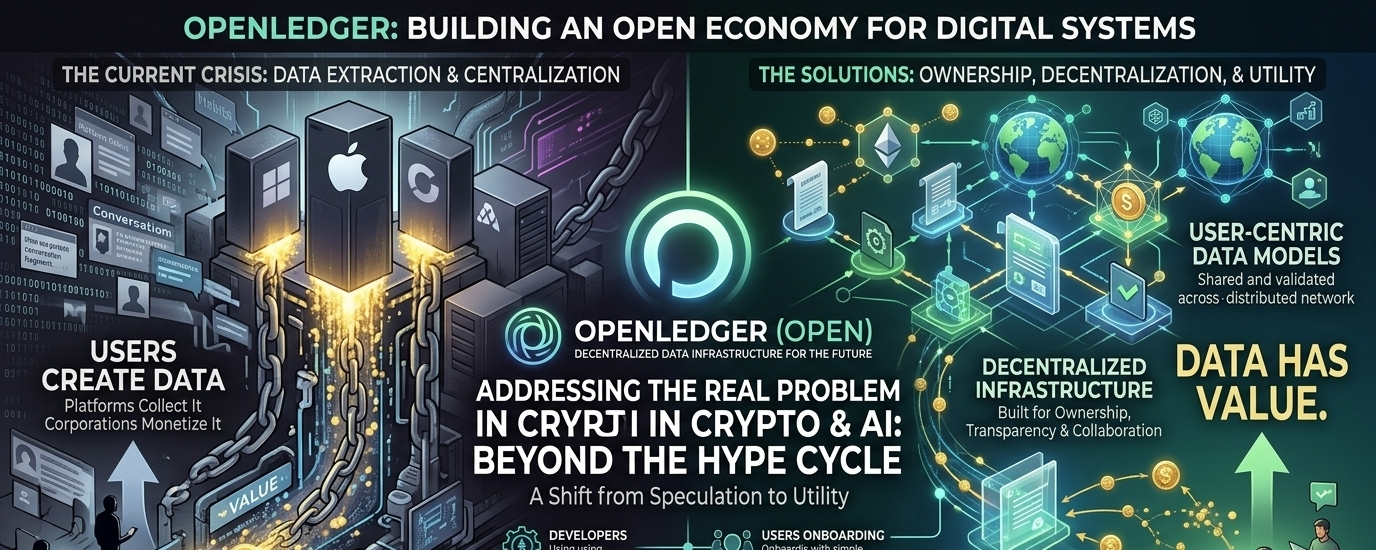
A few massive companies are quietly taking control of everything. The infrastructure. The data. The systems people rely on every day. Most regular users don’t even realize how much value they create online because it happens in the background now. Every search, every click, every conversation, every habit becomes part of systems being trained and improved constantly. People feed these systems every single day while giant corporations collect the real value from it all.
That’s why OpenLedger stands out a little more than the average crypto project.
Not because it’s promising some fantasy future where technology magically fixes society overnight. People are done believing that stuff anyway. What makes OpenLedger interesting is that it’s at least focused on a real issue instead of inventing fake problems to justify another token launch.
The core idea behind it is pretty simple when you strip away all the marketing language. Data has value. Models have value. Digital agents have value. So the people building, contributing, and interacting with those systems should probably benefit too instead of everything staying trapped inside centralized platforms controlled by a small group of companies.
Sounds obvious. But somehow the internet moved in the complete opposite direction.
Right now most online systems work like giant extraction machines. Users create activity. Platforms collect it. Companies monetize it. End of story. People accepted the deal because the products are convenient. Nobody really thinks about ownership anymore because convenience became more important than control a long time ago.
OpenLedger seems to be trying to change that dynamic by building infrastructure where these systems can operate inside an open blockchain economy instead of behind closed walls. That’s the important part. Infrastructure. Not just another app. Not another speculative token pretending to be useful. Actual infrastructure designed around ownership, coordination, and transparency.
And honestly, crypto desperately needs more projects thinking this way.
Because right now the space has a serious identity problem. Ask ten different people what blockchain is supposed to solve and you’ll probably get ten different answers. Some people only care about trading. Some care about decentralization. Some just want quick profits. Others still believe blockchain can create more open systems long term.
The truth is probably somewhere in the middle.
The technology itself still matters. The problem is that speculation became louder than utility. Memecoins get more attention than infrastructure projects because fast excitement spreads easier online than complicated backend systems nobody immediately understands. That’s why projects focused on real infrastructure usually grow slower. They aren’t built for instant hype. They’re trying to solve deeper problems that take years to matter.
OpenLedger feels closer to that category.
The Ethereum compatibility is another reason it makes more sense than most new chains popping up lately. Developers already understand Ethereum tools. Wallets already exist. Smart contracts already exist. Layer 2 ecosystems already exist. Nobody wants another isolated network where users have to learn completely new systems from scratch. Crypto already feels complicated enough for normal people.
That’s another thing the industry forgets constantly. Most users do not care about technical ideology. They care whether the product works without giving them a headache.
People want simple onboarding.
They want low fees.
They want systems that don’t break every time the network gets busy.
They want security without needing a twenty-minute tutorial just to move assets around safely.
And most importantly, they want products that actually feel useful outside of speculation.
That last part matters a lot.
Because eventually hype fades. It always does. The projects that survive are usually the ones quietly building infrastructure while everybody else is chasing trends. OpenLedger seems to understand that the future battle is not just about tokens or charts. It’s about who controls digital systems long term and whether users have any ownership inside those ecosystems at all.
The internet is changing fast right now. Automated systems are becoming part of everything. Workflows, finance, customer support, content creation, online services, research tools, communication platforms. Over time these systems stop feeling experimental and start becoming normal infrastructure people depend on daily without even thinking about it.
That’s where the ownership question becomes serious.
If all of those systems end up controlled by a handful of giant corporations, then users lose leverage completely. Developers lose independence too. Everything becomes dependent on centralized platforms that decide who gets access, who gets paid, and who gets pushed out.
OpenLedger seems to be betting that blockchain infrastructure can prevent at least some of that centralization before it becomes permanent.
Of course, none of this means success is guaranteed. Crypto history is full of ambitious projects that sounded great in theory and failed in practice. Building decentralized infrastructure is difficult. Scaling networks is difficult. Creating fair economic systems is difficult. Human behavior alone breaks half the elegant ideas people design on whiteboards.
And combining blockchain with AI-related infrastructure makes everything even harder.
Costs become a problem. Scalability becomes a problem. Coordination becomes a problem. Security becomes a problem. Every project sounds amazing during presentations. Reality is where things get ugly.
That’s why skepticism around projects like this makes sense now. The industry earned that skepticism. Too many promises. Too many abandoned roadmaps. Too many founders disappearing after market cycles end.
But still, there’s something refreshing about a project at least aiming at a real structural issue instead of launching another useless trend token for engagement farming.
Because the deeper problem underneath all this isn’t technology. It’s control.
Who owns the systems shaping the next version of the internet?
Who profits from them?
Who gets access?
Who gets left out?
Most people don’t think about those questions yet because the systems still feel new. But eventually they matter. They always matter.
And maybe that’s why OpenLedger feels more interesting than most projects right now. Not because it promises perfection. Not because it guarantees some utopian future. Just because it’s trying to build infrastructure around a real problem while most of the industry is still busy selling hype to itself.