
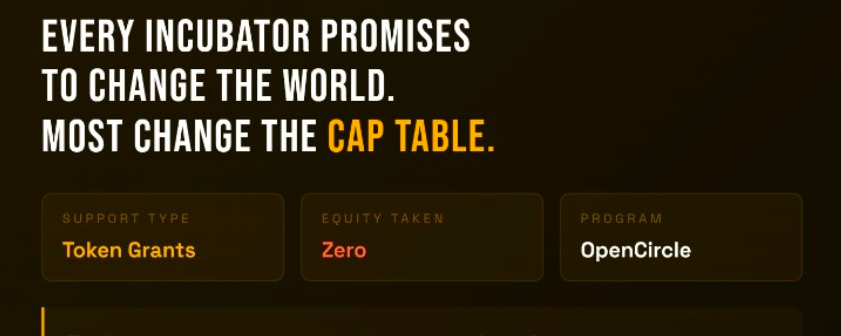
Every incubator promises to change the world. Most of them change the cap table.
The difference between an incubator that creates value and one that extracts it is almost never discussed honestly because the people running incubators are rarely incentivized to have that conversation.
Here is what traditional incubation actually looks like for an early stage AI team. You get funding typically in Echange for equity that compounds dilution at every subsequent round. You get mentorship from ADdvisors who are simultaneously advising thirty other companies and have forty minutes a quarter for yours. You get infrastructure access To tools and platforms that create dependencies you will spend years trying to unwind. And you get visibility at demo days attended by investors who have already deCCided what they are looking for before you walk in the room.
The support is real. The terms underneath it are designed for the incubator's returns, not yours.
I have watched talented teams take incubator deals that looked like opportunities and functioned like anchors.
Not because the incubators were malicious. Because the incentive structure of traditional incubation is fundameentally misaligned with the long-term success of the teams it funds. The incubator wins when you exit. You win when you build something sustainable. Those are not the same objective.
OpenCircle is structured differently and the difference is architectural rather than cosmetic.
Selected projects receive OPEN token grants rather than equity investment. The distinction matters more than it first appears. An equity investment creates a relatioonship where the investor's return depends on your exit which creates pressure toward outcomes that maximize valuation at a specific moment rather than sustainabnility over time. A token grant creates a relationship where the support comes from the ecosystem fund and the obligation flows back to the ecosystem through contribution building Datanets, developing evaluation frameworks, creating protocol. Level tools that make the infrastructure more valuable for everyone.
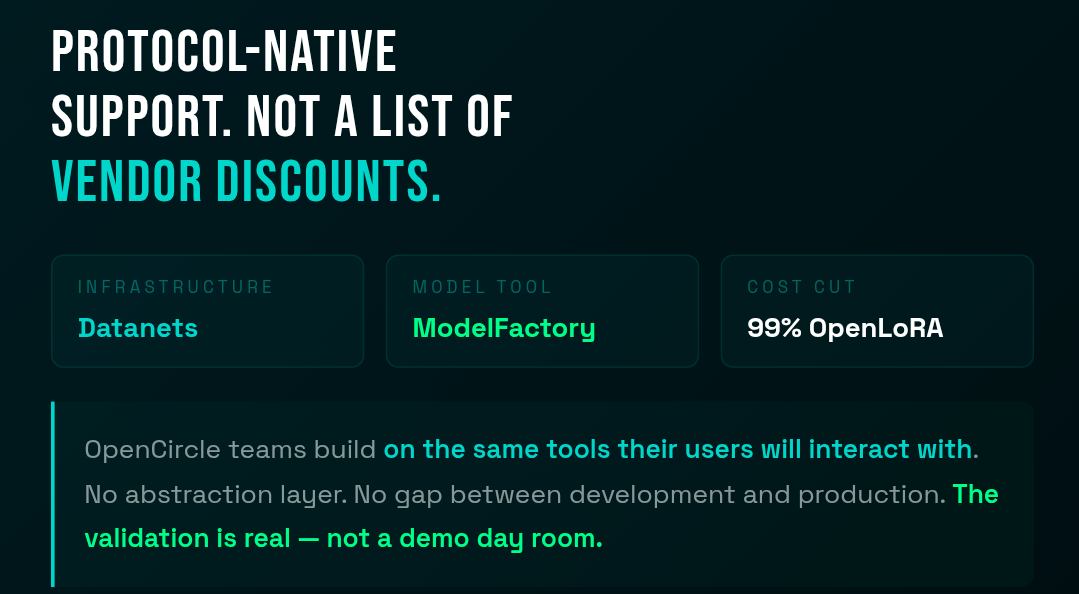
The infrastructure Support is protocol native. Teams building on OpenCircle are not getting access to a curated list of vendor discounts. They are getting Embeded access to the actual OpenLedger infrastructure Datanets for data collection, ModelFactory for model development, OpenLoRA for inference optimization, Proof of Attribution for provenance tracking. The tools they use to build are the same tools their users will interact with. There is no abstraction layer creating a gap between the development environment and the production environment.
What I find genuinely interesting about this model is what it does to the selection criteria.
Traditional incubators select for teams that can raise the next round which means they are optimizing for pitch Quality, market size narratives, and founder pedigree. OpenCircle's selection focuses on teams building Datanets, AI agents, evaluation frameworks, and protocol level tools which meanns the selection criteria are aligned with what the ecosystem actually needs rather than what makes a good slide deck.
The visibility component works differently too. In a traditional incubator, visibility means access to the incubator's investor network. In OpenCircle, visibility means exposure across an ecosystem of active participants who are already using the infrastructure the selected team is building on. The audience is not a room of investors evaluating whether to fund you. It is a community of users evaluating whether what you are building is useful.
That is a fundammentally different kind of validation and a harder one to fake.
The honest limitation is selectivity.
OpenCircle focuses on early stage projects that meet specific criteria teams building things the ecosystem needs, not teams building things that happen to be interesting. If your project does not fit the protocol's actual development priorities, the support is not available regardless of how good the team is. That is not a flaw in the design it is the design working correctly. But it means OpenCircle is not a general-purpose incubator. It is a protocol development accelerator with a narrow and specific mandate.
Whether that mandate is the right one for where the OpenLedger ecosystem needs to go that depends entirely on what the next eighteen months of protocol development actually require. The roadmap points toward agent economies, enterprise partner ships, and cross chain bridges. The incubator needs to produce teams capable of building those things.
The gap between what an incubator selects for and what the ecosystem actu ally needs is where most protocol develop ment programs quietly fail. OpenCircle is not exempt from that risk.
What would make you apply to a protocol incubator the funding, the infrastructure access, or the ecosystem visibility?