
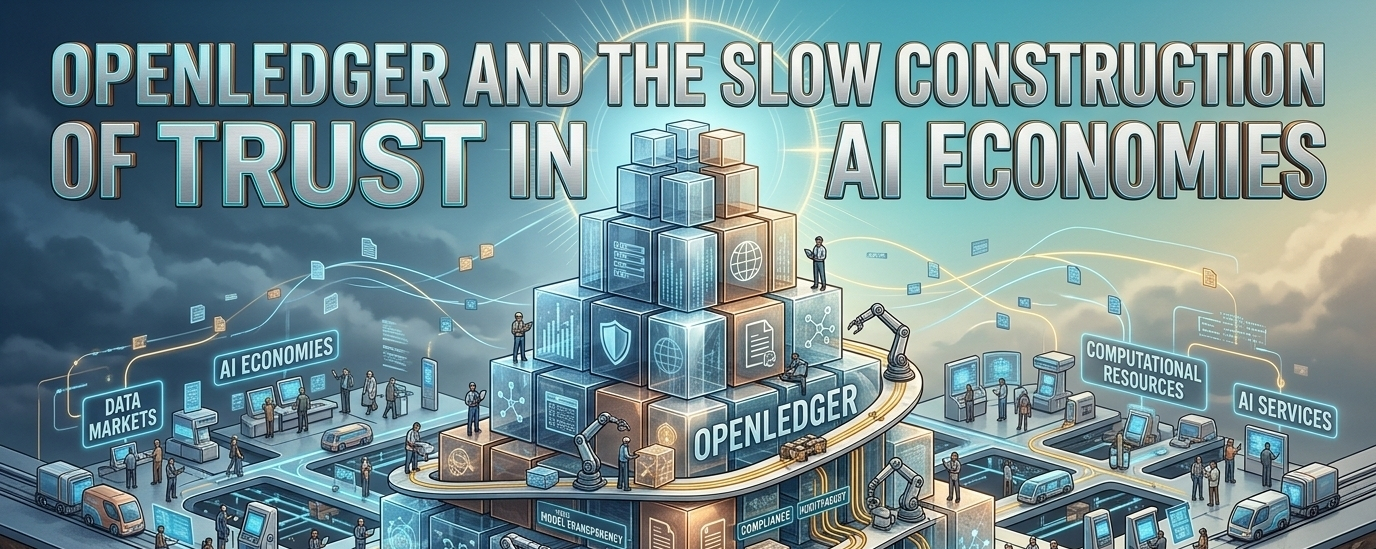
There is a strange pattern that repeats itself across almost every new AI platform: people arrive talking about intelligence but eventually end up talking about distribution. Not because distribution is more exciting but because it becomes the invisible bottleneck that quietly shapes everything else. Models improve interfaces become cleaner benchmarks move upward and yet underneath all of it there is still the same unresolved question: who actually owns the value produced by these systems, and who gets paid when intelligence becomes modular?
That tension is what makes projects like OpenLedger interesting to observe over time. Not because it promises some dramatic reinvention of AI but because it started from a more uncomfortable realization that most AI ecosystems today are structurally extractive in ways people have become strangely numb to. Data contributors rarely retain leverage. Model builders depend on opaque infrastructure they do not control. Smaller developers produce value that larger aggregators absorb almost automatically. Even autonomous agents which are often framed as independent actors usually operate inside environments where ownership and monetization are dictated externally.
The first thing noticeable about OpenLedger is that it does not behave like a project trying to win attention quickly. The architecture feels shaped more by constraint than ambition. That distinction matters. Systems built around ambition often overextend early adding features faster than behaviors can stabilize around them. Systems built around constraint tend to evolve more slowly because they are responding to actual coordination problems rather than theoretical opportunity.
In practice OpenLedger appears to have emerged from watching a very specific failure pattern inside AI infrastructure: intelligence creation was becoming cheaper but attribution remained fragile. As models became composable and agents became increasingly modular it became harder to identify where value originated. A dataset informs a fine-tuned model. The model powers an agent. The agent produces outputs integrated into another service. Somewhere along that chain, the original contributors disappear economically.
Most users do not notice this immediately because the AI industry trained people to think about outputs rather than lineage. But lineage becomes critically important once AI systems become economically meaningful. OpenLedger seems built around the idea that attribution cannot remain informal if AI economies scale. Once money enters the loop consistently, vague contribution tracking stops working.
What becomes especially interesting is how this changes user behavior over time. Early participants in ecosystems like this are usually highly ideological. They contribute data, experiment with tooling and tolerate friction because they are motivated by structural beliefs about ownership and openness. Their behavior resembles a research collective more than a market. They care about whether the system feels fair even before it feels efficient.
Later users behave differently. They arrive once reliability becomes visible. They are less interested in philosophy and more interested in predictability. They want to know whether contributions are measurable whether payouts are consistent whether integrations break whether governance decisions remain coherent under stress. The transition between those two user groups is often where ecosystems quietly fail.
OpenLedger’s more disciplined choices start to make sense when viewed through that lens. Many AI-chain projects attempted to accelerate adoption by introducing excessive financialization early. But speculative velocity creates misleading feedback loops. Activity increases without meaningful utility deepening underneath it. OpenLedger appears more cautious about allowing economic layers to outpace infrastructure maturity which is probably less exciting in the short term but healthier structurally.
There is also a noticeable emphasis on liquidity not merely as trading liquidity, but as usability liquidity. That difference is subtle but important. Most blockchain systems define liquidity narrowly assets moving efficiently through markets. But AI ecosystems face a different problem: useful assets are often illiquid because they are hard to verify difficult to attribute or impossible to standardize. Datasets behavioral feedback model improvements inference contributions these are economically valuable but traditionally difficult to convert into persistent ownership structures.
What OpenLedger seems to recognize is that monetization without attribution eventually collapses into platform dependency. Contributors stop contributing once they realize value capture consistently drifts upward toward aggregation layers. So instead of treating AI outputs as isolated products the system treats the production pipeline itself as economically legible.
That framing changes incentives in quieter ways than people initially expect. Contributors become more careful. Builders think longer-term about interoperability. Integrators pay more attention to provenance. Communities become less tolerant of low-quality data spam because poor inputs now affect shared economic credibility rather than abstract platform metrics.
One of the more revealing things about any decentralized AI ecosystem is how it handles low-quality participation. Early optimism often assumes openness naturally produces abundance. In reality openness usually produces noise first. Synthetic data loops manipulative contributions shallow engagement farming and low-effort automation appear long before healthy coordination emerges.
OpenLedger’s slower pacing around validation and contribution quality reflects an understanding that AI systems degrade silently before they fail visibly. Bad data rarely causes immediate catastrophe. Instead it creates gradual trust erosion. Outputs become slightly less reliable. Attribution becomes slightly more ambiguous. Economic rewards drift toward opportunistic behavior. Over time users stop trusting what they cannot verify.
That is why restraint becomes more important than expansion during the early phases of infrastructure formation. Projects that survive long enough to matter usually develop an internal culture of saying no repeatedly. No to premature scaling. No to governance theatrics. No to complexity that cannot yet be operationally maintained. Watching OpenLedger evolve, there is a sense that many delayed features are not signs of weakness but signs of defensive thinking.
The relationship between decentralization and operational efficiency is another tension the project appears to wrestle with honestly. Fully decentralized systems often become unusable. Fully centralized systems become extractive. The difficult work lives in designing layers where coordination remains flexible without allowing capture points to dominate the network over time.
That balance becomes especially difficult in AI because intelligence infrastructure naturally centralizes around compute advantages. OpenLedger seems less focused on pretending this reality does not exist and more focused on reducing how much control compute concentration ultimately grants over economic participation. That is a more grounded approach than the simplistic decentralization narratives common elsewhere.
Trust inside ecosystems like this also forms differently than outsiders assume. Incentives alone rarely create durable trust. People observe operational behavior. They watch how outages are handled. They notice whether governance changes appear reactive or deliberate. They remember whether the team avoids rewriting core narratives every six months.
In OpenLedger’s case, the more important signals are probably not headline partnerships or token activity, but whether integrations remain stable across iterations. Infrastructure trust accumulates through boring consistency. Developers return to systems that behave predictably under pressure. Contributors remain where attribution remains coherent over time.
Retention patterns reveal more truth than growth charts ever will. Temporary speculation can inflate participation metrics dramatically, but sustained usage exposes whether the protocol actually fits real workflows. If contributors continue returning after incentives normalize it usually means the system solved a coordination problem that existed before the token did.
The token itself becomes more interesting when viewed through this behavioral lens rather than a financial one. In healthier ecosystems, tokens are not primarily instruments of speculation. They are mechanisms for continuity. They align participants around the maintenance of shared infrastructure. Ideally they create consequences for short-term governance decisions and reward long-term ecosystem stewardship.
That alignment is difficult to achieve because most token systems accidentally reward extraction over contribution. People optimize around volatility instead of utility. Governance participation collapses into symbolic signaling. Long-term builders become diluted by short-term actors cycling through attention.
OpenLedger appears aware of this risk, which may explain why much of its ecosystem framing revolves around productive coordination rather than ideological decentralization. The emphasis is less about abstract freedom and more about sustainable contribution accounting. That may sound less romantic but it is probably more realistic.
Another overlooked aspect of the project is how it treats agents not as magical autonomous beings, but as economic actors requiring accountability structures. The AI industry often discusses agents as if autonomy itself creates value. In practice, autonomous systems without attribution or responsibility layers quickly become operational liabilities.
OpenLedger’s architecture suggests an understanding that future AI ecosystems will not merely need intelligent agents; they will need traceable agents operating inside enforceable contribution frameworks. That sounds less glamorous than fully autonomous AI economies but infrastructure usually advances through constraint management rather than imagination alone.
There is also something culturally important happening beneath the technical layers. OpenLedger reflects a broader shift in how developers think about participation itself. Earlier internet eras normalized contribution without ownership. Social platforms extracted behavioral value while users accepted the trade implicitly. AI changes the scale of that extraction dramatically because cognition itself becomes economically productive.
Once people recognize that their data, preferences, evaluations, workflows, and interactions are training economic systems continuously, expectations around ownership begin changing. OpenLedger feels partially like an attempt to build infrastructure for that psychological transition before the rest of the industry fully acknowledges it.
Still, none of this guarantees success. Many structurally thoughtful systems fail because coordination problems are harder socially than technically. Users often choose convenience over ownership until dependence becomes painful enough to reconsider. Infrastructure maturity takes years. Community patience rarely lasts that long.
The more realistic way to view OpenLedger is not as a finished answer, but as an ongoing attempt to solve a problem most AI ecosystems still avoid confronting directly: how to preserve economic dignity for contributors once intelligence production becomes deeply distributed.
What matters now is whether the project can maintain discipline during the phase where ecosystems typically lose coherence. As attention increases, pressure grows to simplify narratives, accelerate monetization, and expand faster than governance culture can absorb. Many projects survive technological risk only to collapse under behavioral distortion.
The healthier sign is when systems continue optimizing for reliability even after visibility arrives. That is usually the moment infrastructure stops behaving like an experiment and starts behaving like a public utility.
If OpenLedger continues moving in that direction carefully, sometimes frustratingly slowly prioritizing attribution integrity over spectacle it could become something more important than a trend cycle. Not a dominant monopoly, not a universal AI layer, but a stable coordination substrate where contributors, models, agents, and applications interact under clearer economic rules than the current internet allows.
And in the long run, that kind of quiet structural reliability tends to matter far more than whichever ecosystem happened to be loudest first.
