

Most crypto traders still think AI is just another sector rotation. They see a token with “AI” in the description, a few exchange listings, maybe a partnership announcement, and they assume the opportunity is already priced in. After watching this market for years, I think that mindset is exactly why most people will miss the next major AI-driven expansion in crypto.
The market has a habit of misunderstanding infrastructure during its earliest phase. People notice applications first because applications are visible. Infrastructure is usually ignored because it looks boring before it becomes essential. We saw this with cloud computing, with GPU manufacturers, with Ethereum scaling, and even with stablecoins. By the time the broader market understands what quietly became necessary, valuations have already moved beyond the easy part of the trade.
What I notice now is that AI inside crypto is slowly shifting from a narrative into an economic coordination problem. That distinction matters. Narratives attract attention. Coordination problems create long-term markets.
Most traders are still focused on AI chatbots, AI-generated images, or tokens claiming to power autonomous agents. But underneath all of that, a much larger issue is emerging: AI systems need infrastructure that traditional web platforms were never designed to handle efficiently. Training, inference, verification, data ownership, distributed compute access, and machine-to-machine economic settlement are becoming increasingly important. The average trader looks at these as technical details. I look at them as future liquidity layers.
The reason this matters now is because AI is no longer experimental. Large models are already consuming enormous amounts of compute, data, and capital. Every month the demand curve gets steeper. Centralized providers currently dominate the market because they already own the infrastructure, but that dominance creates friction points that crypto networks are uniquely positioned to solve.
I think many people underestimate how naturally crypto fits into AI coordination. AI systems need programmable payments, permissionless access, machine identity, and global settlement rails. Crypto networks were effectively designed for environments where autonomous systems exchange value without trusting each other. That overlap is not theoretical anymore.
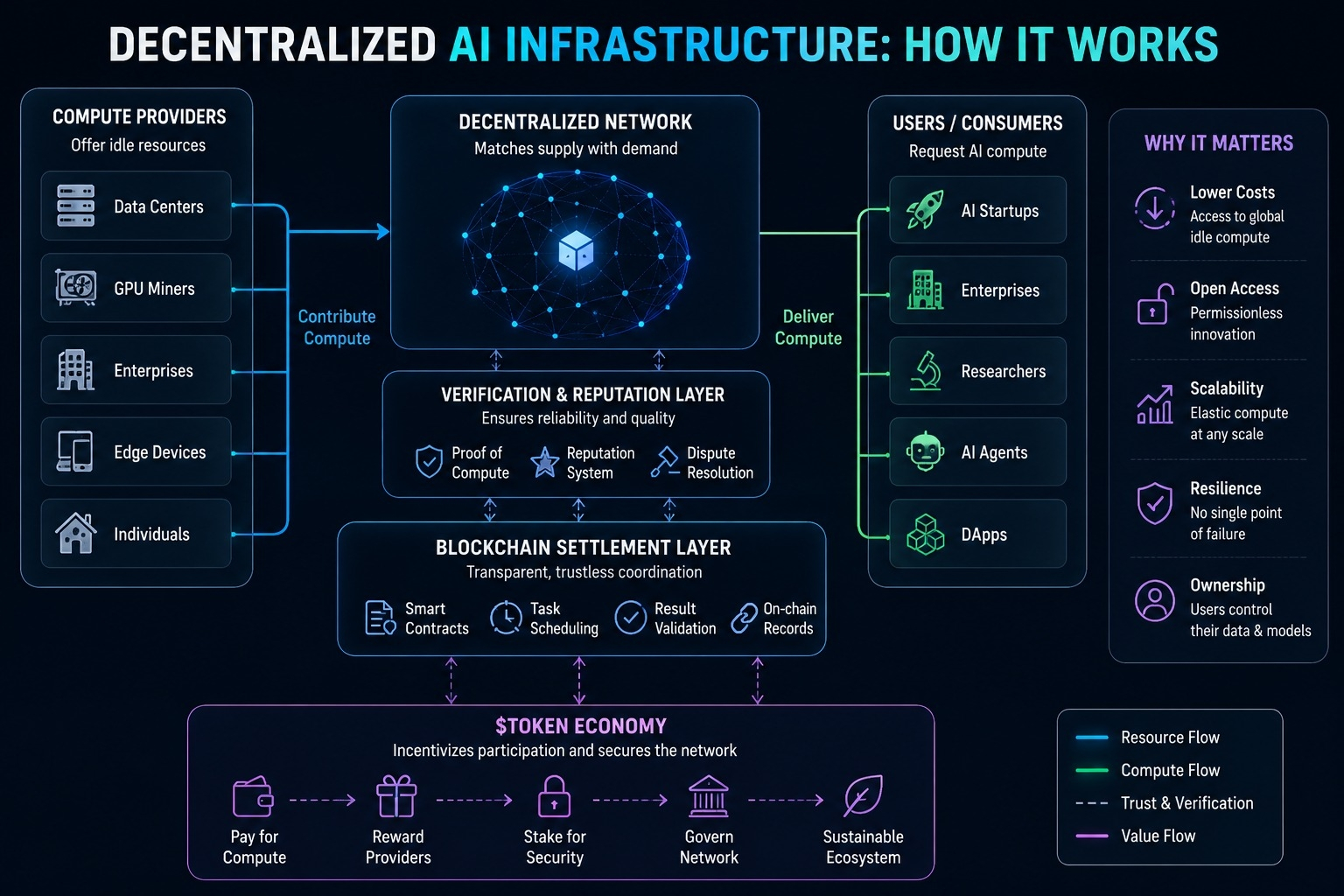
When I look at emerging AI-related crypto projects, the ones that stand out are usually not the loudest. They are the projects attempting to solve invisible backend problems. Distributed GPU marketplaces, decentralized data verification systems, inference marketplaces, AI-specific Layer 1s, and tokenized compute networks all share one common characteristic: they are trying to turn idle digital resources into productive economic networks.
In simple terms, many of these systems work like Airbnb for computation. Instead of a company owning every server and GPU, unused hardware across the world becomes accessible through a decentralized marketplace. Tokens often function as the accounting layer that coordinates pricing, access, rewards, and verification.
That sounds straightforward until you think about the scale of coordination required. AI workloads are extremely sensitive to latency, reliability, and quality control. A decentralized network cannot simply connect random computers and expect enterprise-grade performance. This is where the real architectural challenge appears.
The projects that survive this cycle will probably not be the ones with the best marketing. They will be the ones that quietly solve reliability problems. Verification mechanisms, reputation systems, proof-of-compute frameworks, distributed scheduling, and efficient incentive design matter far more than flashy AI demos.
What I find interesting is how market participants consistently misprice these infrastructure stages. Retail traders tend to chase visible user growth, but infrastructure adoption often appears first in subtle on-chain behavior. Increased staking activity, rising network fees, sustained token lockups, or growing utilization rates usually tell a more important story than social media engagement.
This is why token utility matters more in AI than in many previous narratives. A token tied directly to compute demand, network access, or inference payments can reflect actual economic usage rather than speculative attention alone. That does not guarantee long-term value, but it creates a stronger feedback loop between adoption and valuation.
I think the market is beginning to realize this slowly. Over the last year, there has been a noticeable shift away from purely speculative AI branding toward projects building tangible infrastructure. Capital is becoming more selective. Traders are asking harder questions. Does the network actually process workloads? Are developers using it? Is the token required economically, or is it just attached to the project for fundraising purposes?
Those questions are healthy because many AI-crypto projects will still fail. Some will discover that decentralization introduces too much friction for high-performance AI tasks. Others will struggle with scalability. Some token models will collapse under unsustainable emissions. There is also the uncomfortable possibility that major centralized AI firms simply absorb most market demand before decentralized alternatives mature.
I do not think enough people talk about that risk honestly.
The AI economy may end up becoming more centralized before it becomes decentralized. The cost of cutting-edge model development is so large that only a handful of companies currently operate at the frontier. That creates a difficult environment for smaller crypto-native infrastructure networks trying to compete.
But at the same time, concentration itself creates opportunity. Markets eventually push back against dependency. Developers want cheaper compute. Smaller AI teams want open access. Governments increasingly dislike concentrated control over intelligence infrastructure. Users want ownership over their data and digital identity. Those pressures create openings that decentralized systems can exploit over time.
From a market cycle perspective, this feels very early to me. Not early in terms of headlines, but early in terms of economic integration. Most traders still interact with AI narratives as short-term momentum trades rather than structural technological shifts. That usually happens before the larger repricing phase.
What I pay attention to now is not which AI token trends for a week. I watch where persistent demand forms underneath speculation. Which networks continue attracting developers after attention fades? Which protocols generate real transaction activity tied to AI workloads? Which ecosystems are slowly becoming dependencies instead of temporary trades?
Those questions matter more than price predictions.
I also think many traders misunderstand how large this market could eventually become. If AI continues integrating into finance, gaming, search, robotics, social platforms, and enterprise software, the supporting infrastructure layer may become one of the most valuable segments in crypto altogether. Not because of hype, but because infrastructure captures recurring economic activity.
That is the part most people miss during early cycles. They look for the next meme-worthy application while ignoring the rails underneath it. But historically, the rails often become more valuable than the applications themselves.
I cannot say with certainty which project will dominate this space. I doubt anyone honestly can. The sector is still immature, and most networks have not faced real stress at global scale. But I am increasingly convinced that the intersection between AI and crypto is moving beyond speculation into necessity.
And when markets transition from optional excitement into structural necessity, valuations tend to change very quickly.
By the time the average trader fully understands why decentralized AI infrastructure matters, they may discover the market no longer prices these networks like experiments. It may price them like essential systems.
That shift is usually where billion-dollar narratives stop looking obvious in hindsight and start becoming impossible to ignore in real time.