Artificial Intelligence is growing faster than almost any technology industry in the world right now. Every week, new AI tools, agents, models, and platforms appear across the internet. But while AI companies are earning billions, one important question still remains unanswered: who actually owns the value created by AI?
This is where OpenLedger (OPEN) enters the conversation with a completely different approach. I see OpenLedger not just as another blockchain project, but as an attempt to redesign how AI economies work. Instead of allowing only large corporations to control data, models, and profits, OpenLedger is building a system where contributors can finally monetize the value they help create.
OpenLedger describes itself as an AI Blockchain focused on unlocking liquidity for data, models, and AI agents. In simple words, it wants to turn AI contributions into digital assets that can be tracked, rewarded, and monetized fairly. That idea sounds ambitious, but honestly, it also feels necessary in today’s AI market.
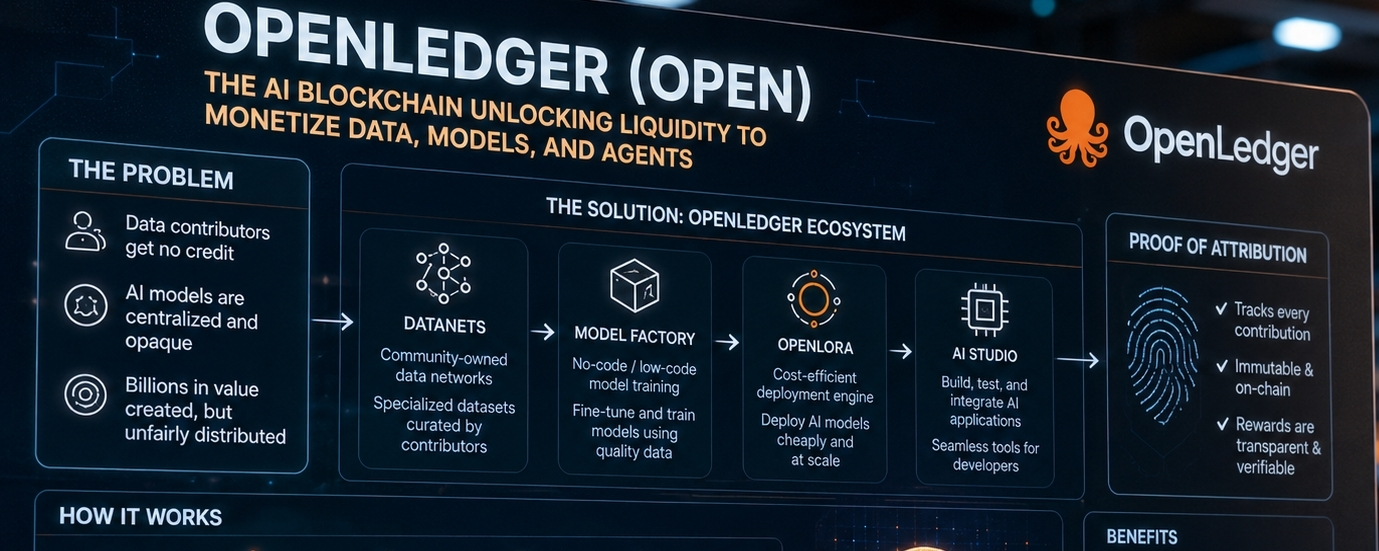
Right now, most AI systems operate like closed ecosystems. Millions of people generate data every day through conversations, content, behavior, research, and online activity, yet very few of them receive any benefit when AI companies use that data to train powerful models. I think this imbalance is becoming one of the biggest issues in the AI industry. Companies continue scaling rapidly while contributors remain invisible.
OpenLedger is trying to change that reality through something called “Proof of Attribution.” This is one of the most interesting parts of the entire project. The concept focuses on identifying where AI value actually comes from. If a dataset, contributor, or community helps improve an AI model, the blockchain records that contribution on-chain and connects it to rewards.
I believe this idea could become extremely important in the future because attribution is missing in today’s AI infrastructure. Most users never know where an AI model learned something from, and contributors rarely receive recognition or compensation. OpenLedger wants to create a transparent ecosystem where contribution is measurable instead of hidden.
What makes the project more interesting is that it is not only focused on theory. OpenLedger is building actual infrastructure around this vision. Its ecosystem includes Datanets, Model Factory, OpenLoRA, AI Studio, staking systems, and AI agent deployment tools.
Datanets are designed as specialized data communities. Instead of collecting random internet-scale information, communities can build focused datasets around specific industries or subjects. For example, there could be Datanets for finance, healthcare, education, legal research, gaming, or blockchain analytics. I think this direction makes sense because the future of AI may not belong only to giant general-purpose models. Specialized AI systems are becoming more valuable because businesses need accuracy and domain expertise.
OpenLedger’s Model Factory then allows developers or contributors to build and fine-tune AI models using those datasets. This lowers the barrier for smaller teams and independent builders who may not have access to massive infrastructure like large AI corporations do. In my observation, this is where OpenLedger could attract serious developer interest over time. AI innovation is no longer limited to big tech companies. Smaller communities are also building highly useful models, and they need infrastructure that supports ownership and monetization.
Another major part of the ecosystem is OpenLoRA. The platform promotes it as a low-cost deployment framework for AI models. Deployment costs are a huge challenge in AI because training and running models require enormous computing power. If OpenLedger successfully reduces these costs while maintaining efficiency, it could become attractive for developers looking for scalable AI deployment solutions.
What I personally find compelling is how OpenLedger combines blockchain incentives with AI infrastructure. Many crypto projects simply attach AI branding to their token systems without solving real industry problems. OpenLedger appears to be taking a more structural approach. Instead of only focusing on speculation, it is attempting to create economic coordination between contributors, developers, data providers, and AI agents.
The rise of AI agents also creates a strong opportunity for projects like this. AI agents are becoming increasingly autonomous. They can analyze markets, automate workflows, manage tasks, generate research, and interact with decentralized applications. But agents also need reliable data, transparent execution systems, and incentive mechanisms. OpenLedger seems to position itself as the infrastructure layer supporting that future.
I also think timing matters here. The AI market is currently shifting from experimentation toward monetization. A few years ago, companies were mainly focused on proving AI capabilities. Today, the focus is moving toward sustainable business models, ownership systems, and economic value creation. OpenLedger is entering the market during this transition period, which could work in its favor if adoption grows.
At the same time, I think it is important to stay realistic. OpenLedger is operating in highly competitive sectors. Both AI and blockchain industries move aggressively, and many projects promise revolutionary transformations. Success will depend on whether OpenLedger can achieve real adoption, attract developers, maintain active communities, and deliver scalable infrastructure.
Still, I believe the project has one strong advantage: its narrative aligns with a genuine industry problem. Data ownership and AI monetization are becoming larger discussions every year. Governments are beginning to debate AI regulation, creators are questioning data usage rights, and developers want fairer ecosystems. OpenLedger fits directly into those conversations.
Another positive signal is the project’s growing ecosystem activity. OpenLedger has expanded its community initiatives, builder programs, staking features, and AI tooling. These developments suggest that the team is trying to create a long-term ecosystem instead of relying only on token hype. In crypto markets, sustainability usually matters more than temporary excitement.
From an investment perspective, OPEN is attracting attention because it sits at the intersection of two powerful industries: blockchain and artificial intelligence. Both sectors continue receiving enormous global interest, funding, and development activity. If OpenLedger successfully becomes useful infrastructure for AI monetization, its long-term value proposition could strengthen significantly.
I also think the project appeals to a broader philosophical shift happening online. People increasingly want ownership over their digital contributions. Creators want royalties. Communities want governance. Developers want transparency. OpenLedger attempts to bring those principles into AI systems through blockchain architecture.
One of the biggest future benefits could be the creation of decentralized AI economies. Instead of a few corporations controlling data pipelines and models, communities themselves could contribute, train, deploy, and monetize AI products collectively. That model could unlock innovation from regions and developers who currently lack access to expensive centralized infrastructure.
For developers, OpenLedger may provide a more accessible way to build AI applications. For contributors, it could create new earning opportunities tied to data attribution. For businesses, it may offer transparent and specialized AI systems. And for the broader industry, it introduces the possibility of more accountable AI ecosystems.
In my view, OpenLedger represents more than a blockchain token. It represents an experiment in how AI value could be distributed differently in the future. Whether it fully succeeds or not, the project is addressing questions that the technology industry can no longer ignore.
As AI continues expanding into every part of digital life, ownership and attribution will become increasingly important. People will want to know where AI knowledge comes from, who contributed to it, and who benefits financially from its growth. OpenLedger is building around those exact questions.
That is why I think OpenLedger deserves attention. It is not simply trying to participate in the AI trend. It is attempting to reshape the economic foundation underneath it. And if decentralized AI economies become a major part of the future, projects like OpenLedger could play a very meaningful role in defining how that future works.