

I spent the last few days digging through OpenLedger and honestly my first reaction was skepticism. Not even aggressive skepticism either, more like exhaustion. Crypto has this habit of grabbing whatever narrative is hot, slapping “decentralized AI” onto a landing page, adding token incentives, then pretending it just reinvented the internet. We saw the same thing happen with DeFi, NFTs, metaverse projects, all of it. So when people kept mentioning OpenLedger as some “AI-native blockchain,” I assumed it was another hype-cycle project trying to survive off AI buzzwords and venture capital decks
 But the weird thing is… the more I read, the harder it became to dismiss completely.
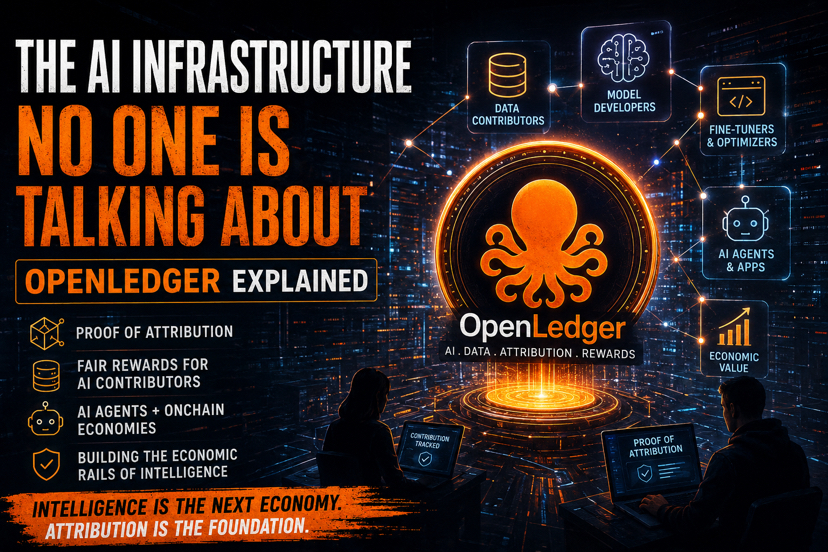
Because OpenLedger doesn’t really seem focused on AI products themselves. It’s trying to build infrastructure around AI contribution and attribution, which is honestly a much more interesting problem than launching another chatbot with a token attached to it. Most people still don’t understand how chaotic AI development actually is behind the scenes. Everyone talks about models, but almost nobody talks about the invisible labor underneath them. The people cleaning datasets for months. Researchers fixing broken outputs manually. Small teams fine-tuning niche systems that larger companies later absorb into bigger pipelines without any real credit flowing backward.
A few nights ago I was talking with a friend who works on finance-related AI tooling and he was ranting for like twenty minutes about how impossible it is to track contribution properly once multiple people touch a model. Somebody cleans data. Somebody optimizes inference. Somebody fine-tunes outputs. Another team builds agents on top. Eventually a company monetizes the entire stack and suddenly nobody can explain who actually created the value in the first place. AI right now is basically a giant black box economically.
That’s where OpenLedger’s “Proof of Attribution” model started making more sense to me.
The core idea, at least from what I understand, is that contribution to AI systems should become measurable and traceable instead of disappearing into centralized platforms. Datasets, model improvements, fine-tuning contributions, agent activity, optimization layers — all of it potentially tracked on-chain so economic rewards can flow back toward contributors instead of only the platform owners. And honestly, whether people realize it or not, this could become a massive issue over the next few years as AI gets more valuable.
Because right now the internet has no clean mechanism for AI ownership.
If someone spends six months improving medical imaging data for a healthcare model, and another team uses that dataset to train something commercially successful, who deserves compensation? The data cleaner? The model developer? The company hosting the infrastructure? Nobody really knows. Most systems today just default to centralized ownership because it’s easier that way.
OpenLedger is basically betting that AI eventually becomes too economically important for that model to hold.
And I think that’s why the project feels different from most AI coins floating around right now. A lot of them are surface-level products pretending to be infrastructure. OpenLedger feels more like it’s trying to build economic rails underneath intelligence production itself. That sounds dramatic, maybe even overly ambitious, but I kinda get the thesis now.
The AI agent side is interesting too, although honestly I’m still mixed on how quickly that narrative becomes real. Crypto people love throwing around the term “AI agents” like they’re already autonomous digital employees running the global economy tomorrow morning. Most of the time they’re still just advanced automation workflows with better branding. But eventually agents probably will coordinate tasks, interact with protocols, exchange information, maybe even generate economic activity independently. If that happens, attribution matters even more because those systems still rely on human-created datasets, model improvements, and infrastructure layers underneath.
At the same time, there’s a huge gap between having an interesting thesis and actually making this work at scale.
That’s the part I keep getting stuck on.
Building decentralized AI infrastructure sounds brutal technically. You’re combining blockchain coordination, distributed incentives, AI computation, attribution systems, data verification, and agent coordination all inside one network. That’s an absurd amount of moving parts. Most startups fail building far simpler systems. And if I’m being honest, some parts of OpenLedger still feel vague to me. Maybe intentionally vague because the entire industry is still early. Or maybe because some of these problems genuinely don’t have clean solutions yet.
I also keep wondering whether attribution itself becomes messy once AI development turns deeply collaborative. What happens when hundreds of micro-contributions shape a model over time? What if one tiny optimization creates more value than months of dataset cleaning? OpenLedger makes contribution visible, theoretically, but visibility doesn’t automatically solve fairness. Humans argue about ownership constantly already. AI economies could make that even worse lol.
Still, I can’t fully shake the feeling that they’re aiming at a real problem while most projects are still chasing narratives.
Right now AI is centralized because coordination is centralized. Data is centralized. Revenue is centralized. Attribution is mostly invisible. OpenLedger’s bet seems to be that intelligence eventually becomes networked, and once that happens, contribution tracking becomes one of the most important layers in the stack.
Maybe they’re early. Maybe they’re trying to solve something impossibly complicated before the market is ready. Or maybe the entire AI economy eventually runs into this wall anyway and projects like OpenLedger end up looking way more important later than they do right now. I honestly dont know yet. But I do know the project kept sitting in the back of my mind longer than most AI crypto stuff usually does, and that alone probably says something…