A lot of the power is sitting in very large places.
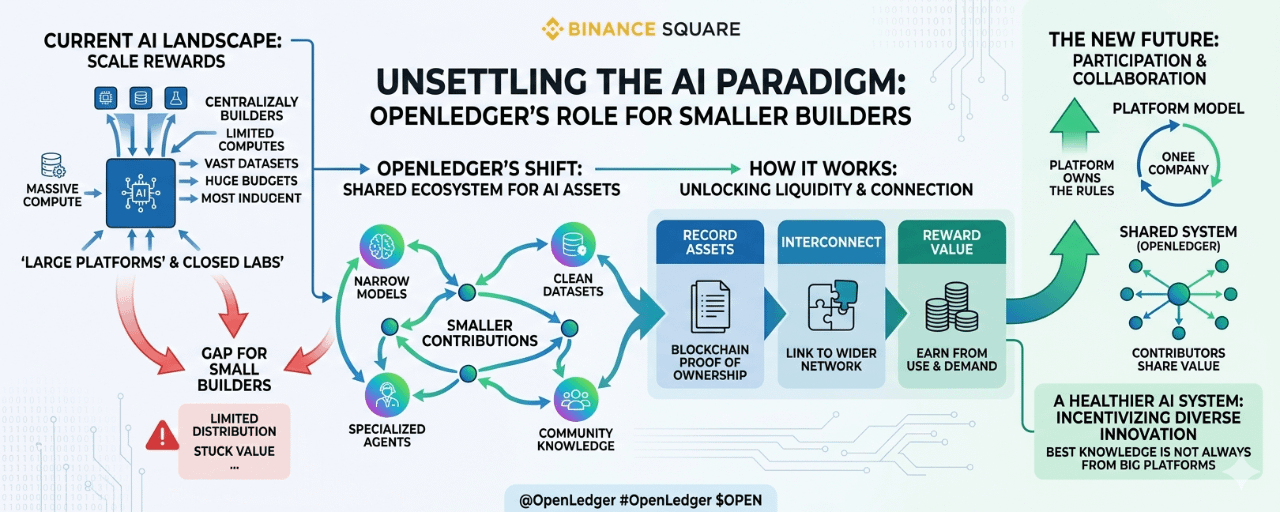
Large labs. Large platforms. Large datasets. Large compute budgets. Large products that quietly decide what most people can access, build with, or monetize.
That does not mean small builders are locked out completely. They are not. People are still making useful tools, small models, agents, datasets, workflows, and experiments every day. But the gap is there. You can feel it.
AI rewards scale.
It rewards access to data.
It rewards distribution.
It rewards infrastructure.
It rewards the ability to connect many pieces together.
For an independent builder, that can be frustrating. You may have a good dataset, a useful model, or an agent that solves a narrow problem well. But turning that into something people can discover, use, trust, and pay for is not simple.
This is where OpenLedger can be looked at from a different direction.
Not only as infrastructure for AI assets, but as a possible space where smaller AI contributions can become part of a wider network.
That feels important because useful AI does not always come from the biggest model. Sometimes it comes from narrow knowledge. A clean dataset. A simple agent that handles one task better than expected. A model tuned for one language, one region, one workflow, or one industry.
These things may not look huge from the outside.
But they can matter.
The problem is that they often have no easy path into the larger AI economy. A small builder may create something valuable, but the value remains stuck. It is hard to prove. Hard to price. Hard to connect. Hard to keep earning from if someone else uses it inside a bigger system.
So the builder either keeps it private, gives it away, or tries to build a whole product around it.
None of those choices are easy.
OpenLedger seems to be exploring another possibility. What if data, models, and agents could exist as connected assets inside a shared system? What if a builder did not need to own the whole stack to participate? What if a contribution could be useful on its own and still be linked to the value it helps create?
That is where the idea becomes more interesting.
Because AI today often feels like a race to build the biggest thing. But maybe the next layer is also about making many smaller things work together.
A specialized dataset might help improve a model.
That model might support an agent.
That agent might serve a business use case.
And the original contribution should not simply disappear once the chain becomes useful.
You can usually tell when a system is healthy by whether small contributors can still find a place in it.
If only the biggest players can benefit, the system becomes narrow. Innovation still happens, but it becomes concentrated. People outside the center may stop sharing their best work because the reward is unclear.
That matters in AI because the best knowledge is not always held by big platforms.
Sometimes it is local. Sometimes it is expert. Sometimes it is messy and specific. A farmer may understand crop patterns in one region. A small research team may have niche scientific data. A developer may build a useful workflow for one kind of business. A community may hold language data that larger models do not handle well.
These are not minor things.
They are the kind of pieces that make AI feel useful in real life.
OpenLedger’s idea of unlocking liquidity around data, models, and agents can be seen as a way to give these pieces a market path. Not a guarantee. Not a promise that every contribution becomes valuable. But a structure where value has somewhere to move if demand exists.
That is different from the usual platform model.
In a platform model, users often create value inside someone else’s system. The platform owns the surface, the rules, the distribution, and often the economics. Contributors may benefit, but usually within limits set by the platform.
A shared blockchain-based system tries to shift some of that. It can allow assets to be recorded, accessed, and rewarded across a wider environment. The contribution does not have to live only inside one company’s walls.
Of course, that sounds easier than it is.
Real participation needs good tools. People should not need to understand every technical detail just to contribute a dataset or use an agent. Quality control matters. Bad data, weak models, and unreliable agents can create noise. And markets only work if there is actual demand, not just people listing things and waiting.
So the challenge is not small.
But the direction makes sense.
AI is becoming too important to be shaped only by closed systems. There should be room for more kinds of contributors. Not just people with massive compute, but people with useful knowledge. Not just large model builders, but data owners, model tuners, agent creators, and developers solving narrow problems.
OpenLedger seems to be building around that idea.
It treats AI value as something that can come from many places, not only from the top of the stack. That is a quieter way to think about the future of AI. Less about one model replacing everything, and more about many pieces finding each other.
The question changes after a while.
It is not only, “Who can build the most powerful AI?”
It becomes, “Who gets to participate in the value created by AI?”
That second question feels more human.
Because behind every useful AI system, there are people contributing knowledge, structure, judgment, data, code, and feedback. Some of them are visible. Many are not.
If OpenLedger can help make more of those contributions usable and connected, then it may offer something meaningful to smaller builders too.
Not by making everything equal overnight.
Just by giving useful work a better chance to be found, used, and remembered.
And maybe that is enough of a starting point…
@OpenLedger #OpenLedger $OPEN

Articolo
One thing about AI is becoming clearer with time.
Disclaimer: Include opinioni di terze parti. Non è una consulenza finanziaria. Può includere contenuti sponsorizzati. Consulta i T&C.