
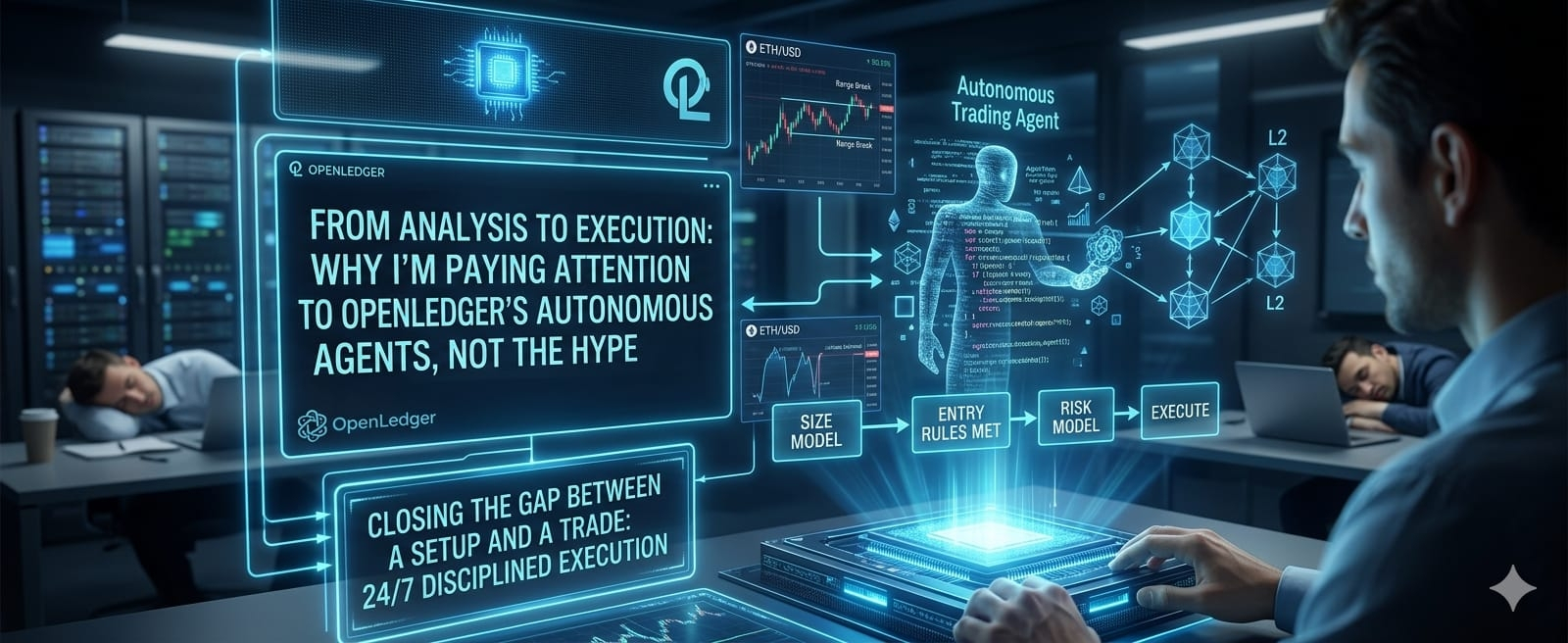
Crypto has no shortage of AI narratives right now. Every other project is trying to attach itself to artificial intelligence in some way, but most of what I see still feels surface-level. Dashboards, sentiment tools, market summaries, chatbot-style research assistants, and whitepaper explainers all have their place, but they do not really touch the part of trading that matters most to me: execution. I do not need another tool telling me the market looks bullish after the move has already started. What caught my attention with @OpenLedger is that the focus seems less about AI simply observing the market and more about agents that can actually act on-chain. That changes the conversation completely, because once an agent can move from analysis to execution, it starts getting much closer to real trading utility.
Every cycle has its main narrative, and this cycle clearly has AI sitting near the center of attention. But a lot of what has been built so far is still passive. It watches, tracks, summarizes, or alerts. That can be useful, but it does not close the gap between seeing a setup and actually entering it before the opportunity disappears. Anyone who trades actively knows how quickly a clean setup can turn into a missed move. You can have the right thesis, the right level marked, and the right plan ready, but if you are not at the screen at the exact moment it happens, the trade can be gone. That is where autonomous trading agents start to become interesting to me, not because they replace the trader, but because they can cover the moments when the trader is not available.
This is something I run into all the time. I may be watching a few pairs, waiting for ETH to break above a range high or waiting for a specific structure to confirm. The move happens at 3am while I am asleep. By the time I wake up, the breakout has already played out, funding has shifted, and the clean entry is no longer there. Other times I am awake and I still miss the best part of the move because I need to check funding, look at liquidity, decide sizing, confirm invalidation, and then execute manually. In fast conditions, that small delay matters. An agent that can monitor predefined conditions, enter only when the rules are met, size the trade according to my risk model, and exit if the structure breaks would not be trading instead of me. It would simply be carrying out the plan I already built.
The reason I think this idea matters more now than it did in previous cycles is because the infrastructure is finally in a better place. A few years ago, trying to run serious autonomous trading on-chain felt much riskier. RPC performance was inconsistent, gas fees could become irrational at the worst possible time, and managing execution across networks was not exactly smooth. Today, the environment is different. Faster finality, cheaper L2s, stronger oracle infrastructure, better wallet abstraction, and more mature execution layers have made this type of agent-based trading feel much more realistic. That does not mean it is perfect, but it does mean the foundation is stronger than it was during earlier attempts.
Still, I would not hand over my main trading wallet to an autonomous agent without seeing it prove itself first. That is not negativity, that is basic risk management. The failure modes matter. What happens if a smart contract reverts during execution. What happens if the agent reads stale oracle data for a few seconds. What happens if the network gets congested and the kill switch does not trigger fast enough. What happens if the agent enters correctly but fails to manage the state properly after a partial fill or failed transaction. These are not random fear-based questions. These are the exact questions any serious trader should ask before delegating execution to any automated system. For me, the proper way to test something like this would be with a small wallet over a full quarter, through good market conditions and ugly ones, before even thinking about scaling.
The more I think about it, the more I believe autonomous agents could change the way on-chain trading works. If these agents become normal market participants, then raw speed alone will not remain a unique edge for long. Once everyone has access to similar execution speed, the real advantage moves back to strategy design. The edge becomes the quality of the rules, the risk parameters, the entry filters, the exit logic, and the ability to define a setup clearly before the market moves. Trading becomes less about clicking faster and more about configuring better. The people who win in that environment will not just be the ones glued to the screen all day. They will be the ones who actually understand their setups deeply enough to turn them into disciplined execution systems.
For $OPEN to matter beyond early attention and launch excitement, the agents need to become useful in the real world. That means traders and builders need to actually use them, not just talk about them. I would want to see clean documentation, transparent execution data, visible failure logs, and some kind of benchmarking layer where different agent strategies can be measured against each other. If OpenLedger becomes a place where on-chain trading agents are not only deployed but also tracked, compared, and improved, then the token starts to have a much stronger utility case. If it remains just a narrow product story without broader adoption, then the valuation discussion becomes very different.
That is why I am watching @OpenLedger from an infrastructure perspective rather than treating it like a short-term chart play. I am not looking at it only through the lens of whether it pumps next week. I am more interested in whether autonomous trading agents become a real category over the next 6 to 12 months, and whether OpenLedger can be one of the names that actually survives once the AI noise cools down. That is a slower thesis, but in crypto, the slower infrastructure theses are often the ones that matter most when the cycle matures. I would rather track something quietly for a couple of quarters and understand its adoption curve than chase every loud launch that disappears after the first wave of attention.
For now, $OPEN stays on my watch list because the idea behind it feels connected to a real problem traders face every day. Missed entries, slow execution, emotional hesitation, poor timing, and inconsistent discipline are not small issues. If autonomous agents can help solve even part of that while keeping control in the hands of the trader, then this becomes much more than another AI narrative. It becomes a practical trading layer. Not a call, not a prediction, just one of the more interesting directions I am paying attention to.