
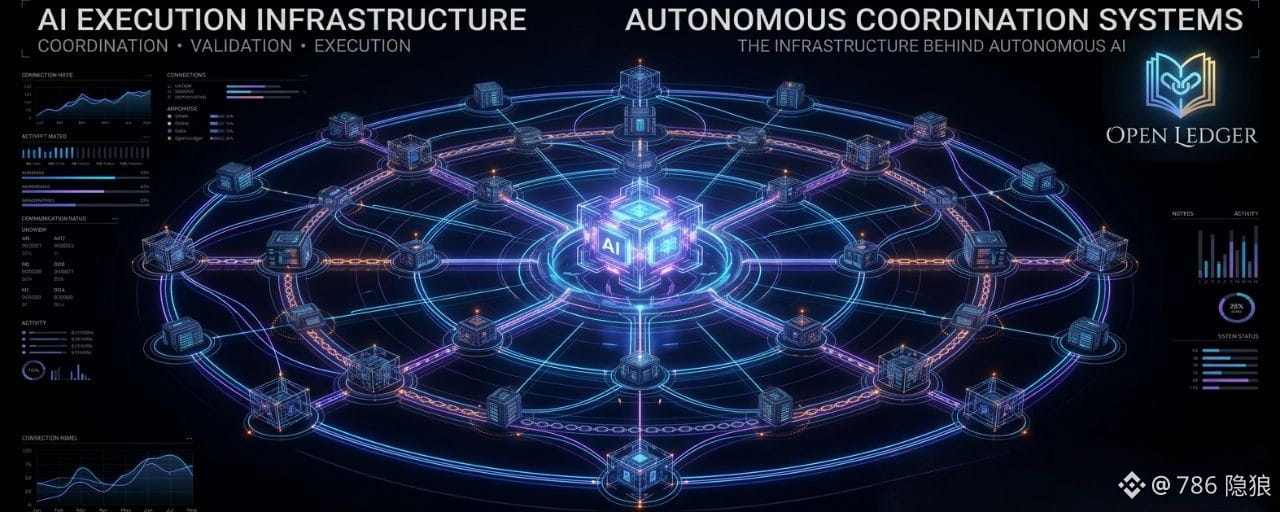

As artificial intelligence continues evolving beyond simple prediction models, decentralized ecosystems are beginning to focus more heavily on autonomous coordination, execution infrastructure, and intelligent on-chain systems. Projects like @OpenLedger are exploring how AI agents, execution layers, and decentralized coordination mechanisms could eventually support the next generation of autonomous digital economies.
AI Infrastructure Is Becoming More Complex
Artificial intelligence is evolving beyond simple prediction models and chatbot systems. A much deeper transformation is beginning to emerge across decentralized ecosystems: autonomous coordination between AI agents, execution layers, and on-chain infrastructure.
As AI systems continue becoming more advanced, many discussions are now shifting toward how autonomous agents will actually operate efficiently across fragmented blockchain environments.
AI Is Moving Beyond Basic Automation
Most people only see the surface level of artificial intelligence such as content generation, automation tools, or trading predictions. However, behind the scenes, future AI ecosystems may require execution routing, risk management systems, coordination layers, and infrastructure capable of handling autonomous decision-making in real time.
This is one reason projects like @OpenLedger are starting to attract increasing attention across the AI and crypto space.
Rather than focusing only on AI outputs, decentralized AI infrastructure is beginning to explore how autonomous systems can coordinate securely, validate execution, route information efficiently, and interact across multiple on-chain environments.
The Importance of Coordination Layers
As decentralized AI systems continue scaling, coordination may eventually become one of the most important components of the future AI economy.
Infrastructure layers such as execution logic, mitigation systems, decentralized validation, and intelligent orchestration could play a critical role in supporting autonomous AI agents operating across blockchain ecosystems.
Concepts like intent-based execution and AI coordination layers are becoming increasingly relevant as decentralized systems grow more sophisticated.
The Future of Autonomous AI Systems
The future of artificial intelligence may not only depend on building smarter AI models. It may also depend on building decentralized infrastructure capable of supporting autonomous execution, secure coordination, and scalable AI interaction across global digital networks.
As the AI economy continues evolving, projects focused on decentralized AI infrastructure and intelligent coordination systems could become increasingly important within the broader crypto ecosystem. 🌐🤖